
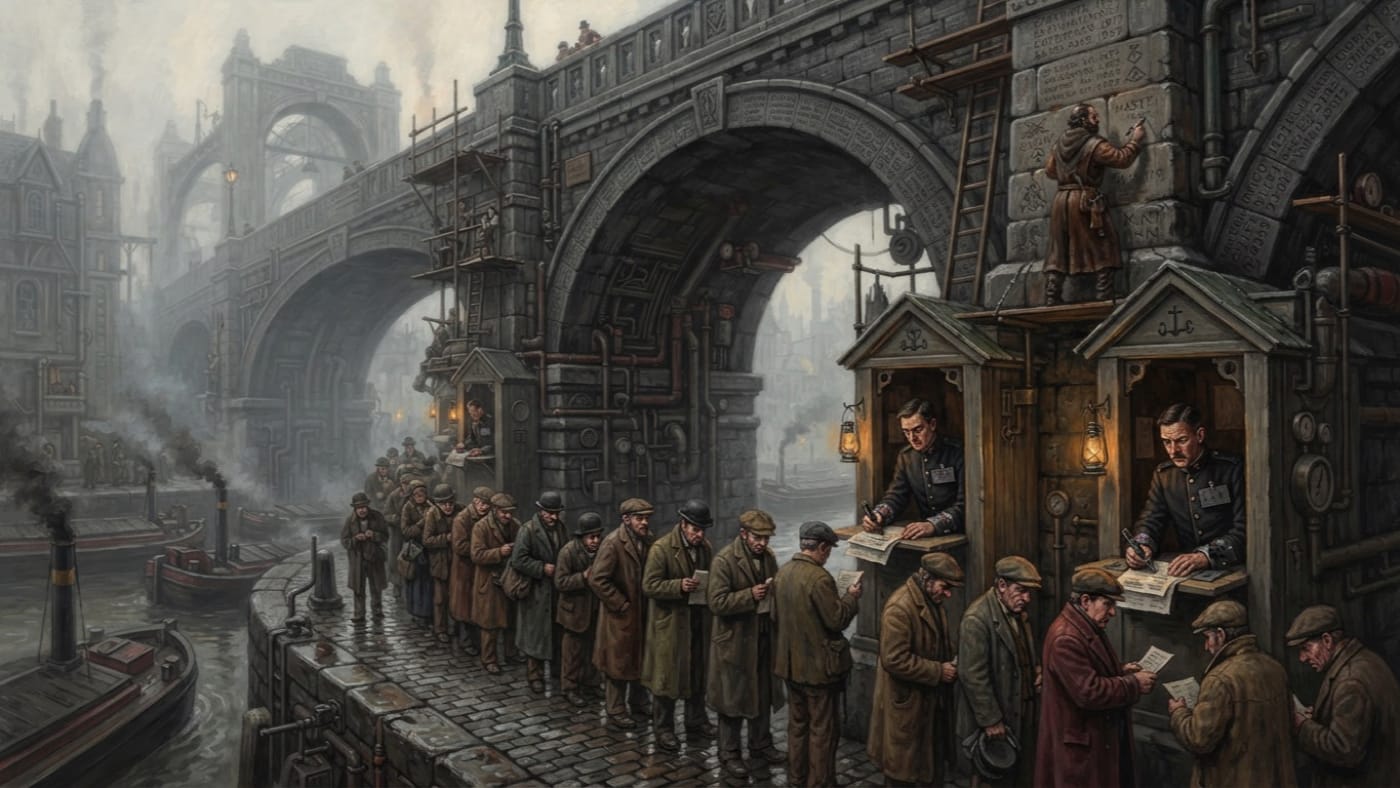
#On the Collegium's Office
"Say it dry or say it numbered." — Advice given in the queue on Archivolt Row, free of charge, which makes it the only free thing on the Row.
The lock bells ring at dawn, and the shutters of Archivolt Row open one after another along the central spine of the Archivolt Causeyworks. Behind each shutter sits a bridge-scribe with ink cuffs at the wrist and a slate tag at the breast. The scribe's work is to decide whether the person at the window exists.
That is the office of the Bridge-Scribe Collegium. The toll warden at the Mouth-Sluice asks for your name. The mason in the Stone-Ledger Yards carves it. Between the question and the chisel sits the scribe, who decides whether the name you offered is a name the city recognizes. In a town where every crossing requires a spoken registered name, recognition determines whether you cross the canal, trade on it or end up in it.
The Collegium describes its purpose as accurate records. Crossing passes, toll chits, cargo declarations, crossing receipts and name-dispute petitions all pass beneath its witness stamps before they carry any force. The Archivolt Registry Hall is where verification is done in earnest. The windows along the Row do it in bulk. The Row smells of wet parchment and chisel dust. Quills scratch in the offices while masons tap beneath and beside them, making permanent what the scribes have only written down.
#On the Constitution of A.S. 92
The city came first. The Causeyworks was chartered in A.S. 82, under the emerging Church authority that later registers, written after the Concordat of A.S. 90, call Synodal with retrospective confidence. The first stone bridge followed in A.S. 84. For the decade after the charter, the toll records were kept on paper, in ledgers, in a city built on water.
Anyone who has left a hymnal in a cellar can guess what happened. The paper rotted. Debts went soft and turned to pulp, and the Bureau of Tithes holds that a toll no one can read is a toll no one pays.
The Collegium was constituted in A.S. 92 to fix this. The municipal account credits its method to the masons of Essen, who had recently shown that an inscription could be load-bearing: a span could carry a record in its parapets and keystones as well as carry carts. The Collegium adopted that principle and added its own division of labour. Paper would hold what may change. Stone would hold what must not.
I record this as the minutes record it: a clerical answer to a damp problem. The founding account mentions only rot, ledgers and the strength of granite. It says nothing about what the arches later began to do with the names they carry. The Bureau does not read miracles into an engineering minute.
By A.S. 110, every major span bore inscriptions and the city held seventy thousand souls. The Collegium already held the position it holds now: the licensed toll that every citizen pays in order to be someone.
#On Verification and Correction
A citizen's dealings with the Collegium begin with papers, and the papers must be dry. Flat, dry papers at the window show respect and carry authority. A damp permit tells the scribe that its bearer either cannot afford shelter or does not understand where they are standing. Neither fault disqualifies anyone. Both are noted. The scribe reads the paper, then the bearer's posture, then the register.
If the name agrees with the register, the scribe witnesses it and the stamp comes down. The citizen goes on to a crossing to speak that name beneath the arch. They may instead speak a registry number, for a fee that the Collegium does not advertise because it has no need to.
If the name does not agree, the citizen has a dispute. Name disputes are heard at midday, during the toll crush. The remedy is a name-correction writ, and in practice the man who decides whether a writ is issued is Chief Scribe Mael Arct.
Arct controls name verification in the Causeyworks, and his ink-stained fingertips are the most consequential hands on the Row. It is common public knowledge that he can arrange for a name to be forgotten in the paper registry for a price, and remembered for a higher one. I set this down without indignation. A Chief Scribe who could not adjust a register would be a copyist.
The Collegium's authority stops at the stone. The paper registry belongs to the scribes. The chisel belongs to Master Mason Lysa Korr and her Lodge. The Collegium administers recognition and revises documents, and Korr's masons do the carving. What the masons have lawfully carved, no scribe may lawfully remove. The Bureau of Doctrine forbids erasure. The law allows only reconciliation: the correction is carved beside the original entry, and both remain.
So a citizen can buy a cleaner name on paper while the parapet over the canal goes on saying what it always said. The scribe's correction travels in the citizen's coat. The mason's original entry waits on the bridge every morning, rimmed with lime, beside its own correction.
#On the Price of a Recognized Name
The stone-entry fee is the most expensive transaction in the Causeyworks. It buys a public record that lasts: a name, a sum, a date, and either a resolution or a conspicuous lack of one. A discharge carved in granite cannot be lost the way a receipt can, and citizens pay dearly for that. They fear it for the same reason when the entry records what they owe.
Debt in the Causeyworks is collected three ways, each more severe than the last. The first is toll denial, which closes the bridges to the debtor. The second is a name flag, which tells every scribe on the Row to read the debtor slowly. The third is the stone entry itself, carved where the debtor's daily route must pass. Arrears turn into labour: lock drafts, upkeep hours, and the name-clearing fees that the Toll Chapter will accept in sweat when it cannot get coin. The Collegium does not run the lock drafts. It keeps the names from which the drafts are drawn.
The Namewash Cloisters are a separate institution, though not a distant one. They take confession, perform identity cleansing and re-verify names, and they etch each confession into slate. On Namewash Night, held weekly, citizens bring their "name doubts" for inspection, so the population audits itself before the Collegium has to. The Cloisters send their results back to the Row for recognition. The Row sends its doubtful cases to the Cloisters for soap.
Children learn their registry numbers before they learn their prayers. Adults avoid nicknames, because an unregistered name spoken under the wrong arch can cost anything from a fine to a visit from the Bureau of Purity.
#On the Names Beneath the Stone
Some arches in the Causeyworks amplify spoken names into physical effects. Water levels shift, inscriptions sweat lime, and candles gutter in rhythmic pulses. Healing has been reported near particular carved lines, and so has harm. The Collegium calls the candle behaviour atmospheric. The pilgrims of the Saintspan Quarter call it liturgical. Whether the Creator moves in those arches or the Great Deceiver hides in them is a question for the appropriate desk. The Collegium is not that desk.
Inspector Corris has been reassigned. The phenomenon has been reclassified to "Category Three: Pending." The reclassification is permanent.
Inspector Corris's A.S. 194 attribution of the phenomenon to mineral moisture was set aside, and the inspector was reassigned. The phenomenon is classified as Category Three, Pending. The Warden withdraws the word "permanent." A pending classification is pending by definition, and it will remain so until the Bureau decides otherwise.
The Mortar Saints threaten the Collegium more directly than any guttering candle does. They are a heretical network that hides forbidden names and lineages in public architecture, using sympathetic masons and concealed carvings. Some of those names the Index Damnatus has struck from every lawful record. Interrogation transcripts disagree about whether the Saints sit inside the Masons' Lodge, beside it or beneath it. None of them establishes that any bridge-scribe belongs to the network, or that the Collegium knows of it, and I assert neither.
The danger to the Collegium is a matter of principle. Its institutional interest is a monopoly on recognition, and the threat it fears most is a rival registry. A name carved into a keystone without a warrant is exactly that: a rival registry, set into the city's structure, where no scribe can amend it and no writ can reach it.
In A.S. 199, a banned name was found inside a keystone cavity of the Stitchbridge, the city's main junction. It could not be seen from the walkway, and every passing foot pressed weight onto it. The Bureau of Alchemical Standards team sent to examine it reported that the bridge's resonance had risen forty percent since the carving's estimated date. The Collegium had never verified that name, never witnessed it and never recognized it. The name was still there, and every barge in the River-belt passed under it.
#On the Present Jurisdiction
Since A.S. 199, the Causeyworks has been tightening. Crossing inspections take longer and tolls have risen. The Collegium's windows still open at the lock bell, and they now close on more petitions than they grant.
The Collegium is one leg of the formal government, together with the Synod Toll Chapterhouse and the Lock Authority. In practice, Canon-Toller Edris Vane controls crossings, Arct controls names and Korr controls the stone. The Bureau of Records keeps a local detachment and a co-sealing interest. It has raised jurisdictional objections to Purity's intervention in the city. The Collegium's scribes are distant cousins of the Records scribe, and they resent the comparison the way any provincial cousin does.
Canon-Inquisitor Silex Marrow now holds authority to unseal keystones in the Saintspan Quarter. The Toll Chapter has petitioned against him and Records has objected. The Bureau of Purity has overruled both. No one knows what the ribs contain, and I decline to guess in a document that will outlast my guessing.
The Collegium's position is uncomfortable. For one hundred and nine years it has based its authority on the principle that stone does not lie. If Marrow's chisel uncovers a name that no register contains, the Collegium must either recognize that name or declare the stone mistaken.