
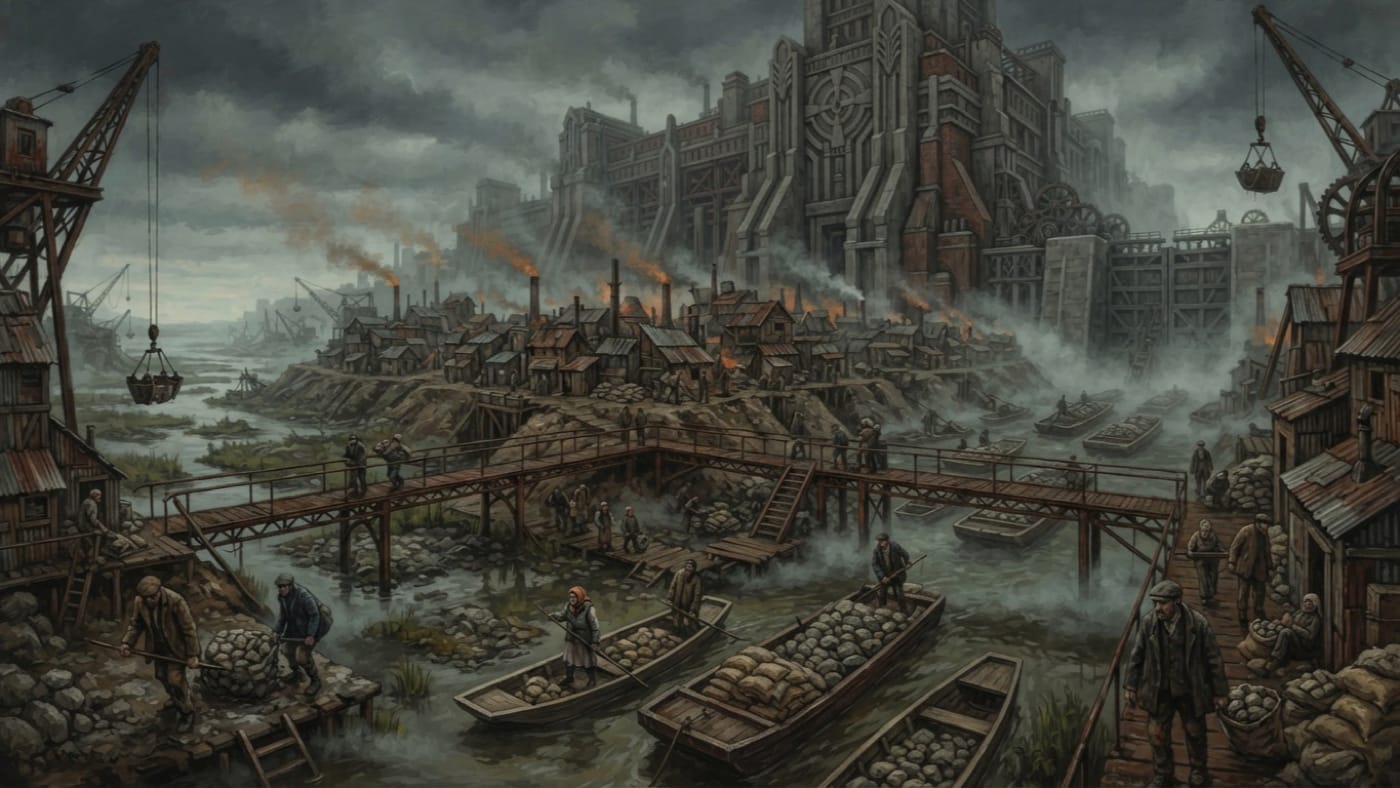
#On the Villages Beyond the Locks
"The stone comes up the water. The men come with it. Only one of them is counted by weight." — Lock-queue saying, recorded in the Archivolt Causeyworks
The Bureau classes the marsh-quarry villages as a region. It does not class them as a municipality, and this is a kindness to the Bureau, which would otherwise have to say how many there are. They lie six to ten hours from the Causeyworks by skiff, depending on the water, the boatman and how much he is paid to hurry. From them come two things the city cannot do without: river-stone and bone-lime.
A city that carves its debts into granite has an appetite for granite. Every span in the Causeyworks that bears a name, a sum and a resolution was raised from material dug out of ground no citizen of the city would care to stand on. The Causeyworks calls itself permanent. Its permanence arrives by skiff, in loads, and is invoiced.
I have inspected the Causeyworks twice. I have not inspected the villages, and the Bureau did not ask me to. What follows is drawn from the city's own account of its hinterland, set down during my survey of A.S. 201, together with the registers that touch on the villages wherever the city's business requires it. The city's business requires it often.
#On Stone and Bone-Lime
The city's own inventory lists its materials in order of importance, though the inventory would not admit to ranking them: river-stone, bone-lime mortar, salvaged brick, rust-iron clamps, tallow-wax sealant and slate. The first two come from the villages. The salvage comes from whatever the city has already broken.
River-stone is dug out of wet ground and goes out by water, because a waterlogged quarry has no road out except the water. The work is done in mud, among standing pools and bad air. When the stone reaches the Stone-Ledger Yards it is clean and dressed, and a mason sets a debtor's name into it without asking where it was lifted from. The Yards smell of lime, iron filings and wax. I am told the quarries smell of the marsh, which is an honest smell, and nobody pays to have it carved.
Bone-lime binds the spans. I record the name the city uses. The registers I consulted do not describe how it is made, and I will not invent a recipe to please the curious. It is enough that the mortar holding the Causeyworks' debts in place came from somewhere other than the Causeyworks.
The Stone-Ledger Masons' Lodge holds the quarry contracts. Its resources, as the city lists them, are crews, catwalk access and quarry contracts, and the order matters. Master Mason Lysa Korr holds the city's chisel, and the contracts the chisel depends on sit with her Lodge. I could find no prices, signatories or exclusive terms on the public record, and I decline to supply any. A contract whose terms the Bureau has not seen is still a contract. It is simply a quieter one.
The city's survey calls the relationship parasitic. The quarries feed stone in, and the city bleeds them. I would have chosen a more liturgical word, but the survey was not written for my ear, and the word is accurate.
#On the Lock Drafts and Toll Exemptions
Stone is only the first thing the villages send. The second walks.
In the barge seasons the Causeyworks swells by several thousand souls, because lock-labour drafts pull men from the marsh-quarry villages and the canal's lower courses. The two sources overlap, and the city's draft does not trouble to separate them. A man from a quarry village and a man from a lower-course hamlet stand in the same queue at the Triple Lock and are counted the same way.
The Lock Authority runs the Triple Lock. It holds the lock keys, the dredgers and the bell schedule, and through the bell schedule it holds every barge that wishes to rise from the lower courses to the upper pools. It says in public that it keeps the water moving. In private it sells priority windows. Its methods, as the city lists them, are slowdowns, "safety closures" and forced labour. The drafted crews make up their own class in the city's register. They sit above the Undervault poor and below everyone who can afford not to be drafted.
The city has several means of extracting work from a body. It requires labour hours for lock upkeep. It keeps debtors in bondage through toll arrears. Some name-clearing fees may be paid in labour instead of coin. These are separate instruments, and I refuse to let them run together. A drafted villager is not by that fact a debtor or a criminal. He is a man the lock needs. The Lock Authority prefers him to the debtor, since the debtor has already proved he cannot be relied on to pay.
The Bridge-Scribe Collegium decides who a man is. The Synod Toll Chapterhouse decides what his passage costs. Between them stands the quarrel the city's survey records against the villages by name: toll exemptions, fought over.
The terms of the quarrel are simple to state. Stone goes up the water to build the city's spans, and men go up the water to work the city's lock. The villages hold that neither ought to pay passage on the way. The Chapterhouse holds that everything which floats pays, whatever its purpose, because if purpose bought exemption, every barge on the River-belt would find it had one.
The record shows that the exemption is fought over. It does not show that the exemption was granted. A demand is not a grant. The Chapterhouse files a petition and a privilege in different drawers, and some petitioners have mistaken one drawer for the other, to their cost. Canon-Toller Edris Vane holds crossing access for the whole city, and whatever he has ruled on village stone or village labour has not reached the public record I was allowed to read. Chief Scribe Mael Arct verifies the names of those who come to argue it, and verification has its own fee schedule.
The city's survey also lists kidnapping into lock drafts among its ordinary crimes. I record it because the city does. It shows that the draft is valuable enough to steal for, and it shows the Lock Authority does not always ask where its labour came from, so long as the labour arrives.
#On the Strike and the Flood
The quarries once struck. The city's survey records this and gives no date, and I have none to give either. I do not know what the strikers demanded, how long they stopped work or who spoke for them. The ending is recorded. The strike was ended by a "miracle" that looked like a flood.
I have read that phrase many times. Its two halves were written for different readers.
A miracle is a useful thing to have ended a strike. It needs no order, no signature and no officer whom a grieving village could name. It also puts the matter into the hands of the Creator, where the Bureau prefers matters to rest whenever human hands would be inconvenient. A strike ended by Providence leaves the strikers nothing to appeal.
A flood is a physical event. Water rises on low ground, and low quarry ground lies under it more readily than most. Whoever chose "miracle" did not trouble to change the description of the thing itself, and the description is of a flood.
The record does not say whether anyone opened anything. It names no gate, no warden and no casualty, so this account names none either. I will not call the water divine, since the Bureau has not ruled, and I will not call it deliberate, since nobody has proved it. Both words are in the record, and neither has been removed.
#On Passage Through the Marshes
The way between city and quarry is six to ten hours by skiff, and the city's survey lists two hazards along it: sinkholes and fever marshes.
Neither needs a heretic to do its work. A sinkhole opens without warning and takes whatever stands on it. The fever is a canal illness, and the Causeyworks knows it inside its own walls, among the mould lung, the stonefall and the drownings. Out in the marshes nobody is close enough to file a report when it strikes.
Stone makes this passage because it must. The drafted men make it because they are made to, going upriver to the season's lock work and, if the lock and the fever spare them, back down at the end. A man may be called away from quarry work in the very weeks the quarry most needs him. The city does not record what that costs a village, because the city is not the one paying.
I have kept the customs of the Causeyworks apart from those of the villages. Namewash Night, the forbidden nicknames, the taboo on speaking a name twice in fog all belong to the city's arches, and I have no evidence they were carried out to the quarries. A drafted man learns them at the Lock. Whether he takes them home is his own affair, and the Bureau has not been told.
#On the Present Obligation
The Archivolt Causeyworks was chartered in A.S. 82, following the Synod's determination that the River-belt's toll revenues were being lost…
In A.S. 82 / 1792 CE the formal Synod did not yet exist. It was constituted at the Concordat of Strasbourg in A.S. 90 / 1800 CE. The charter decision belongs to the emerging Church administration of those years, and "Synod" is applied to it in retrospect. The charter date stands. The attribution has been corrected.
The arrangement continues. Stone and bone-lime go up the water, and men go up with them in the barge seasons. The exemption is still contested, and the Bureau of Records does not file a contested matter as closed merely because no new paper has been added to it. Since the Stitchbridge discovery the Causeyworks has tightened. Inspections take longer, tolls are higher and safety closures come more often. None of this has made the city need the quarries any less.
The city calls its own condition persistence. The villages are what it persists on.