
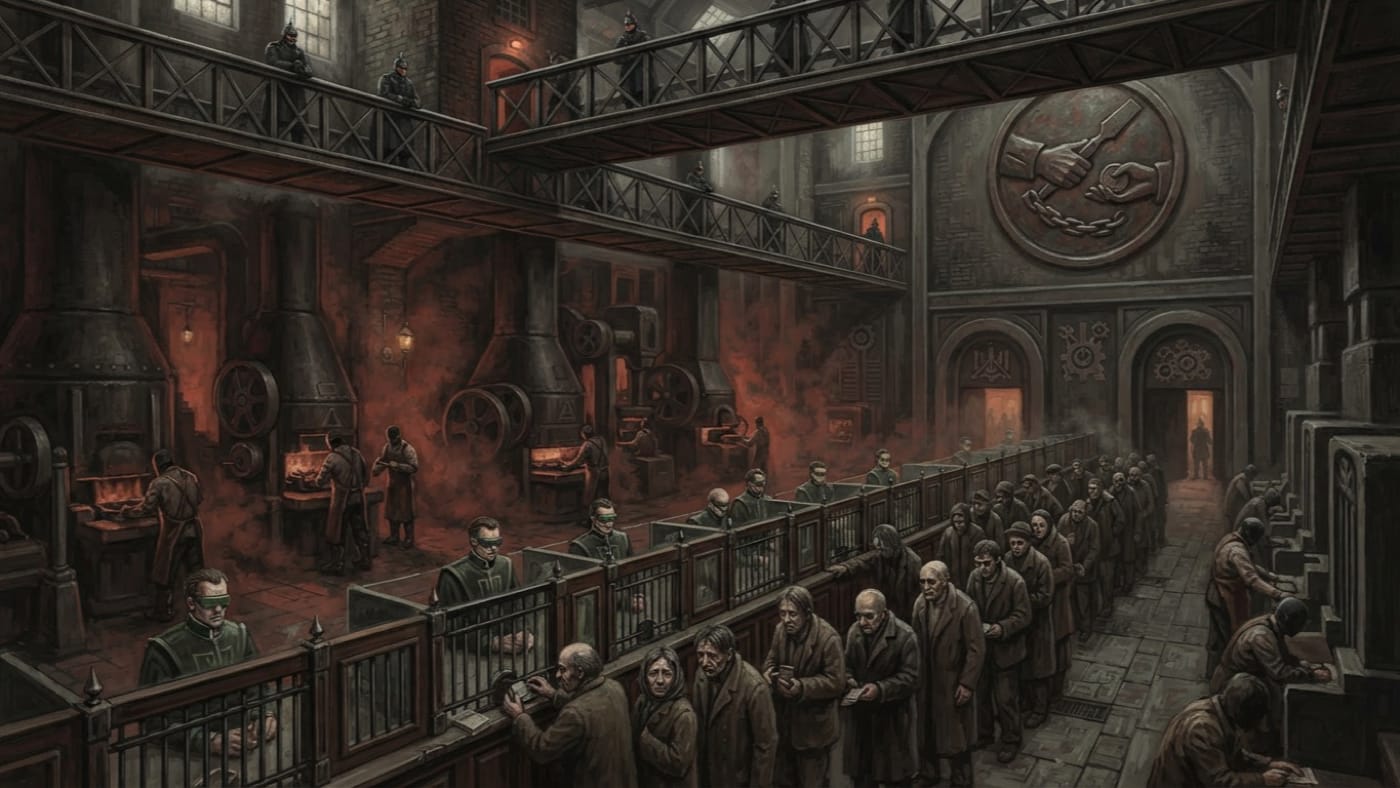
#On the Bargain
"Who strikes the die strikes the world." — attributed to Albrecht Sable, founding Mint-Prelate, A.S. 94
Every face the Synod puts into circulation needs two hands. One must be able to cut a human likeness into steel at the size of a thumbnail, accurate to the lash. The other must be permitted to declare that likeness a person. The Crownwright Guild owns the first hand. The Synod's Mint-Chapter owns the second. The Mint-Chapter Compact is the instrument that chains them together at the wrist.
Its seat is Sable Court, Cologne's restricted south quarter in Zone 2, where the air tastes of acid wash and boots tread the rooftops. The Codex requires me to classify the Compact, and I have filed it as a faction because nothing else in the quarter behaves so much like one. It has interests and revenues of its own. It has also kept watch on itself from both ends without interruption since A.S. 94.
The citizen meets it at the counter. A baker refuses a coin, a clerk consults a ledger and a fee is named. Overhead a warden's boots complete their circuit. No clause has been read aloud, yet the citizen understands that two institutions have agreed on who they are and what that is worth.
#On the Nine Days
The Concordat of Strasbourg made the Synod formal in A.S. 90 and left it with the usual embarrassment of a new government: every parish it had bound now needed stamped currency, and the Synod had no means of producing it. A Church that intended to count every soul needed money that could be counted the same way twice.
The engravers already existed. The Crownwright families had cut seals and dies since before the Sundering. They had served Rationalist magistrates and ecclesiastical courts with the even-handed courtesy of people paid by the piece. Their hands were the only thing in Cologne the Synod could not create by decree.
Albrecht Sable, a canon lawyer of Cologne cathedral, could supply the rest. In A.S. 94 (1804 by the old reckoning, four years after Strasbourg) he negotiated with the Guild for nine days. The settlement founded the Mint-Chapter and bound the existing Guild to it. The Guild would provide craft and the Chapter would provide authority. Each would watch the other in perpetuity, which is the only form of trust the Synod has ever put in writing.
The same year produced the Face Registry Compact, ratified under the joint seals of the Bureau of Records and the Bureau of Tithes. It binds a registered soul's likeness to its circulating coin, its name and its account in the Great Ledger. The Registry mandate says what a face must be bound to. The Mint-Chapter Compact says who may cut that face and who may sign for it. The Cologne archive may hold two instruments, two portions of one settlement, or one settlement filed twice under the titles of two jealous Bureaus. I decline to adjudicate the question, which is a privilege of rank. No clause of either will appear here dressed up as a quotation.
#On Craft and Authority
The Compact governs from three seats: the Mint-Prelate, the Crownwright Master-Engraver Council and the Mint Tribunal. The quarter does not publish how many masters sit on the Council, how they are chosen or whether they may refuse the Prelate anything. What it cannot hide is where the leverage lies. Mint-Prelate Varo Sable controls the lawful recognition of currency. Master Engraver Irena Coilhand controls who is cut into permanence. Warden-Captain Joss Kline controls the gates, the vaults and the raids.
The chain runs as follows. The Bureau of Records assigns a registry number, and the Mint-Chapter commissions a die. A Crownwright master engraves the likeness, each finger wrapped separately in silk. The Assay Cloisters approve the work, the shift choir blesses it over hot metal, and the Strike Floors produce the coin in batches. Everything before the engraving is paper, and everything after it is paper again. The Chapter holds both ends of the chain. The Guild holds the one link without which the rest is stationery.
Since A.S. 102 the master plate for each registered face has lain cold in the Face Archive, cross-referenced to the Ledger and sealed under triple lock. The Bureau distinguishes three objects here and enforces the distinction harshly. The master plate is the face's legal original. The working die is a tool and wears out. The circulating coin is lost in gutters by the thousand without the slightest effect on anyone's existence.
In A.S. 134 the Bureau of Doctrine ruled that dies cut by machine produced spiritually imprecise currency. The presses still fall on the Strike Floors; only the cutting must be done by hand. The Guild lobbied for that ruling. A skill can be taught to a stranger, but a doctrine cannot be outbid, so the ruling made the Guild's indispensability a matter of faith.
Above all this run the watchwalks, rooftop bridges raised during the enclosure of A.S. 94–100, while the later Council of Cologne was at its own work. Wardens look down through slits in the bridge floors. Someone looks out from behind the mirrored inspection windows. The founding bargain set surveillance in both directions between two parties. The architecture extended it to everyone else.
Earlier editions of this Codex stated that the Crownwright Guild has always operated under Mint-Chapter authority. The Guild is older than the Chapter by generations and worked for magistrates and courts on its own account before the Sundering. Its submission to Mint-Chapter authority dates from the Compact of A.S. 94 and from no earlier hour. The word "always" has been withdrawn from this entry and returned to stores, to be issued only where it applies.
#On the Price of Recognition
The Compact divides its revenues the way heirs divide a corpse. The Guild charges identity fees for new entries, because nothing enters the Archive unless a Crownwright has cut it. The Chapter charges correction levies when a face is disputed, because only authority may decide which likeness is the true one. The Wardenate charges inspection tolls at the gates through which every fee and levy must be carried. Seigniorage is taken from every strike, and no rate schedule is posted anywhere a citizen might read it.
Follow one dispute. A clerk finds that a registered face does not match its bearer, or a fine goes unpaid. The face goes into facehold: the coin is declined at the counter and the matter passes to the Tribunal, which sets the levy. A debtor who cannot pay may be served a debt-labour warrant and find the sum converted into furnace labour or purity-penance shifts.
A hold can be lifted. A face recall is a heavier instrument. The Mint Tribunal orders it, and the coins are withdrawn and restruck, either blank or with a replacement face. The person remains standing and breathing, and is no longer recognised for any purpose. Merchants refuse their custom. Landlords end their tenancies, and employers end their contracts. The Crownwrights call this unfacing. Nobody vanishes; the counter simply stops answering them.
In Sable Court the matter does not end at the counter. When a face stops circulating, it stops holding in recollection. Merchants hesitate halfway through a name, witnesses falter, and families argue over whether a brother existed. In A.S. 194 the Bureau of Doctrine classified the condition as a Category Two Localized Identity-Scribal Anomaly and, with professional reluctance, attributed it to a sacred resonance between image and identity. I report Doctrine's explanation. I do not certify it. I note only that the explanation arrived long after the fees.
#On the Compact Under Emergency
In A.S. 187 an audit found that three Archive plates had been altered overnight. That same year the Bureau of Engineering sealed a survey of the quarter's canal foundations. Many clerks have been excited that the two fall in one year. The coincidence proves nothing, and I have reprimanded two clerks for saying otherwise in writing.
Face Theft began in A.S. 199. Citizens found the faces on their coins subtly wrong: their own likenesses, carried every day, altered. The Compact answered with both hands, as it was built to do. The Mint Tribunal ordered an emergency recall across seventeen denominations, and Die Row went to triple shifts. The Guild closed its apprentice rolls for the first time in a century. The Archive was sealed to everyone below Mint-Prelate clearance, so the Chapter now guards the Guild's originals against the Guild. The Assay Cloisters added fidelity testing, in which blind clerks compare struck coin with archived plate by hymn-frequency without ever seeing either face.
The recall was meant to protect the registry. It suspended people whose only offence was carrying the wrong metal. Citizens whose faces were intact queued beside citizens whose faces were compromised, and each wondered whether the queue itself was contagious. The registry had become unreliable, yet it governed the people in that queue as fully as before.
Two parties outside the Compact feed on its distress. The Clipped Choir trades in recognition itself, selling clipped coin, face-swaps and counterfeit dies through the shadow stalls of Clipper's Market. It keeps its own assayers and its own hymn-timing, and it needs the registry to survive, because a forged face is worthless where faces mean nothing. The Unface Society wants the registry abolished, every Archive plate destroyed and the quarter flooded with faceless coin. The Society has claimed responsibility for Face Theft. The Bureau of Purity doubts the claim. Nothing has been proved.
There is also the report of a master die: a steel cylinder said to predate the Compact and to be capable of loosening the concordance simply by being circulated. The Mint-Chapter has denied its existence under deposition, more than once. I record the denials. They are the most energetic documents the Chapter has produced since A.S. 94.
#The Ratification
At the assessment of A.S. 201 the Compact operates. The coins are struck and the fees are charged. The Guild cuts what the Chapter commissions, and the Chapter recognises what the Guild cuts, while the wardens walk overhead counting both. Neither party can dismiss the other, because the Chapter cannot cut a face and the Guild cannot make one lawful. That is dependence, and it has never been equality. The Guild knows the difference better than anyone, having stood on the wrong side of it for a hundred and seven years.