
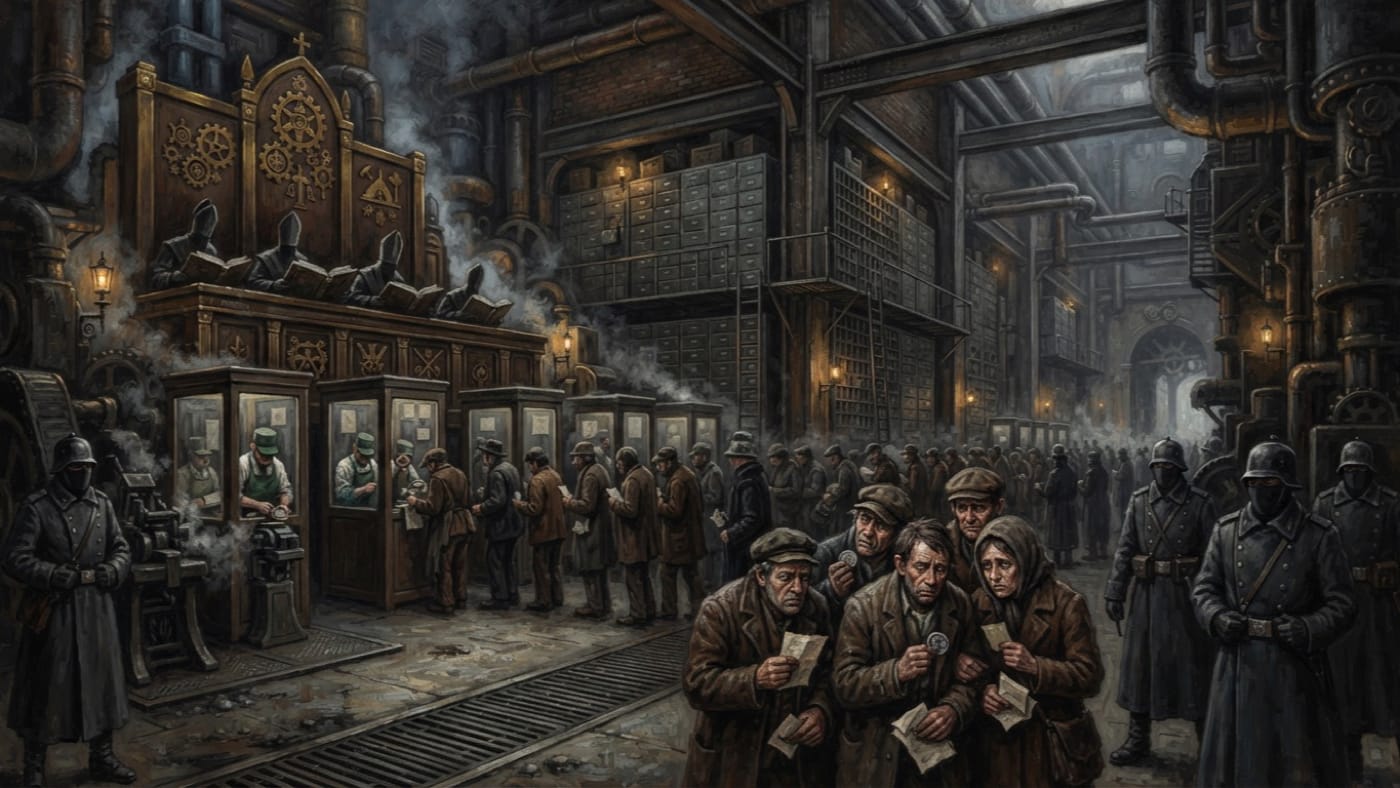
#On the Tribunal's Authority
"Recognition is lent. The Hall keeps the receipt." — chalked on the clerks' stair, Tribunal Hall of Corrections
The Mint Tribunal of Sable Court holds one power worth naming, and it names that power as modestly as the Synod's vocabulary allows. It may withdraw recognition from a face. It does not hang, brand or burn anyone. It corrects. A correction from the Tribunal Hall of Corrections can leave a citizen healthy, fed until supper and housed until the quarter-day, and unable afterwards to buy a loaf.
The restricted southern mint quarter of Cologne is governed by three bodies. The Synod Mint-Prelate, at present Varo Sable, controls lawful currency recognition. The Crownwright Master-Engraver Council holds the craft, without which no face is cut. The Tribunal adjudicates correction and recall. The Mint-Chapter occupies both the Face Archive and the Tribunal Hall, so the plates and the court stand a short walk apart. The clerks find this convenient. Petitioners do not. Warden-Captain Joss Kline holds vault access, raids and enforcement, so a Tribunal finding reaches the street through his wardens.
Who presides in the Hall, by what appointment and for how long, the registers open to my office do not say. I record the gap as a fact about my clearance and offer no theory about the bench.
#On the Face Entered in Evidence
Every dispute before the Tribunal asks whether four things still agree: a coin, a face, a name and a soul's account in the Great Ledger. The chain is documented. The Bureau of Records assigns the registry number. The Chapter commissions the die. A Crownwright hand engraves it. Assay and blessing in the Assay Cloisters come before circulation. Three objects come out of this process, and the Hall treats each one separately. The master plate stays in the Archive. The working die stays on Die Row. The circulating coins go wherever the citizen's money goes.
A lost coin is no case. Coins are struck in batches, and losing one revokes nothing. A purchaser who pays for salt with coins bearing other people's faces commits no offence. Nobody is obliged to carry only his own likeness, and few could manage it. The Tribunal's business starts when the coin, the die and the plate disagree with each other or with the Ledger.
The paper arrives before the petitioner does. It includes assay slips, face-confirmation papers, exchange warrants, vault manifests and the intent declarations that pass for confession at the exchange window. Matters I have seen referred to the Hall include clipping, faceholds, arrears of fees and contaminated or disputed coin. These are examples. The Hall has published no schedule of its jurisdiction, and I do not intend to write one for it. Exchange arbitration, assay fraud and identity forgery belong to the wider legal economy of the quarter, and several offices claim a share of each.
#On Hold, Recall and Unfacing
The lightest instrument is the facehold. It freezes recognition pending review or payment. The coins stay in the purse and the face stays on them, but the Gate of Assay stops accepting them and refers the bearer to the Hall. Nothing is gathered or re-struck. The citizen waits, and the review sets the length of the wait.
The heavier instrument is the face recall. The Tribunal orders the relevant coinage gathered and re-struck, either blank or with a replacement likeness. What follows is called unfacing. Merchants refuse custom because the coin no longer carries authority. Leases denominated in the face fail. Employment contracts stop working, since wages cannot be paid to someone the money does not recognise. The Bureau of Records calls the outcome "administrative dissolution, non-lethal variant." The unfaced person stays in the room, in the queue and at the baker's counter, holding out metal that nobody will take.
Some clerks speak of hold, recall and unfacing as three grades of sentence. Others keep unfacing for whatever follows a recall. I have found no statute that fixes the ladder, so I will not pretend to one.
Within Sable Court, the records describe a further consequence. Circulating faces appear to anchor memory, and withdrawing a face loosens it. Merchants hesitate halfway through a sale, unable to say who sold them the salt. Witnesses lose their suspects. Families dispute, with growing distress, whether a brother existed. The Bureau of Doctrine compares the effect to the reliquary effect. That comparison is Doctrine's interpretation, and the mechanism has not been solved. I have seen these observations recorded for Cologne. I have not seen them recorded for other provinces, and I will not supply them.
The revenue is divided carefully. Correction levies go to the Chapter. Identity fees for new entries go to the Crownwright Guild. Inspection tolls go to the Wardenate at every gate the unfaced person must pass on the way to petition. The faceless are expensive to process, and the cost falls on them.
#On Correction as Business
Three things in Sable Court are for sale: correction orders, assay delays and errors in the exchange rate. The Hall is known for heated wax, erasures and correction orders signed in advance. A pre-signed order is efficient. It is also a blank that waits for a name, and a blank of that kind can be bought.
Delay is the more refined product. A facehold lasts while review is pending, and a matter can be kept pending for a price, or ended for a slightly larger one. Craft dependency adds a second toll. Every replacement likeness needs a Crownwright hand, and the Council can slow a correction simply by being busy. Master Engraver Irena Coilhand is one master among several. I have never caught her selling time, and I have never caught her giving it away. Enforcement adds a third toll. A finding nobody carries to the door has no effect, so the speed of Kline's wardens is itself something of value.
Two objects are kept off the market. The Hall's verdict seals are unavailable even in the shadow stalls of Clipper's Market, and touching an Archive plate without authorisation brings annihilation. These limits show which objects are too dangerous to sell. They say nothing about the honesty of the people who handle them.
The Crownwright Guild has always served under Mint-Chapter authority.
Corrected. The Guild's submission to the Chapter dates from the settlement of A.S. 94. Before then, Crownwright families cut seals for Rationalist magistrates and ecclesiastical courts alike, with equal skill and equal indifference. "Always" was an overstatement of the Chapter's case, and the Bureau has removed it.
#On the Court Beneath the Canal
Every official court eventually gets a parody, and Sable Court's parody meets under water. The Candle Tribunal of the Clipped Choir sits beneath the second lock of the quarter's Black Canal. It can be reached by a drowned stair only at low water. It has three judges, chosen by trade: a clipper, a broker and an assayer. That bench belongs to the Choir alone and should not be read back into the Hall above.
The Choir copies the Hall's forms and reverses its effects. It issues shadow holds that freeze a debtor's standing among clippers. It issues counter-corrections that undo, by a back route, what the Hall imposed by the front. Its verdicts are clipped coins pressed into the palm of the person judged, who reads the sentence with a thumb. The Hall needs wax, a clerk, a witness, an archive copy and a fee. The Candle Tribunal needs a coin and a hand. I find this economy offensive, and the offence is professional rather than moral.
#On the Complaints That Ceased
The Face Theft began in A.S. 199. Citizens of Cologne's outer districts found their own faces wrong on their own coins: a husband's jaw under a stranger's eyes, or a merchant's likeness replaced by a face he had never seen and could not stop remembering. More than four hundred complaints reached the Mint Tribunal within three months. Each complaint asked the complainant to describe the face that should have been there. Within six months the complaints stopped, because the complainants could no longer remember their original faces.
The four hundred counts complaints. It does not count victims, and no census of the affected has been filed.
The Chapter ordered an emergency recall across seventeen denominations. The figure measures the scope of the recall, not the size of the currency. Citizens whose faces had already slipped had their coins confiscated and their recognition suspended. Citizens whose faces were intact stood in the same queues. Die Row went to triple shifts. Under the current Amber status, the Archive is sealed to everyone below Mint-Prelate clearance, warden circuits are doubled, and doubt inspections run at every gate. Blind clerks in the Assay Cloisters now compare the hymn-frequency of a struck coin with that of its archived plate. The Bureau of Purity continues its investigation. The Unface Society's claim of responsibility is disputed. A master die has been rumoured and denied in four separate depositions, and I certify nothing about it.
The Tribunal now faces a problem of evidence it was never built to handle. The complainant cannot describe the face. The disputed coin is the thing being disputed. The master plate was supposed to settle every quarrel, yet in A.S. 187 three Archive plates were found altered overnight: a jawline softened, an iris darkened, a hairline moved. Doctrine classified the Category Two Localized Identity-Scribal Anomaly in A.S. 194 and has not revised that classification since. The Hall has three witnesses, and each one may have been tampered with.
The Creator keeps the original of every face. The Hall keeps a copy, and the copy has been known to move.