
#On the House and Its Three Names
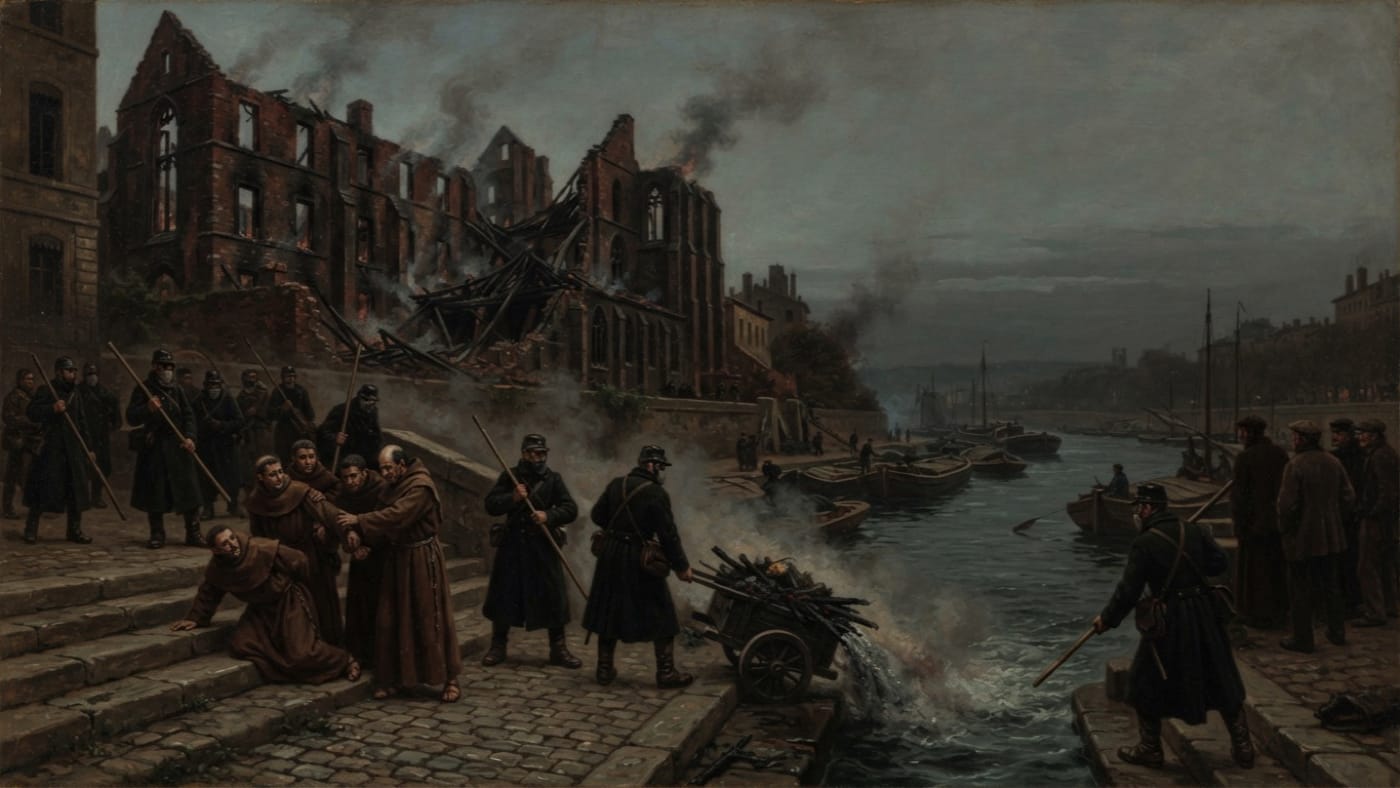
The friary that the Codex files as the Minor House of Saint Sabina stood on the left bank of the Rhône at Lyon until –39 A.S., which the old calendar calls 1671. In that year Lyonnais militias burned its brothers and carried their ashes to the river. The Ledger holds that much without embarrassment. The name at the head of this entry it holds with tongs.
Three names survive. The Lyon register enters the house as Saint Sabellian's House of the Lower Rule. A later Purity index, compiled long after the dead had ceased to object, calls it the Minor House of Saint Sabina. A fishmonger's deposition calls it "the brown brothers by the water." The title above is the index's. It is kept because the index is where readers will look, and because the Bureau would rather keep its errors catalogued than lose its truths. The title proves nothing about the dedication. Readers who came hunting a foundation of Sabina of Ghent on the Rhône may turn back now and spare the archivists their questions.
No founding year is recorded. There is no founder, no superior, no charter, and no rule that can be produced and read aloud. "Minor" proves no order and "Lower Rule" preserves no constitution. Both are words in a column, and a column is a poor witness to a vow.
#On the Work of the Brown Brothers
What the brothers did is better attested than what they were called. That is the usual condition of the poor and the holy alike.
They fed dock paupers. The quays below the house carried barges, fish, timber and salt, and the men who hauled them ate when someone fed them. The brothers fed them. They copied penitential psalters by hand, slow work done by men who expected no buyer and found none. They also sheltered two priests driven out of Vienne by earlier anti-clerical riots. The names of those priests are not preserved. Their fate after the house fell is not preserved either, and the Ledger will not guess it.
That was the whole of the offence: a kitchen, a copying table, and a spare cell for two hunted clergy. The city's Republican clubs found in it everything their vocabulary needed. Bread for the poor became the purchase of dependents. Psalters became superstition put to ink. Sheltering the Vienne priests became "harbouring contra-civic elements," a phrase so smooth it could be swallowed without chewing. The Rationalists would later polish that vocabulary into doctrine. In Lyon it was still rough and municipal, still learning which words made neighbours look away.
#On the Registers and Their Quarrels
The three names amount to a small war over authority, and I judge it with pleasure.
The Lyon register is the oldest and most official record, which recommends it to every clerk and to no historian. Registers are kept by men who need a house to have a saint, a rule and a rank, so that it can be taxed, inspected and, when convenient, condemned. "Saint Sabellian's House of the Lower Rule" sounds like a form filled in under supervision.
The Purity index is the latest record and the most confident. Its clerks worked long after the house was ash, when Lyon was a line in a ledger of martyrdoms and Sabina was a name everyone already knew. Its title is almost certainly a confusion with the later cult of the Ghent saint. Confidence in an index usually means nobody checked.
The fishmonger had no rank to protect. He sold fish below the house and saw the brothers daily, and when he was asked, he described them. His deposition survives in a cracked parish chest and still smells of scales. I accept the fishmonger. That is a judgement about witnesses. It settles nothing about the dedication, and the Bureau of Doctrine wants this written down before some enthusiast carves "Brown Brothers" over a chapel door.
#On the Night After Compline
The destruction belongs to the Red Slaughter of Lyon, and readers who want the full account should go there. This entry gives only what the house requires.
The attackers were Lyonnais Republican militias under municipal colour, carrying civic warrants. They were local men. The continental Republican Guards did not yet exist, and the formal Rationalist Republic was nearly seventy years away. These men were apprentices, and they worked without a master. The Slaughter entry has them arriving after Compline. It records forty-three friars burned in the lower refectory and four lay brothers shot at the postern. Older summaries in the Lore Book, some in my own hand, say the friars died in the marketplaces. The Ledger does not reconcile the two accounts here, and it will not invent a march between them to make the clerks comfortable. The dead are counted in both.
The ashes went into the Rhône. The Slaughter entry names the quay below Saint-Barthélemy's fish stairs. For three nights afterward, witnesses on both banks reported psalms coming from the water. They disagreed about the language. They agreed about the hours, which were the hours the brothers had kept.
The Bureau of Doctrine has classified the event, retrospectively, as escalatory blood. It came seven years before the Year of Letters and forty-nine years before the Massacre at Saint-Malo, which remains the public opening of the Atheist Wars. Lyon opened nothing. It was practice.
#On the Saint Who Was Not There
Sabina of Ghent belongs to Saint-Malo, A.S. 10, which the old reckoning calls 1720. She tended the wounded there, and the Bureau of Mercy claims her as its founder. Her recorded work begins forty-nine years after the brown brothers were burned.
The confusion is easy to reconstruct and impossible to excuse. Picture an indexer working through martyrdoms. He has a house with a saint's name half-legible in the register, in a river city, with friars, wounds and charity, and a famous name of mercy ready to fill the gap. "Sabellian" becomes "Sabina" with two strokes of a careless quill. No record shows that Sabina founded, visited, endowed or knew of the Lyon house. No record shows anyone there praying to her, and her cult did not yet exist.
Index title "Minor House of Saint Sabina" read as the house's dedication to Saint Sabina of Ghent.
Withdrawn. The title is an indexer's label, kept for retrieval. The house was destroyed in –39 A.S. / 1671 CE, and the saint's recorded work belongs to A.S. 10 / 1720 CE. The house's original dedication remains unproven. Pilgrims seeking her relics in Lyon will find a quay, a permit office and a fish market, and should buy from the last.
#On the Present Remembrance
No surviving community of the house is recorded, and the Ledger knows of no restored chapel or authenticated ruin. The brothers survive in three places: in registers that disagree about them, in a deposition that smells of fish, and in the river.
Lyon remembers under supervision. On the anniversary, a licensed procession carries bowls of clean ash down from the upper city to the Rhône, empties them, and walks back empty-handed. The procession holds a permit from the Bureau of Festivals. Anyone who wants to sing at the waterline needs a silence waiver from the Bureau of Bells, or is moved along by men who have never fed a docker in their lives. The procession does not name the house, and none of its banners carries Sabina's name. That is one mercy the clerks managed without being told.
The index title will stay, since an index is harder to amend than a heart and retrieval must be served. Beneath it, the Ledger now enters the fishmonger's words. Whoever opens the drawer will find the brothers as a man at the fish stairs saw them on an ordinary day, ladling soup.