
#On the Wards in Motion
This survey records the March of the 144 Wards as Strasbourg keeps it in A.S. 201. It covers the present observance only. The founding decree, the first performance and whatever instrument first ordered the wards into step lie outside this entry, and I will not invent them to fill the space.
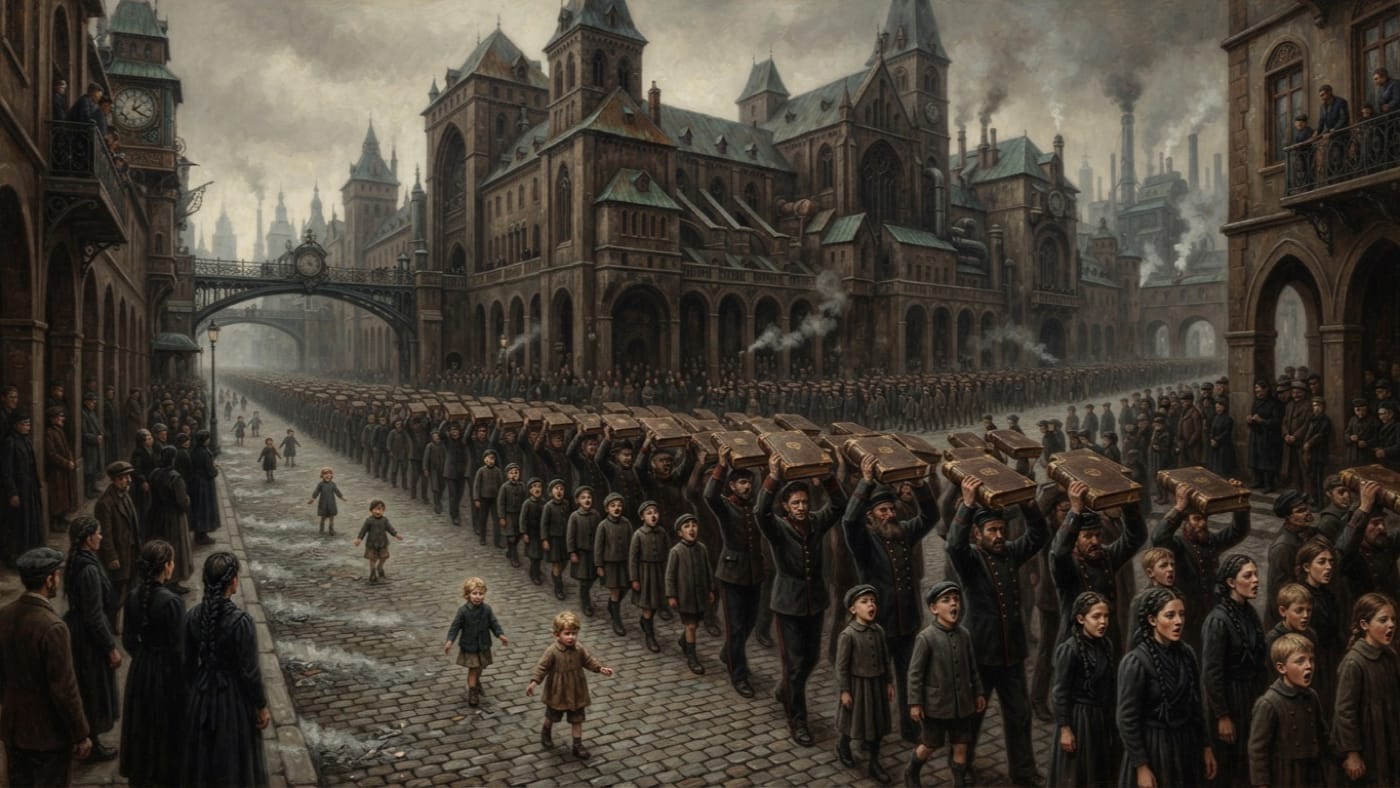
In the high months the wards file past the Cloister of Concord. The stewards come first, each holding the ward's ledgers overhead the way a deacon holds a reliquary at the elevation, with elbows locked, chin raised and the spine of the book turned toward Heaven. The children follow in ruled lines, chanting sums. The mothers walk with ledger cords braided into their hair. Debts are recited aloud, and small hands throw ash across the paving to mark the road.
I have stood at the Cloister's edge and watched the faces. They show pride and fear in equal measure. I have not found a ward where the proportion changes much, and I have stopped looking for one.
A word on the name, for provincial readers. The March is a procession. No territory called a March lies within the city walls, and no frontier stands anywhere near. The Ecclesiastical Quarter sits deep in the safe heartland, where the only blood on the paving belongs to a clerk who tripped on it.
#On Ledgers and Their Bearers
The ledgers are raised like reliquaries. The simile is the ward's, and I endorse it. The bindings hold no saint's knuckle and no phial of martyr's blood. They hold the ward itself: its households, its sums and its standing with the Counting House. A relic proves that someone was holy. A ledger proves that someone was counted. The Church has long held these to be neighbouring virtues, and on the day of the March the two share a gesture.
What the steward carries is custody. A ledger kept in a cupboard is a private matter between a family and the Bureau of Tithes, conducted at a counter, in a queue, under breath. Raise the same ledger above a crowd and the account becomes public property. The street can see it. The Cloister can see it. The neighbours can see it, and the neighbours are the auditors the Church never has to pay. The steward's arms ache by the Cloister gate. No steward I have watched has lowered the book early.
Families become legible through their bodies. A mother who wears the ledger cord has put the household's account where everyone can read it, on her own head, and she has braided it herself, which matters. The child in the ruled line has done the same with her voice. Nobody had to search a house. Every house has walked out of its own door and announced itself.
#On the Accounting Aloud
The children chant sums. I have heard them at the Cloister gate, high and flat and precisely in time, the way children recite anything they have been told is important and have not been told why. The adults chant debts. Their voices are lower, and some go lower still as the line nears the Cloister arcades.
Outsiders take the March for civic pride. Insiders know it is a census dressed as a parade. I am an insider, and I wrote that sentence before this survey asked me to. A census taken by clerks needs clerks, doors, ink and a season of bad weather. A census taken by procession needs only a street. Each household that walks has been present. Each mouth that chants has been heard. Each debt spoken aloud has been confessed before the whole ward, in its own owner's voice, at no cost to the Bureau of Doctrine beyond the paving.
Doctrine teaches that an account spoken in order is an account offered in obedience, and that correct arithmetic said in the open is a form of devotion. That is the institution's belief, and I teach it. I do not teach that a chanted debt grows smaller. The Counting House would never allow it, and it has never been asked.
The ash is scattered by the children ahead of the line, and the road is marked with it. I can certify the gesture but not the material. No source I accept names where the ash comes from, so this survey records grey on pale stone, small fists opening and the procession walking on what they leave behind.
In the Cloister precinct, on the days of the March, the whole precinct counts aloud, and any silence during the March is noted. I chose the passive voice when I first wrote that, and I keep it now. A child who loses the sum loses the rhythm, and the line has a rhythm loud enough to hear a gap in it. Nothing more needs to be enforced. Pride carries the families to the Cloister. Fear keeps their mouths moving once they arrive.
#On Bells and Correct Silence
The March has a companion story, and it belongs to a bell. It is told in my entries on the Whisper and the Tower of the Quill: a girl in the March asks her mother why the little bell rang, and the mother presses a finger to her own lips. The entries record no date and no ward for this, and the story needs neither. It is told because it teaches, and it teaches because every mother in the line knows the gesture.
The same child who bellows sums at the Cloister learns from a single finger which sounds are hers to make and which belong to the Tower. Her lesson in arithmetic and her lesson in silence come on the same day, from the same procession, and the second leaves the deeper mark.
The Whisper tolls whenever a soul strays from orthodoxy.
Corrected against the belief as it is still repeated along the route. Bell 7-C rings by schedule. The Bureau of Bells sets its hours, Doctrine approves them and a bellman pulls the rope when the folio tells him to. No special toll for the March is on record. The bell listens to nobody. The ward listens to the bell, and that is the arrangement working as designed.
I keep the legend's correction in the erratum rather than the body because the body of this survey concerns what the wards do, and the wards do not stop believing when a Warden corrects them. A mother with a ledger cord in her hair, a ward account above her head and her daughter's sums ringing off the arcade has every reason to think something in the Tower is listening. Something is. It is a timetable.
#On the Neighbouring Rites
Visitors confuse Strasbourg's processions, so I separate them.
Later in the year comes the Festival of the Flaming Sword. Seized Rationalist compasses are heaped up and burned, and they burn badly, with a squealing noise. The Weeping Pilgrimage of Saint Edras' Bones carries empty biers through queues long enough to teach patience that no catechism could. That description is Strasbourg's own observance of it. Pilgrims elsewhere keep their own customs and their own complaints.
The Festival destroys the instruments of measurement. The March parades what measurement produces. The Edras biers carry nothing and invite the faithful to grieve over the space. The March's books are full, and they invite the faithful to stand inside them. Of the three, only the March sends every household into the street with its accounts in hand. Only the March leaves its participants more legible than it found them.
#On the Present Observance
As of A.S. 201 the March continues in the high months. The stewards raise their ledgers past the Cloister, and the children walk in ruled lines and chant sums. The mothers braid in their cords. Debts are said aloud in the street, and ash marks the road. The faces still show pride and fear, and no edict has yet tried to separate the two. One that tried would be ill advised.
I admire the rite. It turns an audit into a liturgy, enlists neighbours as clerks and fits a census into one walk past the Cloister. I also know what it costs, because I have watched the stewards' arms shake, the mothers' fingers rise toward their lips and the children step carefully over their own ash. Doctrine does not require me to choose between admiration and accounting. Doctrine requires the ledger to balance, and so it does.