
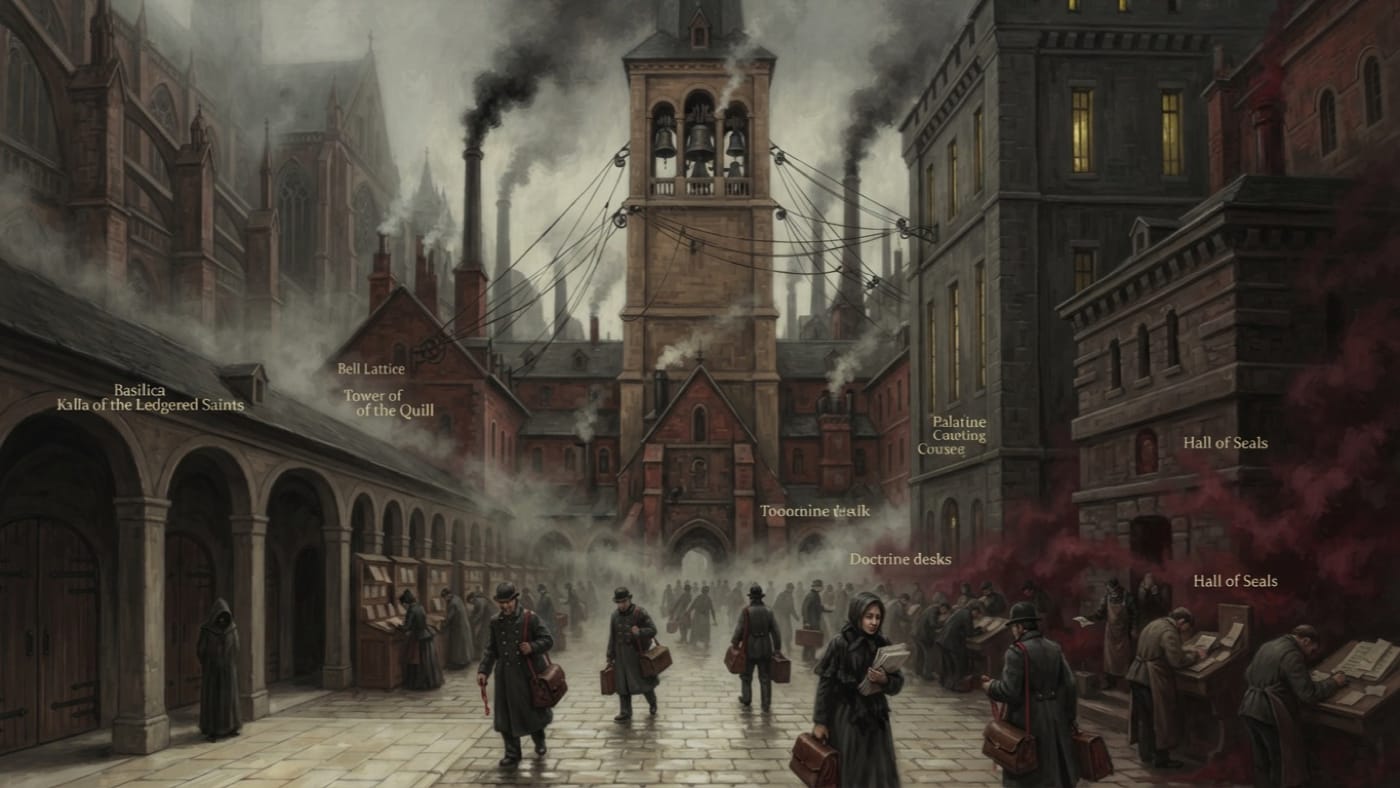
#On the Precinct
A clerk leaves the Doctrine desks with a red-corded packet tucked under his left arm. He crosses the pale paving and passes under wax smoke drifting from the Hall of Seals. He steps around a petitioner who has stopped to reread a form she cannot alter, and he reaches the Basilica wall before the ink in his packet is dry. That walk is the Cloister precinct. No charter names it. No surveyor has walked its edge with a chain and come back with a figure the Bureaus would sign. It exists because the offices of the Synod were built close enough to quarrel by shouting and far enough apart to bill one another for messengers.
The Cloister of Concord is its named heart: a quadrangle of walks and desks around a court whose drains are carved as listening mouths. The precinct is the larger habit around it. It is the ground over which the ecclesiastical offices of Strasbourg send runners, petitions, bell slips and reprimands. It belongs to the institutional streets of the Sanctum Mile, which is entered by custom and left at curfew. It lies in the safe heartland of Zone 2, where the worst danger a clerk faces is a misdated receipt.
When I say "precinct," I mean the walk. When the Bureaus say it, each one means the part it plans to annex.
#On the Neighbouring Authorities
The precinct is an argument conducted in masonry. The Synod became a formal government at the Concordat of Strasbourg in A.S. 90. It then took over the city's inherited civic buildings with the appetite of a bishop at a funeral supper. It consecrated some of them and merely renamed the others. The offices now crowding the Cloister grew into place after that settlement, one ledger at a time. None of them has ever conceded a boundary in writing.
Doctrine holds the Cloister desks and the Tower of the Quill. That sandstone landmark has three bells, for heresy, hunger and war, and they sound so alike that only bell-copyists can tell them apart without a schedule. The Bureau of Doctrine is my own house, and the only office in the precinct that writes its arguments before having them.
The Basilica of the Ledgered Saints is the older choir of the Cathedral, and it shares a load-bearing wall with the Cloister. Behind that wall the Bureau of Records keeps the census of the living beside the absolutions of the dead. It amends both whenever Doctrine coughs.
The Palatine Counting House is the seat of the Bureau of Tithes. It was a Rationalist tax depot before it became a sacrament. It works three watches and never closes. Its clerks count coin, grain, widows and the unborn with the same posture.
The Hall of Seals completes the ring of pressure. There the Bureau of Heraldry and the Bureau of Masks and Seals ration colour, register dies, and decide which reds stay legal this year. The Hall and the Counting House fight a war of margins. Tithes wants stamps fast. The Hall supplies them correct. Each side refers the dispute to Doctrine, which answers with a sentence both sides then frame.
#On the Petitioner's Walk
Adjacency is only a theory until a widow tests it.
The Bureaus' favourite demonstration is the matter of the boots. A woman's husband is lost at Knife-Mile, last seen feeding the mud, and she petitions for his boots. Her first stop is the Basilica, to identify the right entry. That means standing at a Records counter while a clerk confirms that her husband existed, was issued footwear, and died, in that order. Once the entry is found, she crosses the paving to the Hall of Seals to request the Boot Indulgence. Heraldry must be satisfied that the boots were worn under a lawful crest.
From the Hall she goes to the Palatine Counting House to pay the Leather-Penny. Tithes returns no property without first selling it back.
From the Counting House she passes through the Cloister into the Seven Inner Courts and along the proxy corridors to the Censorium of Taverns. There she signs the Sobriety Pledge, lest she squander the boots in drink. Nobody asks whether she drinks. The pledge is cheaper than the question.
Last of all she presents her papers to the Wardens. They issue a pair of boots of the same weight as the ones recorded, stamped in the tongue with the Synod's crest and sized by grace rather than foot.
Count the steps: five offices, five counters, a queue at each. All of them lie within a short walk of one another, and that closeness is both the cruelty and its excuse. A capital with its Bureaus scattered along the river would have to apologise for the journey. Strasbourg can point across the square. Every refusal stands a short walk from the next requirement. The widow cannot plead distance. She can plead only fatigue, and no Bureau recognises fatigue as a category.
She leaves shod. The ledgers balance. The boots pinch.
#On Bell Hours and Public Rites
The precinct runs on the civic peals carried along the Bell Lattice. The Bureau of Bells keeps that web of tuned lines strung from tower to tower. The Tower's three bells are a separate matter. They keep their own schedule and do not care whether a petitioner has finished her form.
At First Peal, fog rolls from the Orison vents across the paving and clears away what curfew left behind. At Second Peal the counting houses and bakeries open together. By then the first petitioners are already queuing outside offices whose clerks are still fastening their cuffs. At Sixth Peal the Palatine Counting House sings Psalm CCCXIV, "A Weight of Wheat Is Worth a Breath," and every scale in the building tips toward the Synod. Seventh Peal summons the auditors. Across the precinct, clerks suddenly remember documents they meant to file that morning. Ninth Peal is curfew. After it the square empties and the wax rooms bank their fires. Anyone still crossing the paving had better carry a reason with a seal on it.
In the high months the March of the 144 Wards files past the Cloister. Stewards raise the ward ledgers like reliquaries. Children walk in ruled lines chanting sums. Mothers wear ledger cords braided into their hair. On those days the whole precinct counts aloud, and any silence during the March is noted.
One strip of the precinct is exempt from all this arithmetic.
#On the Northern Arcade
The Silent Colonnade closes the precinct to the north. It is the fourth side of the Cloister: pale stone, shallow arches and clean paving. Its doors are plain wood banded in iron, with unmarked lintels, handles set too low and thresholds without dust. Its custody is unrecorded. Its official door count is withheld. On Wednesdays it is shorter. The clerks dispute by how many arches, and the masons decline to count again.
An undated advisory limits speech beneath the arcade to name, office, purpose and answer. It forbids counting aloud. The advisory governs the arcade and nothing else. A few paces south, a ward child may bellow sums at the sky. Under the first arch, sound loses its standing, and a petitioner's own footsteps reach the ear late.
Traffic there is thin. A Night Wagon passes in the hour before dawn, its wheels wrapped, its lamp hooded, its horses blindfolded. It carries nothing that any manifest admits. The Night Wagon Drivers know Strasbourg's unmarked doors the way a sacristan knows which pews creak. Their Corridor Masters say nothing useful about any of them. I once saw a wagon halt under the arcade. I did not see it unload. Wagons are not a Doctrine matter.
"Restricted offices of the Bureau of Shadows." — visitor's handbook for provincial notaries, A.S. 187, describing the northern arcade.
Withdrawn. The Bureau of Shadows maintains no official offices in the Colonnade and no official position on it. Notaries still holding the uncorrected copy are advised to remove the page and stop citing it.
The Colonnade's own entry holds the full account of its counts, its silences and its returns. This one declines to repeat that account while standing within the arcade's jurisdiction, whatever that turns out to be.
#On the Present Condition
As of A.S. 201 the precinct is at work. Doctrine's desks are full before Second Peal. Records clerks cross the shared wall in shifts. The Counting House has not closed in living memory and will not start now. The Hall of Seals suspends colours at its usual rate. Tithes contests the cost of every notice reprinted as a result.
Petitions still move in the order the ledgers prefer. Widows still walk from Basilica to Hall to Counting House to Censorium to Wardens, and still leave shod. The Bureaus still dispute where the precinct ends. Each claims more paving than its neighbours concede. None claims the northern arcade, which receives its visitors without anyone's permission.
No Bureau has filed to annex the Colonnade. I once asked in committee whether one should. The minutes record my question and no reply.