
#On the Situation of the Quarter
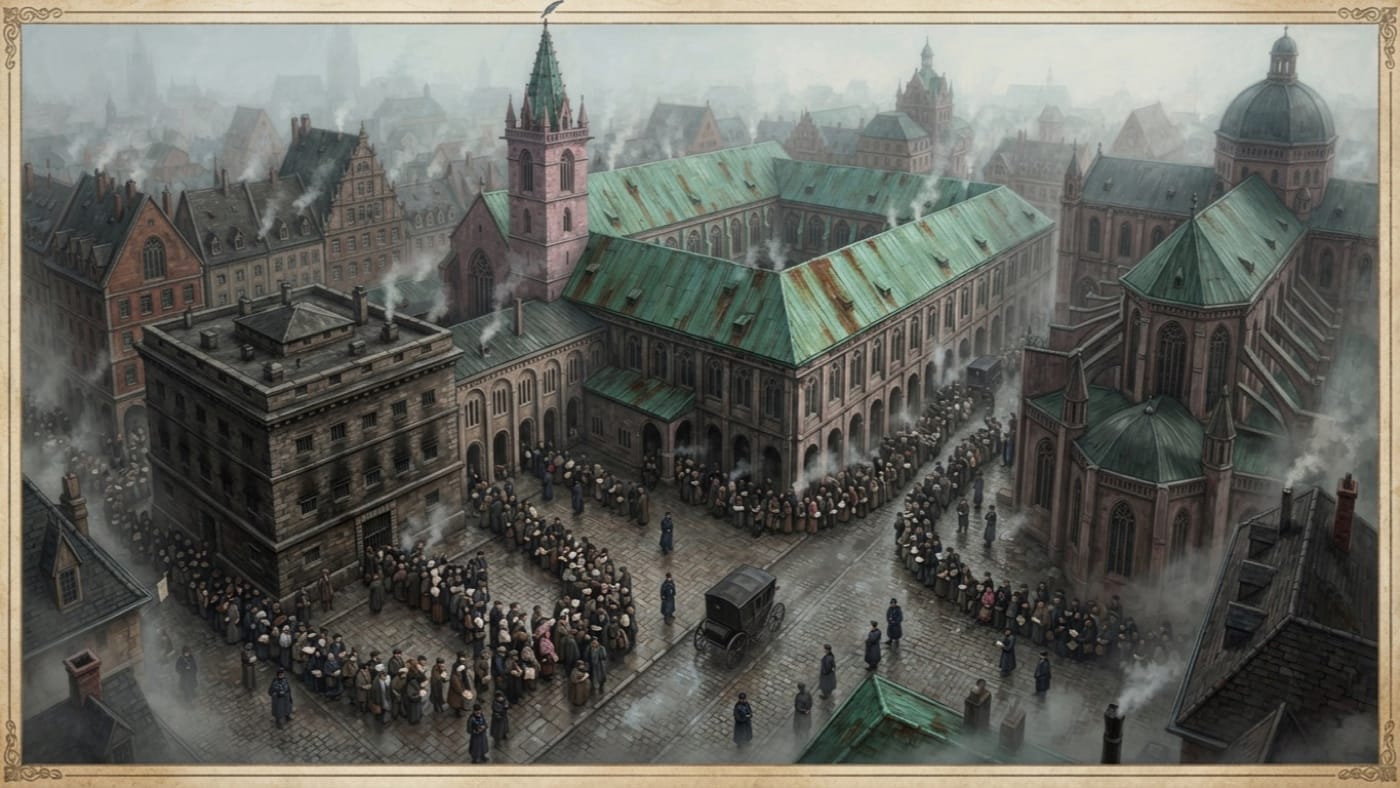
At First Peal the Orison vents breathe out the last of the night's curfew fog. It slides off the verdigris roof of the Cloister of Concord, runs down the gutters and spreads across the wet paving into the lanes, where the petitioners are already standing. They have been there since before the bell, though no one told them to come early. Strasbourg teaches punctuality by example.
The Ecclesiastical Quarter lies within Strasbourg, capital of the Synod, deep in the safe western heartland, where the war arrives as correspondence. It has no wall of its own and no surveyed perimeter I would defend before the Bureau of Records. Some clerks say the Sanctum Mile, some the Cathedral Close, some the Cloister precinct. Each means a slightly different set of streets and is certain the others are wrong. I mean the ground visible from the Gallery of the Tower of the Quill without leaning over the railing: the Cloister below and the houses of authority pressed against it.
The quarter had no consecration day. Offices gathered around the Cloister as the Church's administration grew, unevenly after the Sundering of A.S. 45 and with more deliberation once the Concordat of Strasbourg gave the Synod its formal shape in A.S. 90. Each new arrival built against its neighbour's wall and then complained about the damp.
Here doctrine is written, lives are recorded, dues are counted and symbols are licensed. The results reach the Line in sacks.
#On the Houses of Authority
The Cloister of Concord is the hinge on which the rest turns. Its arcades hold the exegetes of the Bureau of Doctrine, who sit in rows at slanted desks and decide what words will mean this year. Its nave stones are said to have been mortared with ground Rationalist compasses and martyr-ash, and on damp days they sweat brine. The roof has gone the green of an old penny. The Bureau of Engineering calls this corrosion. I call it seniority.
The Basilica of the Ledgered Saints buttresses the Cloister on one side. Other registers call the same cathedral the Cathedral of All Saints and Settled Accounts, so visitors should understand that it is one building with several letterheads. Its business is the record. The census of the living lies there beside the absolutions of the dead, written in red ink on vellum, linen, leather and anything else that would hold a soul still. The windows show no martyrdoms. They show columns of numbers, oiled so they gleam when the sun is charitable, and the faithful kneel beneath the sums.
At the Basilica's northeastern corner, adjoining the Cloister, rises my Tower. It is pink-grey Rouffach sandstone with a quill-nib on the vane, and it is the tallest structure in Strasbourg. The rest of the quarter's architecture amounts to a series of replies to it.
The Tower of the Quill exceeds every steeple in Europe.
The Tower of the Quill exceeds every structure in Strasbourg. The bell-towers of Cologne are taller if one credits their surveyors, and I do so under protest. The quarter's dignity does not depend on Cologne.
West of the Tower squats the Palatine Counting House, seat of the Bureau of Tithes. Its business is harvest returns, levies, coin, scales and the arithmetic of what a petition will cost. Ledger lines are burned into the counters' abacuses, so even the grease of a clerk's thumb counts as a sacrament. Beyond it stands the Hall of Seals, where Masks and Seals and the heralds ration colour to the Synod's dominions. A washed red is refused. A blue drifting toward Rationalist ink is burned. Every impression of the Triune Knot pressed into wax anywhere in the Church's lands began as a matrix on a bench in that building.
The two houses need each other the way a lock needs its key, and each resents it. Tithes cannot release a coin without a seal, and the Hall of Seals cannot cut a die without a budget line. Their clerks drink in different taverns.
North of the Tower lies the Silent Colonnade. I will come to it.
#On the Day by the Bells
The quarter keeps no clocks it trusts. It keeps bells. The hours belong to the Bureau of Bells and its lattice of tuned lines, and the quarter moves when they speak.
When the fog lifts, kitchens light. Soon the bakeries and the Counting House open their shutters together, so yeast and coin rise in the same hour. Later the confession kiosks fill, and the queue for absolution runs alongside the queue for the census, and people regularly join the wrong one. Levy musters form in the squares with sergeants holding rolls. Auditors are summoned and cross the paving in pairs, and every clerk who sees them suddenly finds his ledger fascinating. At Ninth Peal the vents open again, fog fills the lanes, the Basilica's number-windows go dark, and anyone still queuing goes home and loses their place.
The Tower's three bells keep none of these hours. The Leviathan tolls for war and Fames for hunger. The third, Bell 7-C (Auxiliary, Doctrinal), which the common people call the Heresy Bell, rings by schedule. The rope does not know what heresy is. The petitioners in the lanes believe otherwise, and the Bureau of Doctrine has never tried very hard to correct them.
#On Petitioners and Processions
The quarter's buildings are joined by footsteps. I once recorded the errand of a widow who came to recover her husband's boots, lost on the Line. She went first to the Basilica, to find his entry. The Hall of Seals sent her to request the Boot Indulgence, the Counting House to pay the Leather-Penny, and the Censorium of Taverns to sign a Sobriety Pledge, lest she drink the boots. At the last office the Wardens presented her with a pair equal in weight to those recorded. They were stamped on the tongue with the Synod's crest and sized by grace rather than by foot.
She crossed the same square four times, and each crossing earned her a receipt. The receipts mattered more than the boots, because they proved to every office that her husband's absence had been noticed by the proper authorities in the proper order. The Church can give a widow that, and it gave it to her in full.
The quarter also sees movement of the other kind, ordered and occasional. The March of the 144 Wards files past the Cloister in its season. Each ward's steward carries the ward's ledgers high like a reliquary, the children walk in neat lines chanting sums, and mothers come with ledger cords braided into their hair. The faces show pride and fear in proportion. The Festival of the Flaming Sword burns seized compasses into a poor, squealing fire. The Weeping Pilgrimage of Saint Edras' Bones carries empty biers through queues long enough to teach patience to the impatient.
A procession passes through the quarter once, in a single direction, to music. A petitioner goes round in circles on foot for as long as the business takes. The paving wears down evenly under both.
#On the Unmarked Edge
The Silent Colonnade is a long arcade of doors without names, numbers or knockers. Everyone swears it is shorter on Wednesdays. I have paced it on a Tuesday and again on a Wednesday and got different counts. My stride is not a surveyor's chain, and the Bureau of Engineering declined to lend me one. The doors are attributed to the Bureau of Shadows, which publishes no roster and so cannot be contradicted. Petitioners go in for "adjustments" and come out having never applied. Night Papers cross the quarter after curfew by corridor doors and midnight bridges, and the couriers carrying them will not tell you where they came from.
Under all of this the stone hums. The vibration sits at the threshold of hearing, strongest in the Cloister and weaker toward the river. Doctrine has declared it a benediction, and public copies call it blessed acoustics. Off the record, the Bureau of Engines and Furnaces speaks of engine-cant poured into the footings when the Cloister's mortar set, and of counter-sorcery. Records has struck that word from public copies because it startles the gullible. I note only that sigils of the Great Deceiver chalked on these cobbles never set properly. They smear. Both explanations remain on file.
Beneath the Tower lies the Sealed Archive of Doctrine, which is older than the Tower above it. That is all this entry will say about the quarter's depth.
#On the Present Condition
In A.S. 201 the quarter is crowded, clean and watched. The lanes are swept before First Peal and full by the next bell. The small, tidy carriages of the Bureau of Purity pass down the quiet middle of the street, and their wheels never rattle. The verdigris spreads. The queue at the Hall of Seals reaches the Counting House steps on levy days, and the Counting House has filed a complaint, which is waiting in a queue of its own.
Doctrine writes. Records remembers. Tithes counts, Seals licenses, and the Colonnade adjusts. The bells tell everyone when to begin and when to stop. Those who find the arrangement wearisome may say so at any unmarked door.