
#On the Title
The register of Bastion-Constantinople disposes of the matter in one sentence: the internal administration of the fortress is inspected quarterly by the Legate-Praetorial. The sentence names no incumbent and cites no charter. It fixes no day within the quarter. It needs none of these. Four times a year a commissioned stranger comes through the gates of the most self-governing fortress on the Sagittal Line and asks to see the books, and the books are shown.
That is everything the record says about the office at Constantinople. I have been instructed to make an article of it, and I have made articles of less.
The title has two halves. Legate means delegation: the man holds an authority that belongs to someone else and carries it in a travelling case. Praetorial is the suffix also borne by the Bishops-Praetorial, the spiritual governors of provinces who sit in the Assembly of Thrones. A shared suffix proves only a shared vocabulary. No instrument on my desk makes the Legate-Praetorial a bishop, gives him a throne, or sets out the legal terms of his commission. I have searched, and I will not supply the missing statute by imagination.
#On the Legatine Power
The general constitution of the Bureaucratic Synod places the Procurators at the top: regional administrators appointed by the Concordat Hall of Strasbourg, whose seals are said to weigh as much as the Synod itself. Beneath them, in the Lore Book's phrase, "labor the Legates and Vicars."
The two are easy to tell apart. A Vicar lives where he works. He is assigned to a city or province and keeps its quotas, taxes and observances in balance, and his red-sealed ledgers decide whether that city feasts or starves. A Legate is sent. He goes to dioceses already judged troubled, and the documented powers of his office are three: he may seize records, depose governors, and suspend armies in the Synod's name.
Those powers belong to the legatine office in general. Whether every commission styled Legate-Praetorial carries all three, the archive does not say. What the archive does show is that at Constantinople a legate has exercised authority over generals, and that the garrison obeyed.
There are other compound legatine titles. Theron Vast, Legate-Inspector, commands the Bureau of War checkpoints on the Macedon Escarpments northwest of the city. His title also begins with Legate. No source makes the Inspector and the Praetorial successive ranks, sister departments or members of one corps, and the Bureau of Doctrine has not asked me to make them so.
#On Inspection at the Southern Anchor
Constantinople is a Shield-Prefecture: autonomous in military matters and authorised to levy tariffs on traffic through the strait. Strasbourg funds the fortress, pleads with it, and sends it memoranda, which the fortress acknowledges, files and routes into chronological order. In practice the Bastion governs itself. Being the only bastion that faces two Sin-Generals at once, it has never had the leisure to do otherwise. Kargath presses from the Black Sea and the Thracian marshes, rotting convoys before they arrive. Maldrake comes south out of Thrace in campaigns of fire and slag. Velkara's agents need no approach march, being already inside.
Autonomous in military matters is a generous phrase, and the Synod examines its generous phrases. The garrison decides where the guns point. The garrison does not decide when it eats.
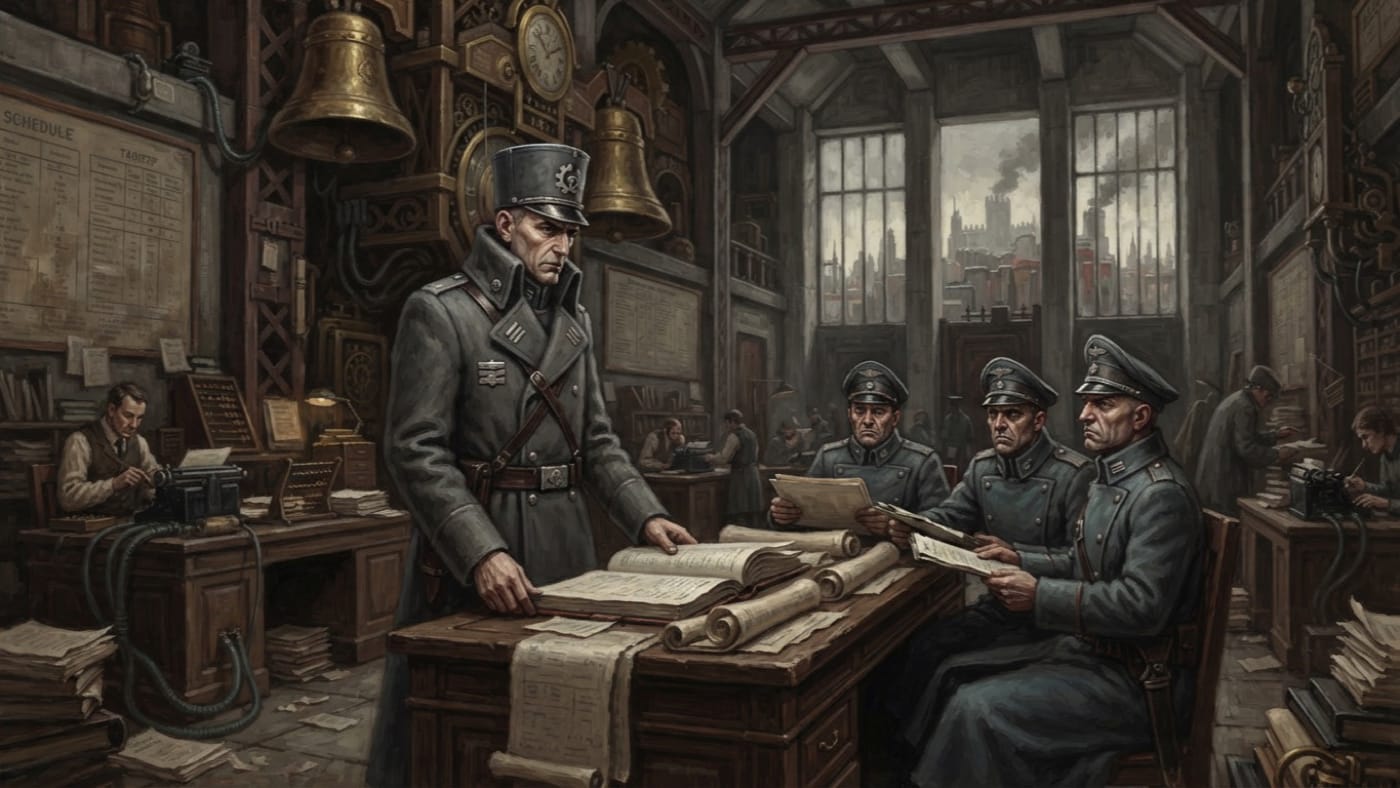
In Constantinople the Bureau of Bells fixes the peals and the Bureau of Doctrine assigns each one its meaning. The Bureau of Tithes attaches a tariff to every toll, and the Bureau of Records certifies that the toll was rung. Miss the noonday peal and the kitchens lock. The ration queues have a litany for this: sing or starve. A ration drawn at the wrong peal is therefore four things at once. It is a kitchen irregularity, a lapse in observance, a discrepancy in tariff, and a line in a register that will one day be read by someone who did not draw it.
A legate needs no special checklist in such a city. The city has already turned every meal into a record.
When the Legate-Praetorial inspects the internal administration, he is reading a fortress that has recorded its own hunger in four bureaus. Commanders who control their artillery absolutely may find their breakfasts open to anyone with a commission. The garrison has kept fighting under this arrangement. It has also kept eating on time.
The Lore Book's general account placed Legate Seraphinus's unannounced arrival at "Bastion-Lorraine," and its description of that fortress styled it the western anchor of the Line.
The fortress is Bastion-Constantinople, the southern anchor of the Sagittal Line, ratified in A.S. 68. The designation Bastion-Lorraine is retired. Every reference to it, including references to legates arriving at it, now points south to the Bosphorus, where the generals were.
#On the Precedent of Seraphinus
At Constantinople the documented example of legatine correction is Legate Seraphinus of Lyon. He arrived unannounced and demanded the execution of three generals for "improper observance of fasts." The fortress register states the outcome with an economy I envy: none dared gainsay him; the fasts were observed; the generals were not.
No register I am permitted to cite gives the year. I decline to borrow one from a neighbouring catastrophe.
Look at the shape of the event. A fortress at war with two Sin-Generals, under its own military command, lost three general officers to a visiting official, and the charge concerned the timing of meals. Nobody resisted. The silence is the more instructive half of the record. Constantinople's autonomy covers ramparts, levies and guns. It has never covered the fast, and the officers present knew this without being told.
The broader account of Seraphinus is harsher. The Lore Book says that armies under his authority were halted mid-campaign to keep the Thrice-Night Fast, and that generals who disobeyed were hanged from their own banners with catechisms nailed to their tongues. That account does not say which generals, where, or when. I will not hang a Constantinople officer from a banner the record has not hung him from. The three are attested. The banners belong to a separate account.
#On Hunger as Doctrine
The fast Seraphinus enforced was a doctrine with texts. His Catechism of the Empty Belly is compulsory reading for field officers. The Thrice-Night Fast is the observance he promoted, and failing to keep it properly cost three generals their lives at Constantinople.
The doctrine's claims for itself are bold. According to the account preserved in the Lore Book, Seraphinus showed that hunger could serve as a stratagem: the starving of his own troops drew Wrath's abominations into the fields, where they collapsed feeding on bones already hollowed by deprivation. Doctrine adds that voluntary hunger strengthens the faithful against Kargath's whispers. Both claims are entered as doctrine and attributed to their sources. I enter them in the same way.
The field record keeps a separate column. At Constantinople, Gluttony works on the convoys, shorting holds and spoiling caravans before the grain reaches the quay. Fasting, by the Synod's own countermeasure files, leaves soldiers physically weak and more susceptible to promises of food. The fortress therefore withholds the bread its enemy has already reduced, and it calls the remainder discipline. Doctrine considers this resistance. The quartermasters consider it arithmetic. Both columns are filed, and neither has been struck.
Wrath complicates the account further. Maldrake's campaigns demand marches, wall repairs and gun crews working through the night, and a gun crew on its third fasting night still has to lift the shell. The Bureau of War has not challenged the Catechism in writing. Its scheduling office has simply been unable to arrange an offensive around the fasts.
The general account of legates records a garrison censured for eating too early by the liturgical clock, after which the fortress fell to siege the following week. Doctrine noted the episode as "proof of vigilance." The account does not name the fortress, and I have not asked.
#On the Present Application
The quarterly inspection stands in the Constantinople register for the survey year A.S. 201. The register names no current Legate-Praetorial, and I name none. It sets no date for the next visit in any document shown to me. The result is that the fortress keeps every bell as though each one were the inspection day.
The commission arrives from outside, and the fortress hands over its books. Inside them, recorded by the Bureau of Bells, Doctrine, Tithes and Records, are the hours at which every officer of an autonomous military command took his bread. Marshals on the Thracian front hold sixty miles of contested ground and answer to nobody about their guns. Their kitchens answer, quarterly, to the Legate-Praetorial.