
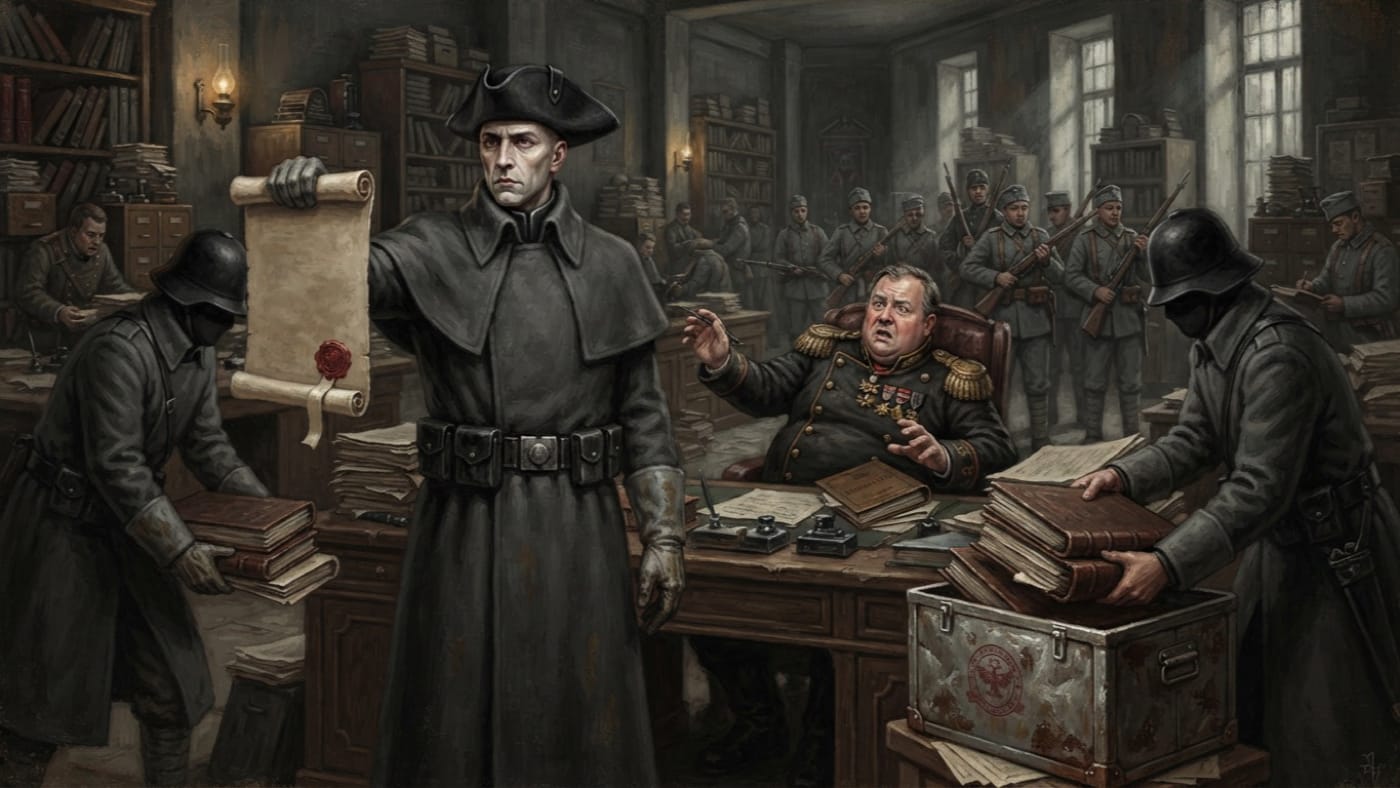
#On the Commission
A legate's arrival is felt first in the kitchens. The cook stops ladling. The garrison clerk finds his ink has thickened in the well. Upstairs, a governor who held his province at breakfast holds it by noon at the pleasure of a stranger who has not yet removed his travelling gloves.
The Legate is a roving official of the Bureaucratic Synod, dispatched from Strasbourg into troubled dioceses and empowered, in the Synod's name, to seize records, depose governors and suspend armies. The office sits beneath the Procurators of Strasbourg, those continental managers appointed through the Concordat Hall whose red wax is said to weigh as much as the Synod itself. A Procurator oversees a region. A legate is sent into one.
The office has no throne in the provinces, no palace or cathedral stall, and no pew reserved in its name. A Vicar lives in the city he oversees, learns its bakers by name and grows fat or lean with its quotas. A legate lives in the commission: a folded writ, a seal and the delegated voice of Strasbourg, carried by road into places that have begun to mistake local custom for law. When the commission is spent, the legate leaves. The correction stays.
I have searched the Ledger for the founding instrument of the office, and I have found nothing I am prepared to cite. No first legate is recorded, and neither is a standard oath, a term of service or a regulation coat. Provincial antiquarians who supply these things from imagination will receive the attention their imaginations deserve.
#On the Visit
The legate arrives unannounced. This is the whole art of the thing. A diocese that expects an inspection prepares for it, and a prepared diocese is a diocese that has rewritten its books. So the legate comes without herald or letter, sometimes without even a bell rung at the gate, and goes first to the registers.
Records are seized before anyone is questioned. Ration logs, tithe rolls, bell schedules, muster books and the private correspondence of officials who believed their private correspondence was private all pass into the legate's custody, and from there, eventually, into the vaults of the Bureau of Records. A governor may argue with a man. He cannot argue with his own handwriting.
Deposition follows the documents. A legate who finds the books irregular can remove the governor who kept them, and the consequences reach well below the governor's desk. Pay warrants carry his signature. Grain releases carry his seal. The night watch takes its orders from his deputies. Remove the signature and the province's whole paper circulation stops until a new hand is entered. Soldiers learn of a governor's fall when their bread arrives late.
Then there is the suspension of armies, which is the power that makes generals pray in earnest. A suspended army has not been disbanded. It stands in its trenches and keeps its guns, and it may do nothing with either until the legate's inquiry closes. The legate does not thereby take the field. Inspection is one authority and tactical command is another, and the Synod has been very precise about the difference. Its precision has rarely consoled the men waiting in the trench.
The published account of Legate Seraphinus of Lyon credits the office with further powers on his commissions: the suspension of individual commanders and the confiscation of bells. I record them as his. Whether every writ carried them, the surviving commissions do not say, and I decline to invent a statute merely because it would be satisfying.
#On Those Overruled
The Synod's government is an orderly hierarchy in the sense that a cathedral's foundations are orderly: layered, ancient, and settled into one another under great pressure. Procurators argue with Vicars. Vicars override Governors, though they are nominally beneath them. Governors and Governors-Praelate rule territories whose borders the Records clerks redraw every few decades. Field commanders answer to the Bureau of War for operations, to the Bureau of Rites for observance, and to Records for every candle they burn in doing either.
The legate cuts across all of them. A Vicar's red-sealed ledger decides whether a city feasts or starves, until a legate seizes the ledger. A governor's appointment is lawful until a legate finds it otherwise. A general's operational duty to War stays absolute until the legate notes that his men have broken the observance Rites prescribed. In that moment two Bureaus with competing claims on one regiment meet in a single intruder, and the intruder holds the wax.
Compound titles multiply the confusion. The parent account names Seraphinus a Legate-Praetorial. The registers also carry a Legate-Prior and a Legate-Inspector, and at least one Legate-Prior has kept the same residence for more than a decade, which makes him about as roving as a bishop's tomb. A hyphen does not make a ladder. The plain office travels. What the compound titles do is their holders' affair and their own dossiers' business.
#On the Lyonnais Precedent
Every office needs a man who shows what it can do when nobody restrains it. The legates have Seraphinus of Lyon.
His motto entered the Lyon register in A.S. 101: Corpus vacuum, voluntas plena, the body empty, the will full. His device, a chalice inverted over three bones, belonged to him and to those who later took his name, and to no one else. Junior legates who have pressed something similar into their own wax have been corrected.
The episode that made him the office's standing example took place at Bastion-Constantinople, the southern anchor of the Line where the fortress overlooks the Bosphorus. The surviving account gives no year, and I will not supply one. Seraphinus arrived unannounced during a season of ration leniency. Three generals had allowed broth before the appointed bell. Their reasons were bombardment fatigue and dysentery, and the plain observation that men holding walls against Maldrake's host fight poorly from the latrine trench. As a military judgement it was sound. As a matter of doctrine it was a breach of the schedule.
He convened a tribunal at dawn beside the ration cauldrons. He read the schedule, then the deviation logs, then the names. The three generals were hanged from their own banners, with catechisms nailed to their tongues. The garrison was put on a corrective fast while still under bombardment.
This is the office in its purest form. A legate with a commission and a fasting calendar reached into a besieged fortress and set the rule of observance above the judgement of the officers who had to hold it. Under that writ, local command had no standing to resist, and none of the garrison dared to.
The published account goes on to say that the wall held, that Wrath's forward beasts stopped in the killing field to feed on the hollowed dead, and that the artillery found them while they ate. Seraphinus called it Providence. The account has had admirers ever since.
Older summaries describe the armies at the southern hinge as "under his command" and credit Seraphinus with the artillery engagement.
Corrected. Seraphinus commanded the fast. The guns were commanded by officers of the Bureau of War, whose names remain in War's ledgers. A legate's suspension of operations confers no authority to direct them.
The fast he imposed survived him. The Thrice-Night Fast began as a penitential observance among Lyonnais companies. By A.S. 112 it appeared in several southern field manuals as a "voluntary severity." By A.S. 118 the word voluntary had disappeared from the text. His Catechism of the Empty Belly is now compulsory reading for field officers, who keep it in their kit and blame it in private.
One clarification is owed to provincial readers. The Tribune-Chaplain Seraphinus who composed a homily on dysentery during the bombardment of A.S. 182 is a different man. Lyon used Seraphinus as an office-name among its fasting legates and chaplains. The name passed from one holder to the next, and its first holder stayed dead.
#On Hunger and Obedience
Seraphinus taught that hunger hardens the body against Kargath's appetite and leaves Wrath nothing to grip. The Bureau that adopted his Catechism accepted the doctrine and spread it, and its field officers enforce it by the bell.
The dedicated files on the Gluttony General set out the opposing case without any of the Bureau's poetry. Fasting weakens bodies. A weakened body listens more readily to promises of food. Mandatory rationing, those files observe, certainly produces hunger, and hunger produces vulnerability. What protection it buys against Kargath's whispers they call unclear. They call the general protection thin, and they add that the Dominion is one bad harvest from proving it.
I record both positions. The office's authority to enforce a fast is beyond dispute, since three generals at the southern hinge settled that question with their necks. The fast's power against the Enemy is a claim made by Seraphinus and ratified by doctrine, and that is how this tract will attribute it.
The quartermasters are not confused about any of this. They know a legate's arrival means the bread goes into hiding, and they know which wall they would rather defend on a full stomach. Their opinions are not filed.
#On the Present Office
The office still travels in A.S. 201. Its commissions still leave Strasbourg sealed in red, its arrivals are still unannounced, and its seizures still begin in the registry. The great tribunals are rarer now. The Sundering's children have learned to keep their books clean before the gloves come off.
What a visit leaves behind matters more than the visit. When a legate rides on, the province keeps a new governor who is not yet sure of his seal, a garrison relearning when its bell permits it to eat, a Vicar whose ledgers have come back annotated, and a commander who now consults Rites before he consults the weather.