
#On the Hall and Its Record
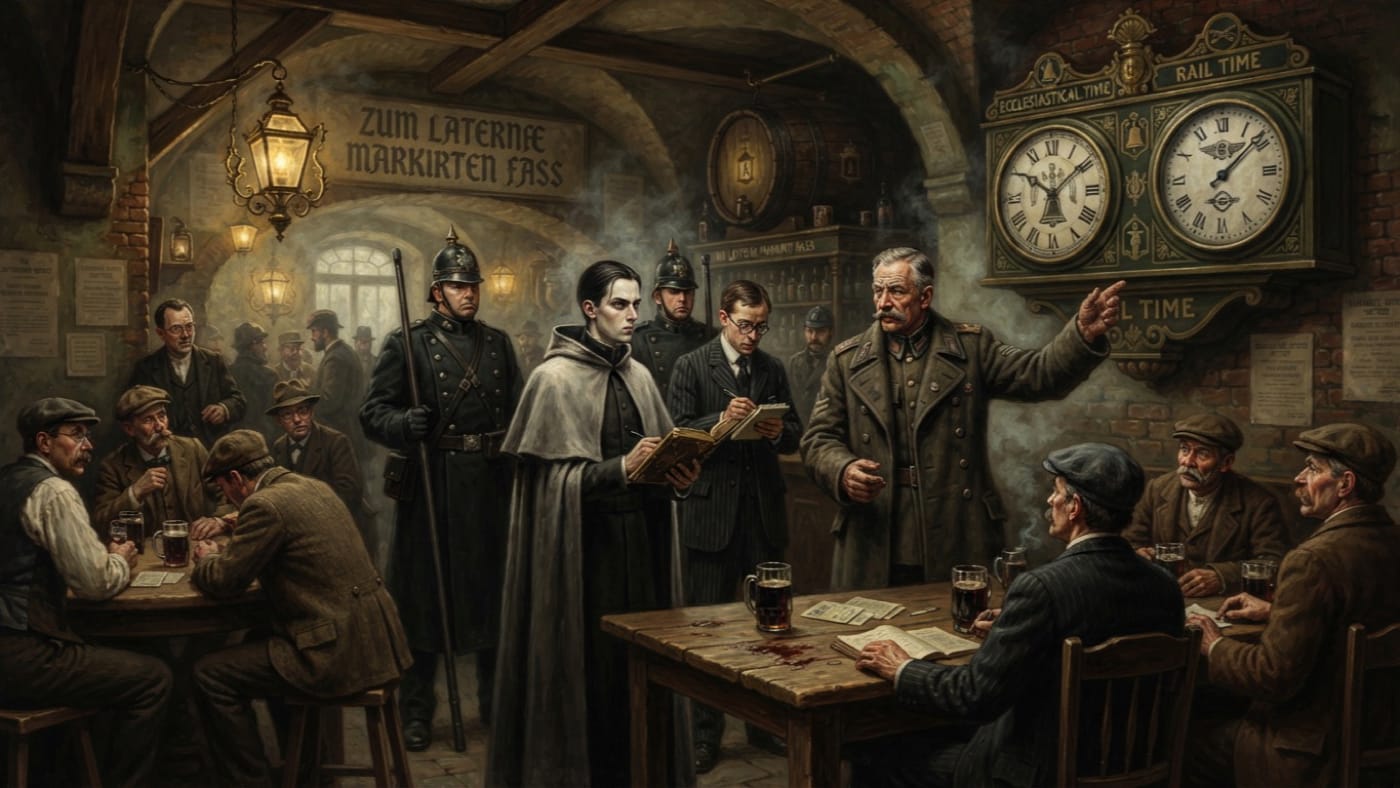
The Lantern-Marked Cask is a beer-hall in the Old City of Kanzleiburg, near the old parade route. The Ledger knows one thing about it worth sealing. In A.S. 140 (1850 CE), on the first night of the Curfew Standoff, a retired major at one of its tables asked the Bureau of Purity a question about clocks. The Bureau has spent sixty-one years not answering it.
Beyond that, the record says little. It names no founder and gives no founding year. It names no proprietor, offers no floor plan and lists no benches. Nor does it explain the lantern in the name, which the Old City has doubtless understood for generations and never troubled to file. Kanzleiburg was Berlin until A.S. 95, when the Prussian state was absorbed and the city received its Synodal name. That is a date for the city, and I decline to lend it to the hall. In the north it is common for a beer-hall to be older than its paperwork. It is rarer for one to outlast Purity's paperwork, and the Cask is one of three that did.
The other two are the Hall of the Iron Stag and the House of Eighteen Steps. Purity visited all three on the same night. Each was read the curfew, and each answered with a question. The Cask's was the most dangerous of the three, because it was the only one aimed at the bell itself.
#On the Old City's Tables
Southern visitors arrive in Kanzleiburg expecting a fortress and find a chancellery with a garrison attached. The city is the seat of the Northern Hierarchate and the administrative brain of the northern theatre. It is also the rail junction where Hamburg's cargo becomes Warsaw's problem and, a few spurs later, the forward problem of Bastion-Königsberg and Bastion-Brest. A city like that runs on schedules. Its clerks count wagons, its officers count men and its priests count bells, and all three drink in the Old City.
The Old City halls serve as its assembly rooms, informal courts, veterans' meeting places, hiring offices and condolence houses. Complaints travel through them faster than any Bureau circular, and with better grammar. The surrounding lanes hold retired officers, shopkeepers, tradespeople, parish widows, brewer families, civil clerks and garrison tailors. These people have filed forms, stood inspections and buried colleagues. They treat a government notice as something to read closely and then dispute at length.
That is the district. The Cask belongs to it as a pew belongs to a parish: one seat among many, unremarkable until somebody stands up in it.
#On Ninth Bell
Purity's curfew divided the night in two. Service stopped at ninth bell, and common-room assembly stopped at tenth. That left one bell's interval in which a citizen could sit lawfully in a hall with an empty mug and contemplate sin without ordering more of it. Unlicensed song was forbidden at every hour. Refusing inspection invited closure, and refusing twice invited seizure.
The patrol that entered the Cask was the one that entered the other two halls. A Purity patrol came accompanied by a clerk of the Bureau of Records, two municipal watchmen and a young Inquisitor in a white mantle. The notice was read aloud. Then a retired major asked whether ninth bell had been audited against ecclesiastical time or rail time.
Consider what he had done. Purity's whole instrument rested on a single moment. Before ninth bell a mug of beer was commerce, and after it the same mug was a fine. The Bureau of Bells had governed peals since its constitution in A.S. 52, and the Bell Codex had been ratified in A.S. 115, twenty-five years before the patrol arrived. The Church's hours were fixed in law. Kanzleiburg's other hours were fixed by the timetable. In a junction city the Warsaw train does not wait for the clapper, and officers in that room had spent careers dispatching men and freight by the railway's minute. The major asked which minute was the sinful one.
He did not claim the two clocks disagreed. The record contains no measured discrepancy, no completed audit and no finding that either standard prevailed. It records no answer from the inspector at all. The question did not need one. A fine issued at a disputed minute has to be defended before someone, and in Kanzleiburg that someone tends to keep rail time.
The neighbouring halls produced the same kind of question in different plumage. At the Iron Stag, the owner asked what fire-safety authority permitted forcing a crowded room shut. At the House of Eighteen Steps, a brewer's widow asked whether unfinished beer would be compensated under the seizure clause or the spoilage clause. None of the three questions was rude. All three were competent, which was worse.
The night's register covers the whole patrol. It shows three doors inspected, seventeen fines issued, no tables cleared, two songs interrupted and two resumed. It does not divide those figures among the halls, and I will not divide them for it. No blows were struck.
A later Purity catechetical appendix described the first night as "minor compliance friction."
Corrected. At the Lantern-Marked Cask, the friction was a question about which clock governs sin. Purity has not answered it. Friction left unanswered for sixty-one years is a standing objection.
#On Obedience and Suspension
The hall owners met before dawn. The record does not say where, who spoke first or who lettered the placard, so the Cask gets no credit for a leadership it may never have exercised. What the record does say is enough. By noon every hall in the Old City had closed voluntarily, the Cask among them, and each displayed the same words: CLOSED IN OBEDIENCE TO PURITY.
Purity had asked for quiet after ninth bell. The Old City delivered quiet from midday, unrequested, in perfect compliance and at full scale. A Bureau can fine a man for selling beer at the wrong minute. It has no clause for a man who declines to sell beer at all.
That evening the officers of the Garrison Quarter found the halls shut. On the second day they petitioned the Archon, citing morale, readiness, informal dispute resolution and veteran welfare, among other practical concerns. The petitioners were the very men the major's question had described. They ran a city by timetable, and they had been told their evenings now belonged to a bell nobody had asked them to audit.
On the third day the Archon of the time, whom the file records only by office, suspended enforcement pending an operational review. Inspection authority was preserved in principle and enforcement deferred in practice. Existing fines were held in abeyance and never collected. By dusk the halls had reopened, the Cask with them.
The Cask received no exemption, and the major received no ruling. The curfew survived on paper, set aside under a review that has not, to my knowledge, been scheduled. Purity filed no later report on the affair. Records classified it as municipal coordination, a label that has buried better scandals than this one.
#On the Anniversary
As of A.S. 201, the Old City halls mark the second day of the standoff by closing from noon until ninth bell and displaying the same placard. The Ledger does not record the calendar date, and the halls have never asked it to. Officers arrive at ninth bell and order the first round in silence. The toast that follows is never printed. I will not print it either, since the Bureau of Records would only classify it.
Purity ignores the observance, and it has never answered the major. Records files both silences under municipal coordination, which is where the Synod keeps defeats it intends to outlive.