
#On the House and Its Name
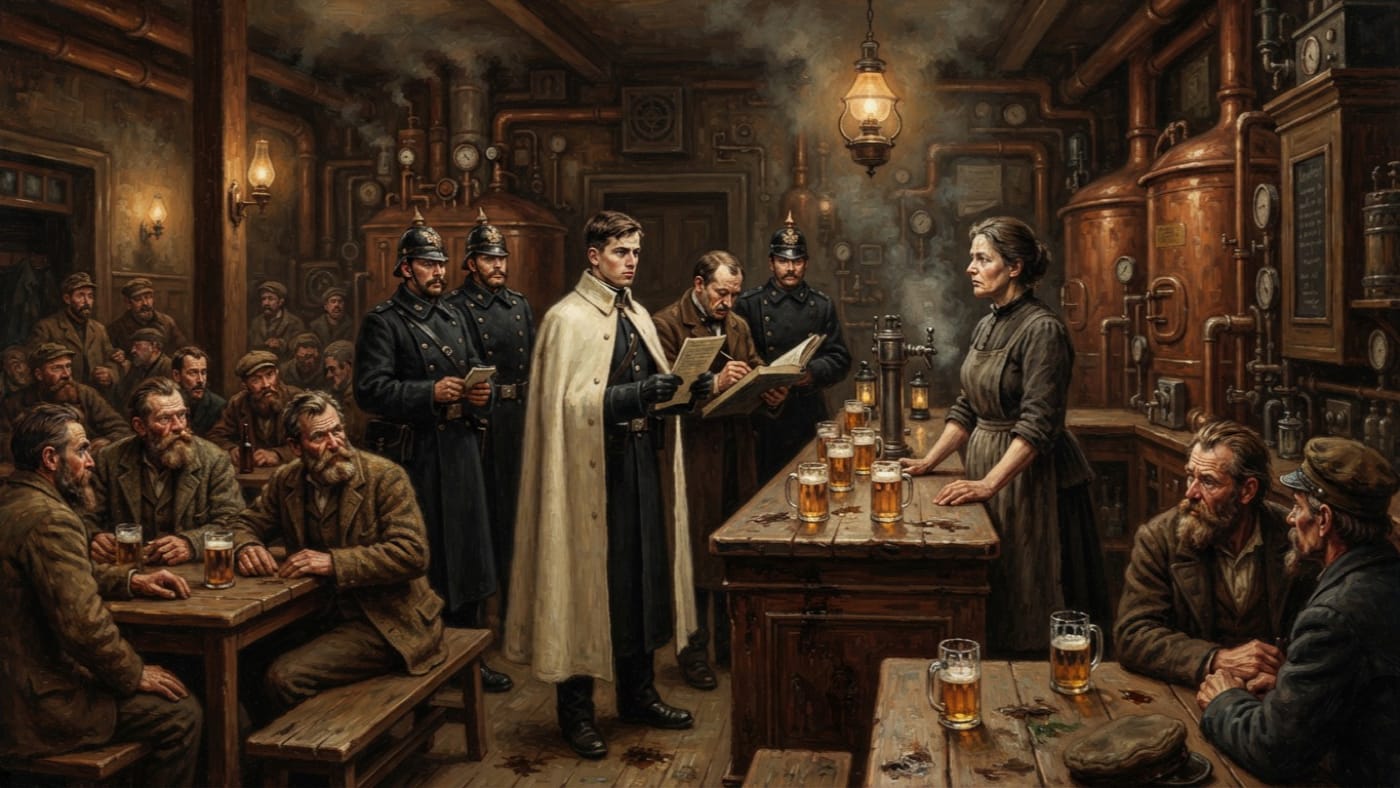
The House of Eighteen Steps keeps its tables in the Old City of Kanzleiburg, near the old parade route. Its lanes were pouring beer long before the Synod renamed Berlin in A.S. 95 and installed a chancellery to frown at them. The Ledger holds the House for a single night. In A.S. 140 / 1850 CE, on the first night of the Curfew Standoff, a patrol of the Bureau of Purity came in to read a curfew aloud, and the brewer's widow at the hall asked it a question about unfinished beer. Everything the Codex certifies about the House radiates from that question, as everything in a parish radiates from its font.
The Bureau of Records has never forgiven the name. A clerk can enter the Iron Stag without distress: one beast, one metal, one line of the register. Eighteen Steps is a number wearing a sign, and Records believes every number in the north is its own issue. It has no form for a quantity nobody submitted. The Ledger does not say what the steps are, where they lead, or who counted them, and I decline to count them on the reader's behalf. Vain men explain names. Wardens leave the uncertified uncertified, and I am vain only in matters of prose.
#On the Common Tables
An Old City beer-hall is a parish that never asked for a priest. The district's halls serve as assembly rooms, informal courts, veterans' meeting places, hiring offices and condolence houses, and as the mill where complaints go in coarse and come out fit for circulation. Their benches hold retired officers and shopkeepers, tradesmen and parish widows, brewer families, civil clerks, and the garrison tailors who know the inseam of every colonel in the city. The Ledger does not itemise which of these offices the House of Eighteen Steps kept on which night, and I will not furnish it with a hiring board it may never have hung. It belonged to the district, and the district kept all of them.
The officers come from elsewhere. The Garrison Quarter is a separate district with its own streets, and its men cross into the Old City for what their mess cannot hold. Kanzleiburg is the seat of the Northern Hierarchate. Its officers and clerks spend their days on the arithmetic of trains: cargo along the Northern Corridor, reserve schedules for Bastion-Königsberg, priority quarrels over Bastion-Brest. A dispatch room produces orders. It produces no reconciliations. Two majors who have spent the day contradicting each other in triplicate need somewhere to stop, and the Church has consecrated no room for the purpose. The Old City built several and put taps in them.
#On the Widow's Question
On the first night the patrol entered three halls near the old parade route. It brought a Records clerk, two municipal watchmen and a young Inquisitor whose bone-white mantle had never yet met soup. At each hall the curfew was read aloud. Readers who know the curfew only from tavern retellings believe it emptied the rooms at ninth bell. The notice was more careful than its reputation.
Ninth bell stopped the pouring. Tenth bell stopped the sitting. Between them lay an hour in which a hall could lawfully hold citizens and beer together, provided nobody added to the beer. The notice did not say what became of a mug drawn before ninth bell and still half full at tenth. Purity had drafted against song, assembly and refusal. It had not drafted against foam.
At the House of Eighteen Steps, the brewer's widow asked whether the inspectors intended to compensate unfinished beer under the seizure clause or the spoilage clause.
Observe the construction. She refused nothing. Refusal would have invited closure, and the notice had already set its price for closure. She asked which kind of loss the inspection was about to cause. Under seizure, the beer becomes property taken by the Bureau. Taken property has a taker, the taker must enter it, and a Records clerk was standing in the room with nothing to do but enter things. The notice also reserved seizure for repeat refusal, and nobody at the House had refused even once. Under spoilage, the beer becomes a loss made by order, and an order has an author. Either answer put the Bureau of Purity's name on a half-pint.
The Inquisitor had come to regulate an assembly. The widow handed him an invoice for interrupting a room's business. An invoice is a dangerous thing to give a Bureau that burns paper, because burning one produces a second document, the report of the burning.
The inspectors' answer is not recorded, and I will not write it for them. Purity has clerks enough. No compensation schedule survives. The Ledger knows of no claim filed, and nothing shows that a single mug at the House was seized. The question settled no entitlement. It proved only that the patrol had never costed its own order.
The neighbouring halls asked questions of their own. At the Hall of the Iron Stag the proprietor asked for a fire-safety certificate covering the forced closure of a crowded room. At the Lantern-Marked Cask a retired major asked whether ninth bell had been audited against ecclesiastical time or rail time. Both challenged Purity's competence. The widow challenged its accounts, which is worse. Competence is a matter of opinion. Accounts are a matter of record.
#On the Closed House
The hall owners met before dawn. The Ledger does not say where they met. It does not say that the widow sat among them, or that the House hosted anything, and I decline to promote the House for the convenience of this article. The decision was collective. Every hall in the Old City had shuttered by noon, and the account admits no exceptions, so the House shuttered with the rest. Its shutters carried the same placard as every other: CLOSED IN OBEDIENCE TO PURITY.
The beer stopped. So did the meals, the hired rooms, the veterans' tables, the officers' side-door service and the clerks' supper benches. Purity had asked the Old City to stop assembling at night. The Old City stopped assembling at noon, and went on stopping, so thoroughly that no Inquisitor could fault it without admitting the Bureau had never wanted obedience.
By evening the Garrison Quarter had found the shutters. On the second day its officer corps petitioned the Archon. The petition cited morale, officer readiness, informal dispute resolution, veteran welfare and domestic order, and asked for "the prevention of unscheduled sobriety among command personnel." The officers wrote it. No hall signed it, and the House did not author it, however neatly it answers the widow's question. On the third day the Archonate Isle suspended enforcement. The halls were open by dusk. Nobody in the district had struck a blow.
Credit belongs in separate columns. The owners supplied the closure. The officers turned inconvenience into a petition. The Archon held the routing authority to turn the petition into policy. The widow supplied one question on the first night, and the Codex enters her in her own column and nowhere else.
#On the Clause That Remained
The fines were never collected, and the inspection authority was never revoked. A suspension "pending operational review" names no date for the review. The clause the patrol read aloud at the House in A.S. 140 has therefore been pending ever since, like a corpse kept on its bier because nobody will sign for the burial. The halls enjoy a practical freedom from Purity's night patrols, but they hold no enacted exemption. An Inquisitor with a fresh writ and a short memory could still walk in at tenth bell and read the old notice aloud. Purity has not done so. That is a habit, and the people who keep a habit can also drop it.
No later Purity report on the standoff has been found. A missing file proves only that Records has not handed one to me.
Do not mistake this local retreat for tameness. The Bureau that left the Old City's beer alone went on raiding kitchens, sniffing candle-wax and fining recipes in other rooms. It retreated from one category of room and gave no other ground.
Certain oral retellings hold that the Bureau of Purity apologised to the Old City halls.
Withdrawn. Purity apologised to nobody: the halls, the widow and the beer all went without. The Archonate thanked the Bureau for its vigilance and let it stop. The Ledger knows of no apology from Purity, at any table, in any year.
#On the Anniversary
As of A.S. 201 / 1911 CE, sixty-one years on, the Old City halls close on the second day of the anniversary from noon until ninth bell. Their placards carry the old wording: CLOSED IN OBEDIENCE TO PURITY. The Bureau of Purity ignores them. The Northern Hierarchate treats the closure as a traffic variation. At ninth bell the garrison officers cross from their own quarter, take their tables and order the first round in silence.
The custom is recorded for the district, and the House belongs to the district. I certify nothing narrower. The Ledger does not say who keeps the House now, whether the brewer's widow's family still draws its beer, or which of its fixtures saw the Inquisitor's mantle. The Archon of A.S. 201 holds the office. The Archon who read the petition in A.S. 140 is filed separately.
Under the curfew, ninth bell was the hour service stopped. On the anniversary it is the hour service resumes. Nobody in the Old City has drafted a clause to explain this, and nobody has asked for one.