
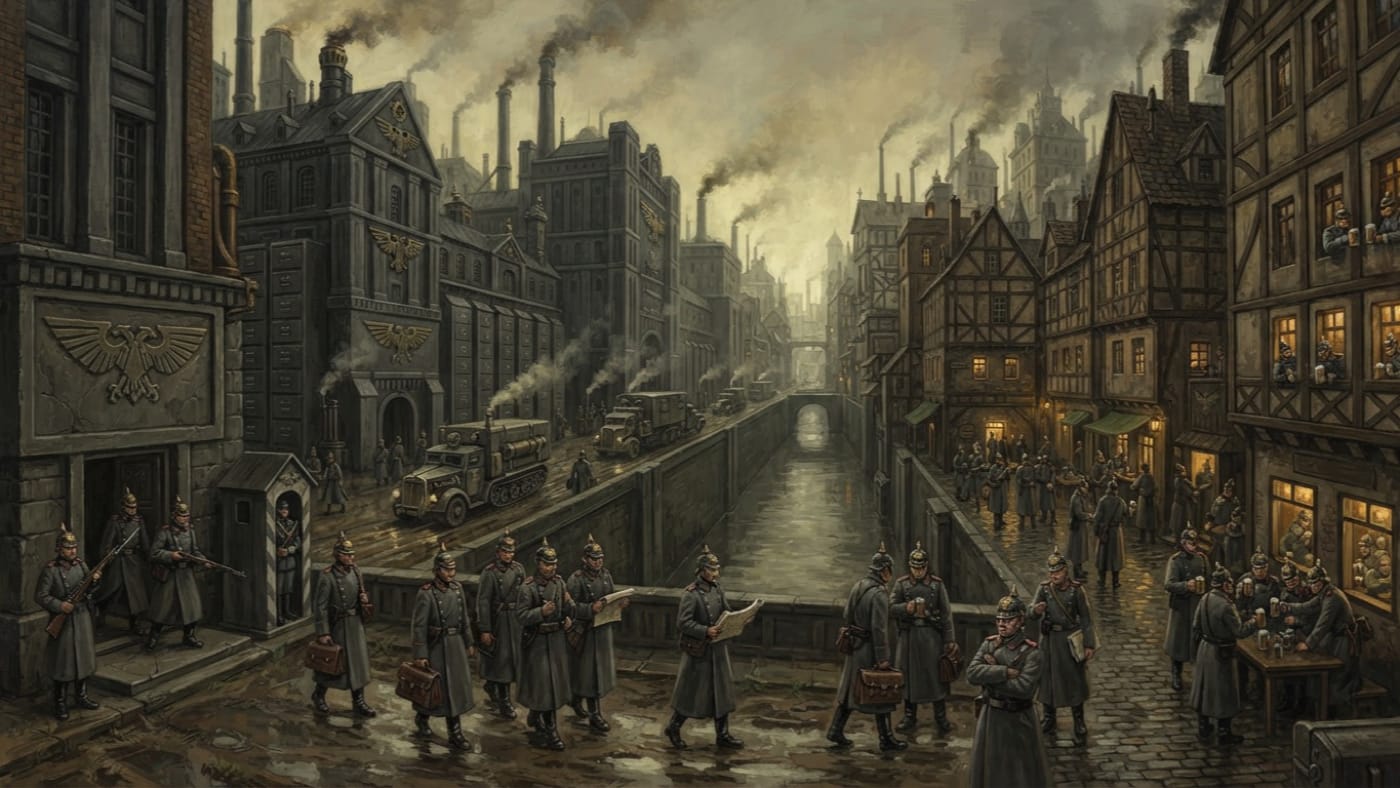
#On the Quarter's Station
The Garrison Quarter is the part of Kanzleiburg where the north keeps its officers between orders. Kanzleiburg was Berlin until A.S. 95 / 1805 CE. In that year the Prussian state was absorbed under Synodal military command, and the city was given a name that sounds like a filing cabinet with a moat. The year belongs to the city's settlement. Records has not produced the year the Quarter was laid out, named or first quarrelled over, and I will not invent one for readers who like their districts born on a feast day.
Its function can be stated. Kanzleiburg sits in Zone 2, inside the safe western heartland. It is the seat of the Northern Hierarchate and the administrative brain of the northern theater. Cargo comes off the North Sea at Hamburg, runs the line to Kanzleiburg, passes the reserve boards, and goes on to Warsaw and the forward spurs toward Bastion-Königsberg on the Baltic and Bastion-Brest on the Bug. The Northern Corridor depends at every junction on men who can read a timetable, countersign a requisition, and decide which colonel's freight crosses a bridge first. Those men live, work and sulk in the Garrison Quarter.
The Prussian tradition survived absorption the way a good regimental coat survives a change of buttons. The Synod took the oath. It kept the tailoring.
#On Command and Daily Business
The Quarter conducts the business of the Bureau of War at desk height. Its working furniture is the dispatch room, the mess table, the regimental club and the barracks. The dispatch rooms receive the north's paper and send it back with more paper pinned to it. The mess tables feed officers by the bell. The clubs supply chairs, newspapers, rank-appropriate silence and, under duress, coffee. The barracks hold junior personnel, and senior personnel prefer not to be seen drinking there.
On paper, discipline in the Quarter is excellent. In practice it covers less than the paper claims. Regulation can send a lieutenant to a post and a captain to a court-martial. It has no instrument for settling a debt between two majors, for quietly reconciling commanders who loathe each other, or for the conversation a colonel must have out of earshot of the subalterns whose careers it decides. A disciplined army produces these problems every day, as reliably as it produces boots and grievances. Its own premises have nowhere to put them.
So the Quarter sends them out to be settled somewhere else, as it sends out its laundry.
#On the Tables Beyond the Quarter
The beer-halls the officers frequent stand in the Old City, and they always have. The Quarter and the Old City are separate districts with separate inhabitants. The Old City's retired officers, brewer families, civil clerks and garrison tailors belong to the Old City's account, whatever their trades suggest. A tailor who measures colonels is still a tailor of the Old City. He has the colonels' inseams. He does not have their district.
What the Quarter holds in the Old City is custom. Officers walk out of their own streets and into the halls for meals, hired rooms, veterans' tables, and a side-door service kept for men whose uniforms make the front room awkward. The hall table does work no regiment admits to having handed off. It hears pension disputes and arranges hiring. It receives condolences when a name comes back down the corridor in the wrong column. It seats veterans who now outrank nobody and remember everybody. A complaint that would take three weeks through a Bureau takes one evening and a round, and the round is cheaper.
The clerks have their supper benches. The officers have their side door. Between the two, wet-ringed and unminuted, passes a fair share of the north's informal administration.
The categories are where the trouble began. Purity filed the halls as taverns. The officers treated them as annexes of command. The Archon, going by what he later did, counted them as part of the city's governing machinery. The Quarter fought its one celebrated campaign over that difference.
#On the Petition of A.S. 140
The full engagement is recorded in the Curfew Standoff of A.S. 140: the patrol, the questions asked at the halls, the owners' meeting before dawn. I give here only the Quarter's part. It is shorter and more dignified, because it was conducted in ink.
In A.S. 140 / 1850 CE the Bureau of Purity imposed a night-assembly curfew on the Old City. The halls answered by obeying it completely and shut by noon. Beer, meals, hired rooms, veterans' tables, officers' side-door service and clerks' supper benches all stopped at once.
By the first evening the Garrison Quarter understood. Officers walked to their usual tables and found placards instead.
On the second day the damage reached the Quarter's own furniture. Dispatch rooms grew sharp. Mess tables filled early and emptied badly. The regimental clubs fell back on coffee. Command personnel who would normally have settled their differences over a stein had to settle them sober, at desks, in front of witnesses. No regulation forbade this. It was simply intolerable.
That same day the officer corps petitioned the Archon. Its grounds were morale, readiness, informal dispute resolution, veteran welfare and domestic order. Among them sat the phrase the Quarter will be remembered for after its parade grounds have become potato fields: "the prevention of unscheduled sobriety among command personnel." The excerpt that survives at Records adds informal command reconciliation, debt settlement, discussions held away from junior personnel, and the risk of unauthorised private drinking in barracks. Parts of it remain blacked out, and I leave them that way. No copy I have been shown lists the signatories. I will not invent colonels to sign it.
Admire the craft. The officers presented inconvenience as readiness, and a shut beer-hall became an operational deficiency. Men who could not get a drink reported, accurately, that the north could not be commanded properly without one.
On the third day the Archonate suspended the Old City night-assembly restriction pending operational review. By dusk the halls were open again.
#On Jurisdiction and Useful Obedience
The suspension notice rewards a lawyer and disappoints a romantic. Existing fines were held in abeyance. Inspection authority was preserved in principle. Enforcement was deferred. Nothing was abolished. No clause exempted the Quarter, or anyone else, from Purity's attention. The curfew applied to the Old City, and so did its suspension. Any officer who reads it as regimental immunity is welcome to test the theory in his own barracks some evening, after first giving Records the name of his next of kin.
Four parties acted, and each stayed within its office. Purity issued a lawful order. The proprietors obeyed it so thoroughly that their obedience was an accusation. The officer corps had no jurisdiction over a single Old City hall, so it used the one instrument every subordinate body keeps: a petition, sent upward through proper channels. The Archon used his routing authority to move the problem off the street and into review. Matters placed in review stay there indefinitely, like relics in a side chapel, venerated and never consulted.
No blows were struck. The fines were never collected. No later Purity report has been found.
Certain oral retellings hold that the Bureau of Purity apologised.
False. Purity issued no apology. It stopped and filed nothing. An apology would have needed a document, and the Bureau of Purity has been careful never to produce one.
#On the Present Observance
As of A.S. 201, sixty-one years after the petition, the Old City halls close on the anniversary's second day from noon until ninth bell. Their placards read CLOSED IN OBEDIENCE TO PURITY. The record notes nothing the Quarter does during those hours, and I suspect it does very little well. At ninth bell its officers cross into the Old City, take their tables and order the first round in silence.
None of them was alive in A.S. 140. Each of them believes the custom belongs to him personally. This is how regiments inherit things.
The first toast is not printed. I asked for it. I was given a stein, which I took as the Quarter's whole reply, and a correct one.