
#On the Hall and the Old City
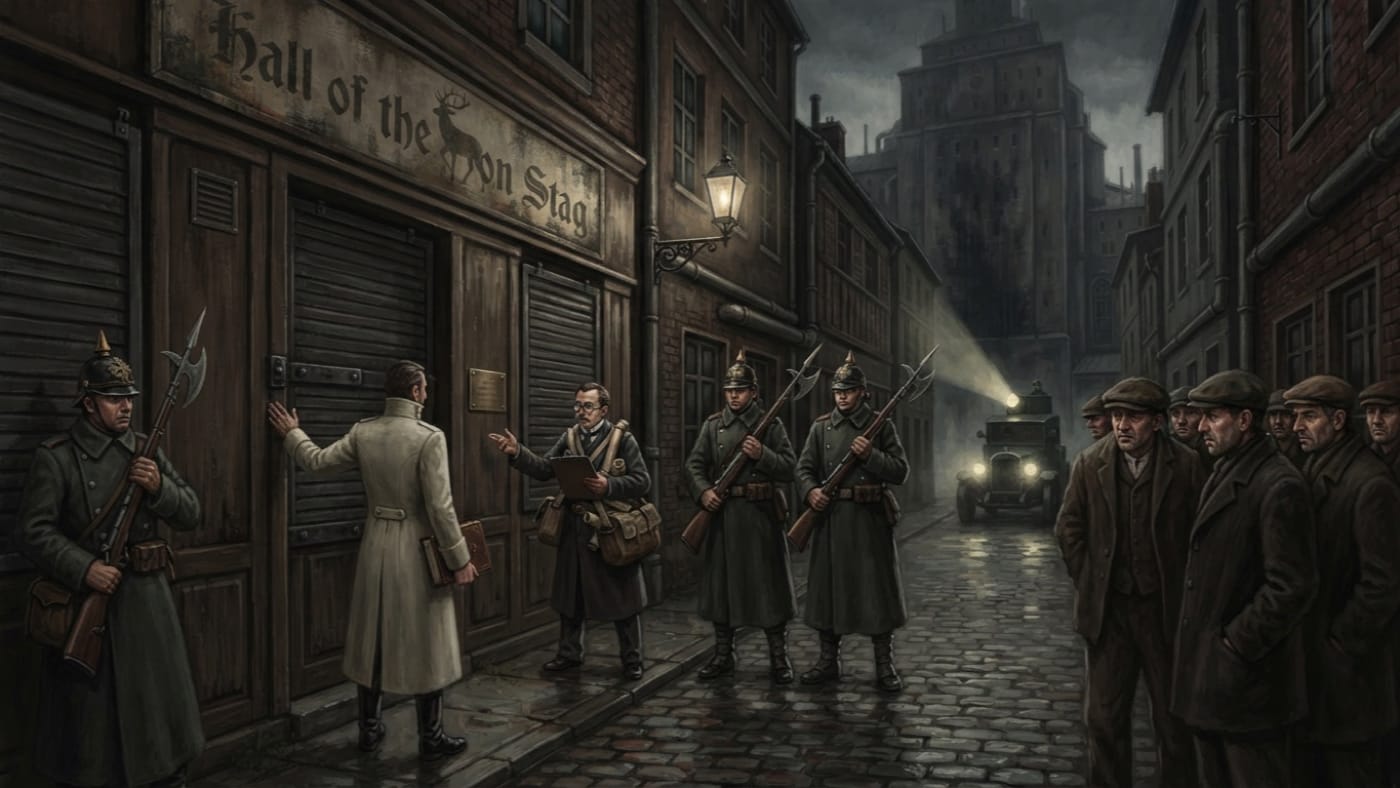
The Hall of the Iron Stag keeps its tables in the Old City of Kanzleiburg, near the old parade route, in lanes that were drinking long before the Synod renamed Berlin in A.S. 95 and gave the city a chancellery to disapprove of them. The Ledger does not record when the hall was raised, by whom, or why its stag was made of iron. I have searched. Records has searched. Records also claims to have searched, which in Kanzleiburg is a separate procedure on its own form.
The Ledger holds a single night. In A.S. 140, during the first enforcement of the Bureau of Purity's Old City curfew, the hall held two hundred and twelve drinking citizens. Its proprietor asked whether Purity possessed a fire-safety certificate for the forced closure of the room. That one exact number and that one impertinent question are the hall's whole claim to fame. Most cathedrals have done worse with more masonry.
The proprietor's name has not survived in any file I am permitted to open, and I will not invent one for the satisfaction of readers who prefer their heroes labelled. The Old City remembers the question. Being remembered for a question rather than a face is the better bargain.
#On the Common Tables
An Old City beer-hall is an office without a seal. The halls of the district serve as assembly rooms, informal courts, veterans' meeting places, hiring offices and condolence houses, and they are where complaints go to be circulated and improved. Retired officers sit there with brewer families. Municipal clerks share benches with shopkeepers and tradesmen. Parish widows come to settle what the parish would not, and garrison tailors arrive to collect debts that regiments prefer not to minute.
Whatever the Iron Stag's particular rooms looked like, it was one of these halls. The curfew of A.S. 140 treated it as one, and in Kanzleiburg classification by Purity is binding evidence.
The serving officers who drink in the Old City do not live there. They come from the Garrison Quarter, which is a different district with different drains, and they cross into the Old City because a hall table lets a major and a quartermaster's clerk disagree without either having to file the disagreement. The Northern Hierarchate governs rail priority, reserve depots and garrison supply from its offices on Archonate Isle. A good portion of that governance is first drafted on a beer-ring by men who spend their days routing trains toward Bastion-Königsberg and Bastion-Brest, and who would be ashamed to put a half-formed opinion on headed paper.
The arrangement suits everyone it suits. Purity does not appear on the list.
#On the Inspection of A.S. 140
The Bureau of Purity's order for the Old City was ordinary in form and unusual in ambition. It reached into the halls' hours and the halls' rooms, and it drew a distinction that later retellings usually lose:
Drink stopped at ninth bell, and the gathering itself had to end by tenth. The extra hour was meant as mercy, or possibly as an hour in which sober men could be counted. Purity's mercies tend to come with a census.
On the first night a Purity patrol visited three halls near the old parade route. A clerk of the Bureau of Records, two municipal watchmen and a young Inquisitor in a white mantle went with it. None of them is named in any surviving account. At the Hall of the Iron Stag the order was read aloud to the room. The proprietor then raised fire safety: if Purity meant to close by force a room containing two hundred and twelve drinking citizens, where was its certificate?
The question proves nothing about any certificate. It does not show that one existed, that the law required one, or that the patrol later produced one. What it did was move the argument out of Purity's jurisdiction over sin and into the district's jurisdiction over doors, stairs, crowds and anyone killed in a crush. The Inquisitor was ready to discuss vice. He had not come prepared to discuss egress.
No blows were struck. The Iron Stag had witnesses, a headcount and an argument made in procedural form, and none of these can be arrested.
Several later guides to the Old City give the Hall of the Iron Stag a licensed capacity of two hundred and twelve.
Corrected. Two hundred and twelve is the number of citizens present on one night in A.S. 140. It is not a capacity, a seating plan, a membership roll or a usual attendance. The guides took a single headcount and treated it as the building's licence.
#On the Closed Shutters
The hall owners met before dawn. The Ledger does not record where, and I will not award the meeting to the Iron Stag only because this article happens to be about it. The decision was collective. Every hall in the Old City had shuttered by noon, the Iron Stag among them. All of them posted the same placard: CLOSED IN OBEDIENCE TO PURITY.
Across the district this stopped beer and meals. It also stopped hired rooms, veterans' tables, the officers' side-door service and the clerks' supper benches. When the Garrison Quarter came to the Old City that evening it found locked shutters and perfect compliance with the curfew, and there was nobody available to blame except the Bureau that had asked for it.
On the second day the officer corps of the Garrison Quarter sent a formal petition to the Archon of Kanzleiburg. It argued from morale, readiness, veteran welfare and informal dispute resolution. Its best line is the phrase "unscheduled sobriety among command personnel." Other parts of the petition are still withheld, and they will stay withheld here, because a Hieromnemon who publishes a sealed excerpt to finish a joke has misunderstood both the seal and the joke.
On the third day the Archon suspended enforcement, and the halls reopened by dusk. The full three-day account is filed under the Curfew Standoff of A.S. 140. A beer-hall's article should not try to hold an entire civic crisis, any more than its cellar should try to hold the river.
#On Authority Retained
The settlement is often described carelessly, and in Kanzleiburg careless description eventually turns into law.
The fines were never collected. No review date was ever set. The notice gave the Bureau of Purity neither an apology nor a defeat. It thanked Purity for its vigilance and then withdrew the means of exercising it, which is how an Archon tells a Bureau to sit down. The Bureau of Records filed the whole affair under municipal coordination. A filing category of that kind is how the dead are labelled when nobody wants to admit to a death.
I have called this the only known retreat of Purity from a beer-hall, and I hold to that wording. It records what the files show. It does not claim that Purity has never been defeated anywhere else. Purity has other files, and some of them are locked away from me as well.
The Hall of the Iron Stag, with the other Old City halls, holds a permanent statutory exemption from Bureau of Purity inspection.
Corrected. No exemption was granted. Inspection authority survives in principle and enforcement stays suspended in practice, pending a review that nobody has scheduled. A suspension is a different instrument from a statute, and the clause is still there in the text.
The Old City's immunity was never declared. It is maintained by habit, and in Kanzleiburg habit is the more durable instrument. Purity keeps its clause and keeps its distance.
#On the Anniversary
As of A.S. 201, sixty-one years after the first night, the Old City halls still close on the second day of the anniversary from noon until ninth bell. The placard is the same one: CLOSED IN OBEDIENCE TO PURITY. Visitors from Hamburg laugh at it. The district does not, because laughing would suggest the joke is over.
I cannot certify that the Iron Stag's present proprietor descends from the man who asked for a certificate, or that its benches, stag or masonry are the ones that held two hundred and twelve people in A.S. 140. Ownership changes. Benches rot. The observance is the only part of the hall that the Ledger can confirm has survived.
The Northern Hierarchate files the closure as a traffic variation. The Archonate Isle makes no comment, and the A.S. 201 holder of the office has no obligation to remember the decisions of the A.S. 140 holder. The Bureau of Purity passes the shutters and ignores them.
The garrison officers arrive at ninth bell. None of them were alive in A.S. 140, and they believe themselves original anyway. They order the first round in silence.