
#On the Second-Bell Feed
On the nineteenth day of Ashmonth, A.S. 74 (1784 CE), during second-bell feed, Kiln Three of the Chrismole Crown at Brast suffered a pressure reversal. Nine men died. That is the whole incident, and I put it first because every office in Brast has since found its own reason to tell the story in a different order.
Ashmonth has no sanctioned equivalent in the secular calendar, and I will not invent one for the convenience of almanac-makers. "Second bell" gives no hour either. It names a stage of the work: the feed that follows first-bell anointing, when the kilns take their charge and pressure is meant to climb. The bells told the feeders what to do. They did not tell the clerks what time it was, and no clerk afterwards was honest enough to guess.
Brast was young then. The works had been requisitioned at a coal-seam rail junction in A.S. 68 and had been producing chrismole since A.S. 72, which made the furnaces about two years old in the trade when one of them did this. The year-count is itself retrospective. The Synod adopted it at its A.S. 90 settlement and applied it backwards to everything, including nine men who never heard the term.
This entry concerns the event. The furnace survives, warm and argued over, and is surveyed under Kiln Three. The cult that grew up at its bent mouth is filed under Saint-Combust. Readers who confuse the event, the furnace and the cult will be corrected by the Chapterhouse, which confuses them on purpose.
#On the Plate That Failed Inward
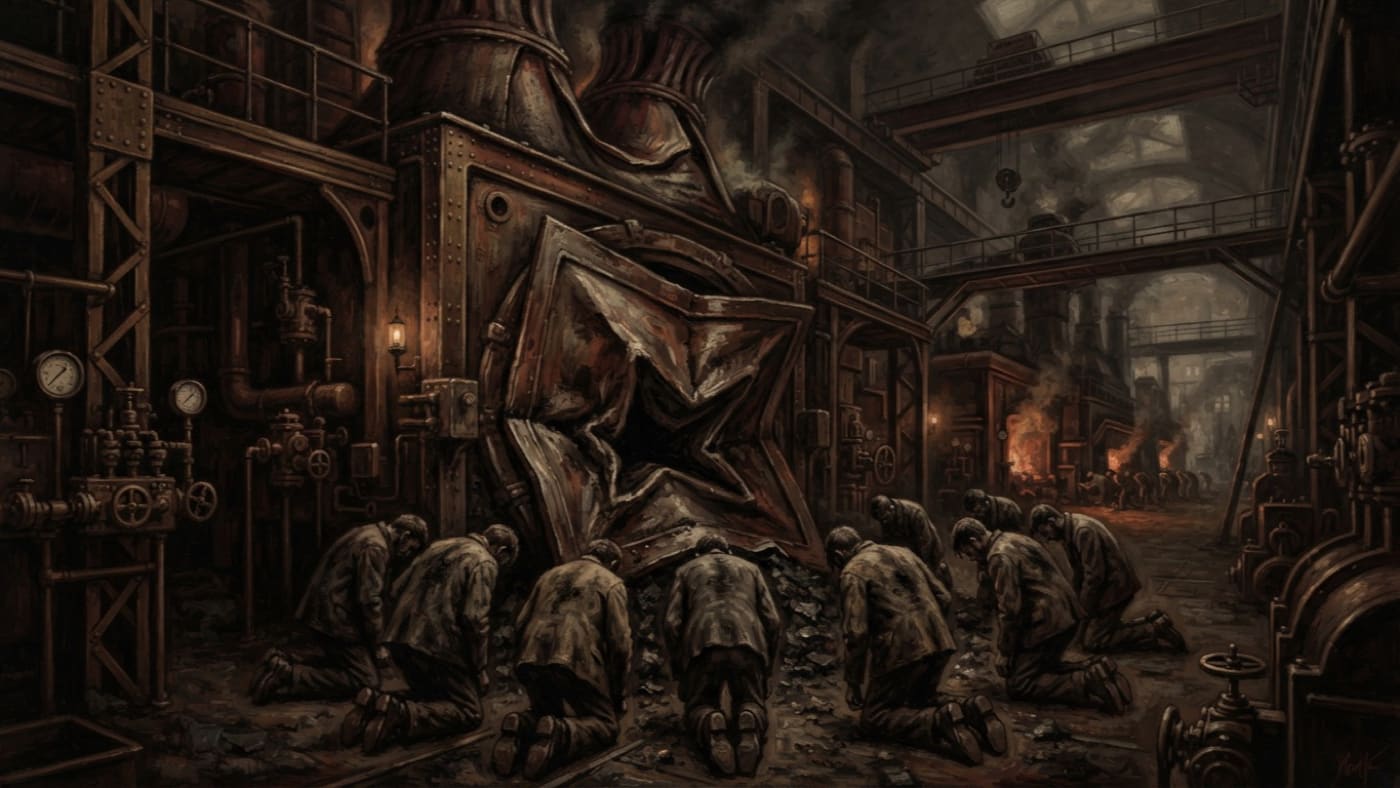
A failing furnace is expected to fail outward. Fire presses against its iron, and when the iron gives way the whole yard knows it, because the fire comes out to meet them. Kiln Three did the opposite. Its front plate blew inward, toward the firebox, and the lips of the mouth folded back into the throat. The crown flues above it sounded. Every surviving account agrees about that sound, and each one disagrees about what it wished the sound had meant.
No account open to me records a pressure reading. None names a failed fitting. None blames a feeder, and in Brast that last omission is the rarest detail of all.
The nine were recovered from the soot. Witnesses described them kneeling, bowed, with their hands drawn toward the chest. These are the postures of devotion. Heat and blast press a body into the same shapes, as any foundry surgeon could have said. None of them is recorded saying it. The record keeps what the witnesses saw and what they chose to call it, filed together on the same leaf. They are separate entries all the same.
I add nothing to the scene. No last words survive, so I supply none. No rescue is recorded, so I stage none. The file holds nine men, an inward mouth and a sounding flue. The Church has raised a chapterhouse on less. It has raised cathedrals on considerably less than that.
#On the Two Classifications
Two authorities wrote the event down. Neither yet carried the name it now goes by in the histories. The engineering office whose functions later passed to the Bureau of Engineering classified it as an Acoustic-Mechanical Disturbance. The doctrinal authorities whose functions later passed to the Bureau of Doctrine certified the deaths as "consistent with martyrdom" and the furnace as "a vessel of instructive Providence."
The engineering phrase comes first here because it is shorter and cheaper to print. It is acoustic because the flues sounded, mechanical because the plate moved, and a disturbance because nobody would sign a stronger word. It describes the event accurately, in the order the event was heard, and explains none of it.
The doctrinal phrase is the finer instrument. "Consistent with" is the most careful clause a cleric owns: it certifies that nothing contradicts a martyrdom and never asserts that one took place. A vessel is something that can be kept. "Instructive" means the deaths are to be read as a lesson, and somebody must be appointed to read it. "Providence" names an author, and an authored event has no further use for an engineer.
Both filings survive. Engineering's has the diagrams and Doctrine's has the seal. Neither settles whether the Creator had any hand in the reversal, and neither was drafted to settle it. One office was classifying a defect and the other was classifying a death. They wrote in the same soot and agreed on the count.
The Bureau of Engineering named the event an Acoustic-Mechanical Disturbance. The Bureau of Doctrine named it useful.
Corrected for chronology. Neither Bureau existed under that name in A.S. 74. The classifications belong to the engineering office and the doctrinal authorities whose functions those Bureaus later inherited. The second sentence is withdrawn as a summary of the record. This house retains it as an opinion.
#On the Shell Retained
The ruined furnace was kept. It was plated, anointed and fenced, and it was called Saint-Combust. The name went to the installation. The Brast record holds no human Saint Combust and no tenth victim raised above the other nine. A pilgrim who goes looking for the saint's bones will find iron and a railing, and he will not be allowed past the railing.
The order of these acts is supported, and the intervals between them are not. No account gives the day the plates were bolted over the old shell, the day oil first went onto them, the day the railings were finished or the day the furnace was next fed. I give the sequence and decline to supply the calendar. Brast has enough forged dates without my help.
Keeping the shell kept more than the iron. A scrapped furnace leaves nothing behind but an entry in the loss column. A furnace that stands, fenced and named, is a document anyone can read from across the yard, and what it records is a precedent: a machine that has killed may be certified instead of condemned, and attended instead of explained. Whoever holds the railing holds the precedent along with it.
Before the bent mouth, after the deaths and before any vow, the first soot-vigil was kept. The Furnace Chapterhouse dates its unbroken continuity from that vigil. This is a claim of descent, and it is made by the descendant. I record it as the Chapterhouse's claim. No rival has ever come to the railing to dispute it, there being a fence.
#On the Vows and the Settlement
Two later milestones are often mistaken for the date of the explosion. I strike both from that office here.
By A.S. 76 (1786 CE), boilerside priests were taking vows at the railing of Kiln Three. By the same year, on the western side of the city, the lung benches by the wall had become a hospice, and the women working there were the order now filed as the Ash-Hospice Sisters. Their record places the hospice after the explosion and after the first soot-vigil. It does not say that any named Sister tended anyone hurt on 19 Ashmonth. It does not say that this one furnace founded the order. Brast kills slowly as well as quickly, and the benches had soot enough to fill them without Kiln Three.
The formal settlement came in A.S. 90 (1800 CE). At its ratification the Concordat of Strasbourg gave the young Synod its constitution and Brast a settled place within it. The Chapterhouse came out of the settlement as custodian of the Crown, and so as keeper of the kiln that had made it. The hospice was recognised after the same ratification, for work already done and long since necessary.
Neither year is the year of the event. The pressure reversal happened once, at second-bell feed on 19 Ashmonth A.S. 74. Every vow, seal and charter that came later draws its authority from that feed and from nothing after it. The later quarrels over the furnace belong to the installation survey and the cult register: the warmth that is said never to fade, the ash that goes into the valve oil, the heretical hymn of A.S. 201. None of them is evidence for the cause of A.S. 74. I refuse them that standing.
The nine have no names in any account open to me. The Chapterhouse keeps their posture, Engineering keeps their diagram, and the Chapterhouse vigil keeps their date. The furnace keeps the mouth they died in front of, folded inward, still in service.