
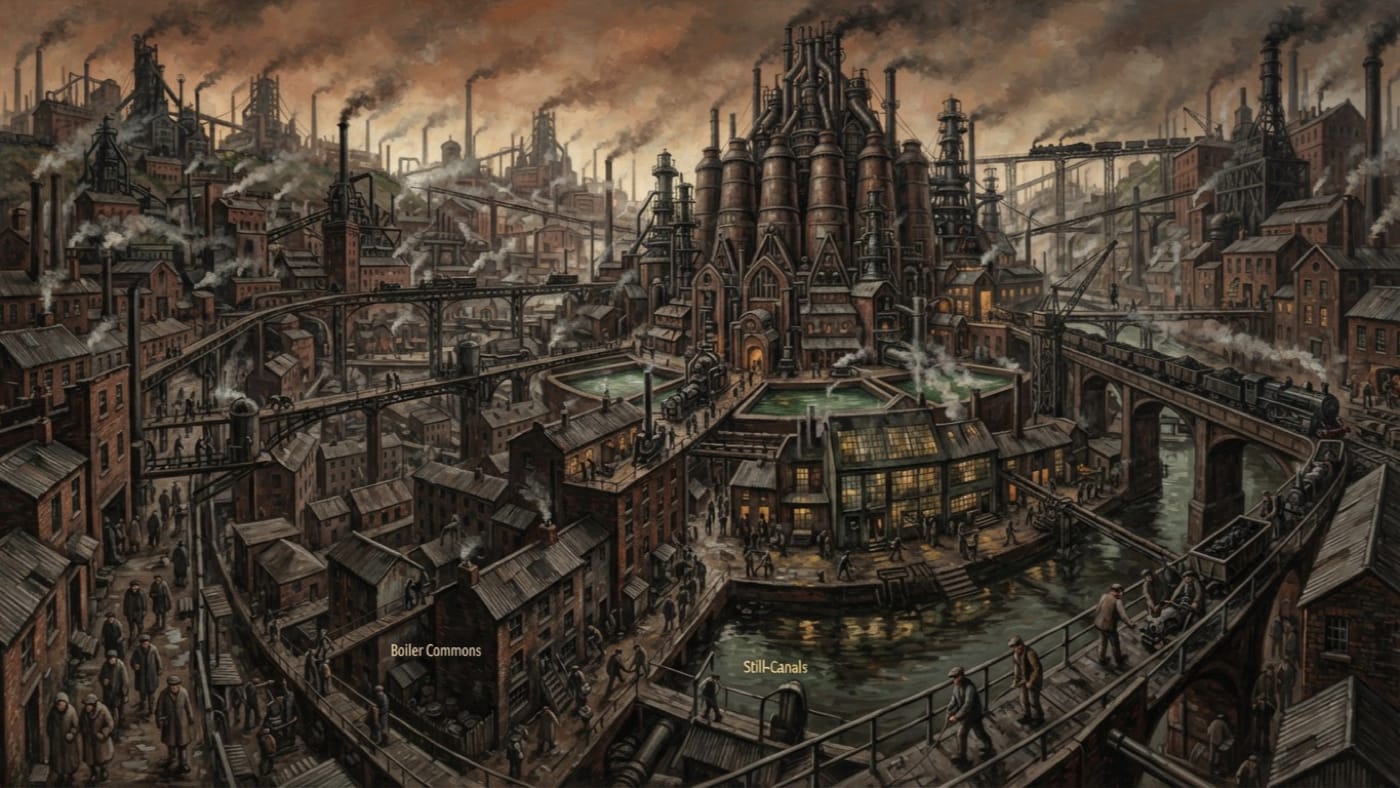
#On the Requisition
Brast was seized before it was built. In A.S. 68, while the Line stood defensible and unfinished, a logistics officer of the office the ledgers now call Ordnance requisitioned a coal-seam rail junction on the Heartlands fringe. His name has been mislaid with admirable thoroughness. The junction had track, a seam, canal water for condensers, and nobody of sufficient rank to object. Furnaces followed. The furnaces made fuel. Cannons burned it and asked no questions, which is the only theology a cannon practises.
The Bureau of Doctrine, as the archive retrospectively styles the authority of that decade, could tolerate useful fire for only so long before it required the fire to be lawful. In A.S. 72 it dispatched one Cantor and fourteen choir-technicians to sing over the stills. From that year Brast's product has been Chrismole. Every report I am permitted to quote calls the distillate chemically unremarkable. Every report I am obliged to sign calls it transfigured. The city grew outward from that first sung batch the way interest grows on a debt: in rings, without pause, and to everyone's eventual surprise.
It holds some ninety-two thousand souls by the present survey, a figure swollen weekly by drafted crews, refugee labour and regiments in rotation, and therefore accurate only on the morning it was stamped. The requisition order calls it Brast Ordnance Works. The Commons calls it the Warm City. Visitors from Strasbourg call it the Soot-Shrine, then ask for a second blanket. Its motto is carved over no gate and repeated at every one of them: Sing it true, or it fails.
#On the Seven Quarters
Follow a drum and you will understand the city. Nobody follows a citizen.
Raw feedstock comes in by rail through the weigh-bridges, where every wagon is weighed against its manifest and every driver is made to hum the gate cadence for a hymn-checker with an ear like a pawnbroker's scale. A wrong interval earns a search. Two wrong intervals earn a provost. From the yards of the Rail-Manifest Quarter, with its cranes, tar and iron rain, the loads pass inward along the spokes of the city. Rail lines and pipe-alleys run straight to the centre like rods to a hub.
The centre is the Chrismole Crown: seventeen kilns in iron vestments, kiln-brick naves, valve towers, and the pressure bells that tell the whole city when it may eat, sleep and walk the streets. Pressed against it is the Gauge Ward, all calibration halls and instrument shops, smelling of alcohol wipe and warm brass, where Ilyra Kest keeps her glass-walled booth above the tuning floor. Distillate and condenser traffic leave the Crown by the Still-Canals, sweet with solvent and green at the lock corners.
The outer rings house the people who pay for all this with their lungs. Boiler Commons is barracks and ration kitchens. Ash-Hospice Row is lung wards and confession booths. On the slag berms of the outermost ring sits the Slag Market, where scrap, soap, boot-leather and forbidden things change hands under the same tarpaulin.
Above the streets runs a second city of catwalks, pipe bridges and valve-tower ladders. Beneath them runs a third, the under-pipe tunnels, which Ordnance maps in ink and the Warmth Thieves map in chalk. Black goods move when the furnaces roar, because nothing else can be heard. Whistling near gauges is forbidden by custom, and so is laughing during a sealing rite. A man in clean cloth in the Commons is taken for an auditor or a mocker, and is treated as both.
#On the City's Government
On paper Brast is governed by three bodies. The Ordnance command, seated at the Manifest Court and the weigh-bridges, holds the sword. The licensed Furnace Chapterhouse of Saint-Combust holds the rites of the Crown. The Rail Manifest Court decides what was shipped, which is not always what left.
In practice three persons govern it.
Guildmaster Pex Ruln feeds. His Distillers' Compact holds the filters, the Still-Canal locks, the emergency mesh, the recipes and the substrate receipts, and nothing reaches the sanctification nave except through his housings. His hands are permanently oiled, and he laughs only when the furnaces roar. Choirmaster-Calibration Kest sings. Her Calibration Choir makes the distillate obedient, and a machine refuses fuel that has not taken her measure. She has a scar at the throat and speaks below the volume of ordinary men. Commander-Auditor Sorn Vale counts. He audits manifests, hunts missing gallons, and holds authority to execute for diversion. His boots are immaculate, in a city where clean leather is a confession of distance from the work.
The dependence is mechanical. Fuel without filters is sludge. Filtered fuel without the measure sulks in the barrel. Sung fuel without a lawful manifest is theft, and theft in Brast is heresy with a weight attached. Each of the three can stop the city. None can run it alone, and each knows exactly how far to push the other two before a battery goes cold in the east.
#On Warmth and Its Price
The Warm City is warm in proportion to rank. Heat is allotted, metered and docked, and the coin of that allotment is the warm chit: a stamped heat credit that buys a night's radiator in the Commons, a pot of marrow broth, a barber's hot water or a place nearer the stacks. Chits are wages, savings and chains. The street calls them all three.
A household that burns past its allotment falls into heat debt. Heat debt is paid in overtime, in informing, or in confession, at rates the Manifest Court publishes and amends without notice. On top of the debt sit the fuel tithe, the labour-hours owed to Ordnance, deductions against every allotment, and the compulsory boiler rites to which a man may be conscripted for the good of his soul and the pressure of the Crown's eastern lines. Debtors who cannot pay are walked into the cold alleys, unheated streets kept for punishment. Winter does the sentencing there. The Court only signs it.
Feeders, valve runners, filter-makers, gauge scribes, manifest clerks and slag divers make up the city that does the dying. Valve runners live on the catwalks and fall from them one slip at a time. Slag divers fish the cooling ponds for dropped tools and bring up what else the ponds have kept. The Commons breakfasts on soot bread and bitter tea. Condenser liquor, sweet and scarce, is drunk on feast days and on the night before an audit.
The Ash-Hospice Sisters treat the lungs the city ruins. They also take Ash Confessions in their booths and index each one against the accident ledger. Their archive and Ordnance's archive describe two different cities. Only one of them was written by people present at the burst.
The Warmth Thieves supply what the allotment withholds. They siphon fuel, forge seals and sell heat by the bladder through the Still-Alleys and the Slag Market. When chits run dry, some households turn to black diesel, which burns hot, stinks of the pit and is tolerated only until someone important notices. Whether it is chrismole's equal or chrismole's blasphemy stays disputed. The boilers have offered contradictory testimony.
#On Fuel and Licensed Breath
The feedstock enters the primary kilns as peat, coal, rendered tallow and a fourth component the Compact calls substrate and the Chapterhouse calls unasked. It passes through a seven-stage cycle. At the fourth bell the condensate enters the sanctification nave, and the Choir sings a fourteen-stanza distillation hymn that must match the condensation rate within three beats per minute. If it lags, the fuel spoils. If it rushes, the lines strain. If the Choir falls silent, the machines learn disobedience.
Three hundred and twelve licensed choir-technicians held that duty under joint Doctrine and Ordnance cadence authority as of A.S. 201. Each wears an oath-collar that records pulse, pitch break and forbidden variance, and tightens when the throat strays from authorised measure. In Brast a trained breath is an industrial resource, licensed, taxed and inventoried like brass. Unlicensed hymn sheets, the quiet hymns, are sold in the Market by failed apprentices with good memories.
Responsibility is divided along the same joints as the work. A failed batch may be blamed on the filter, the feedstock, the flow or the timing. That gives four offices four defences, and none of them has ever lacked an accuser.
Chapterhouse primers describe the calibration hymns of Brast as "ancient and flawless, received entire."
Corrected for chronology. The Cantor and the fourteen arrived in A.S. 72, and the hymns are therefore younger than several of the Synod's better wine cellars. The question of flawlessness is under review by an Inquisitor-Mechanic.
Report 7741-B of the Bureau of Alchemical Standards, A.S. 194, sealed. Subject: refined chrismole, Brast batch receipts. Finding: trace ████████████ consistent with ████████████ origin. Distribution: ████████. Copies held at Brast: ██.
#On the Present Condition
In A.S. 199 a battery at Bastion-Przemyśl, firing Brast chrismole, put four rounds into friendly rail infrastructure. Eleven died. A supply train was crippled, and the Line went short for longer than the communiqués admit. Ordnance blamed sabotage. The Compact blamed the Choir. The Choir blamed degraded feedstock. Kest said in the inquiry what has since become Brast's working scripture: The furnace does not care whether you believe. It cares whether you sing. Doctrine has not forgiven the sentence. The feeders repeat it at shift change.
Since that year the city has worsened by the gauge. Filter mesh wears faster. Residue thickens in the condenser galleries. Emergency screens installed this spring buckled within two cycles, and Ruln calls the attrition tolerable in a tone that makes Ordnance count its reserves twice. The Sulking Engines have grown bolder. Pressure needles answer hymns. Valves stick, as the feeders say, in spite. In A.S. 201 the Choir's night-harmonic watch began reporting a new syllable in the boilers' hiss during the night roar, a syllable that appears in no licensed stanza. Its source is unknown. Rumour assigns it to a rival chorus. A suspicion, so far unproved, assigns that chorus to cells of Essen's Mirror Choir.
Brast feeds the Line. A cold Brast is a silent Bastion-Constantinople and a Line whose gun crews warm their hands at prayer. Strasbourg knows this. It has dispatched Inquisitor-Mechanic Lux Thane Mire with authority broad enough to offend every office in the city. He will test gauges, receipts, throats and excuses. Vale has polished his boots. Ruln has ordered fresh rag for his nib. Kest has said nothing above a murmur, as before.
The pressure bells ring the fourth hour. The Crown takes its measure. The hiss in the eastern boilers carries one syllable more than the hymn.