
#On the Iron Under the Railings
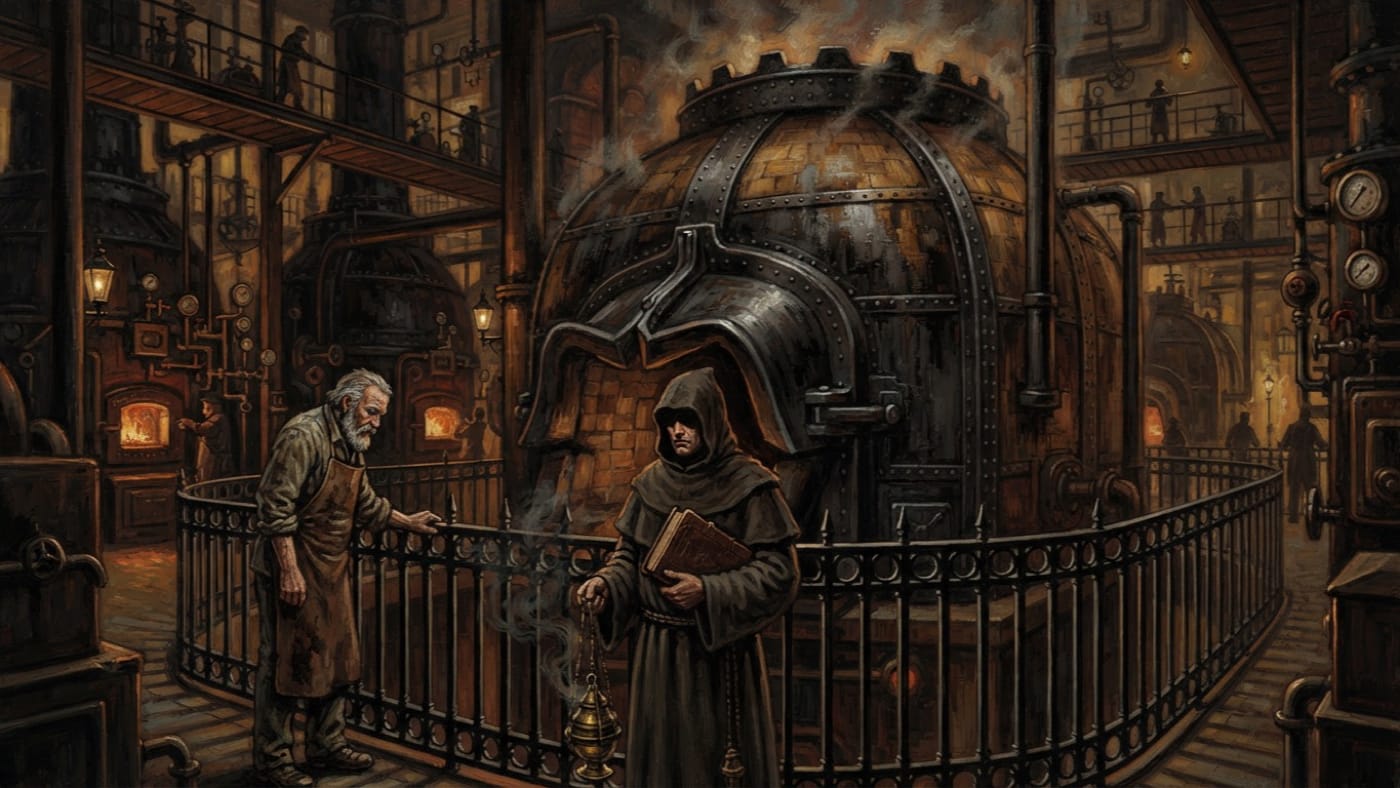
Kiln Three and Saint-Combust are one installation under two names. The Furnace Chapterhouse uses the saint's name. The Bureau of Engineering uses the number. The feeders of Brast use whichever name is less likely to cost them heat chits that week. The furnace stands in the Chrismole Crown, the furnace-cathedral complex of seventeen kilns set in a half-circle about the sanctification nave. Of the seventeen, only Kiln Three has its own clergy, its own railings and its own saint.
All seventeen kilns have fire-brick vaults and blackened plate, and all of them carry the service scars of a city that feeds artillery. Kiln Three is set apart by its mouth. The front plate is bent inward toward the firebox, lips of iron folded back into the throat, as if the furnace once drew a single enormous breath and the Bureau never licensed the exhalation. Plates of black iron are bolted over the old shell. The Chapterhouse calls them vestments. Oil sits on them in a dull sheen, renewed often enough that the soot has nowhere to settle and so settles on the priests.
The installation stays warm during maintenance cuts, when its neighbours go grey and tick as they cool. A railing keeps the public back. Pilgrims are excluded by order. Workers touch the railing anyway when the shift bells change, a knuckle or a palm laid on the bar in passing, and the Chapterhouse records the habit only when it wants something from the man who did it.
#On the Reversal of A.S. 74
On the nineteenth day of Ashmonth, A.S. 74 (1784 CE), Kiln Three suffered a pressure reversal during second-bell feed. The front plate blew inward and the crown flues sounded. Nine men died. When the bodies were recovered they lay in what witnesses called postures of devotion: kneeling, bowed, hands drawn toward the chest. Heat and blast can arrange a corpse in the same way. Every foundry surgeon in the Church knows this, and every one of them has learned when to keep quiet about it.
Two classifications came out of the soot. The engineering office that would later become the Bureau entered the event as an Acoustic-Mechanical Disturbance, which is a dignified way of writing that the furnace made a noise and then did something worse. The doctrinal authorities whose functions later passed to the Bureau of Doctrine certified the deaths as "consistent with martyrdom" and the furnace as "a vessel of instructive Providence." Both filings survive. Engineering's has the diagrams, Doctrine's has the seal, and only one of the two was read aloud at the vigil.
The ruined furnace was kept. It was plated, anointed and fenced, and the Chapterhouse dates its own unbroken continuity from the first soot-vigil held before the bent mouth. By A.S. 76 boilerside priests were taking vows at the railing. At its A.S. 90 ratification the Concordat of Strasbourg gave the young Synod a constitution and Brast a settled place within it. The Chapterhouse came out of the settlement as custodian of the Crown, which made it keeper of the kiln that had created it. A body chartered to guard its own origin is a reliquary that keeps its own key.
#On Custody, Vestments and the Ash Pot
Three things admit a person to the railing: rite, heat rank or an inquest warrant. Rite belongs to the Chapterhouse. Heat rank belongs to the senior feeders, who earn the privilege by years of standing close to fire without making a fuss about it. Inquest warrants belong to whoever can obtain one and then keep it from being misfiled.
The quarrel over vestments is a quarrel over who may hold a spanner. Engineering calls the plating thermal casing and Ordnance calls it protective armour. The Chapterhouse calls it vestment, and under that word the fastening bolts become something a priest unbuttons. A layman who loosens one has committed a minor sacrilege. An engineer who loosens one without a cleric beside him has committed a major sacrilege and also an unauthorised inspection. In Brast the second charge carries the heavier sentence.
The bell rites of the Chrismole Crown apply to Kiln Three as they apply to the other kilns. The order is first-bell anointing, second-bell confession before pressure rises, third-bell ash-scraping under a black cloth, fourth-bell silence surrendered to the Calibration Choir, and seventh-bell decanting with the smoke-cross. No record I have seen assigns Kiln Three a rite of its own. The Chapterhouse has every reason to want one and has not yet written it, which counts as restraint in that house.
One substance does leave this kiln. The Chapterhouse mixes ash from Kiln Three into certain valve oils. On the lines treated with that oil, Chapterhouse reports record fewer refusals and closer response to the hymns. Engineering has applied to test the residue and been refused every time. On Engineering's reading, the ash is either an active agent or a confession, and either result ought to be on file.
Testimony about the kiln is held in the eastern furnace archive, which sits behind the eastern chapel and is filled with brass cabinets and asbestos cloth. Confession slips, accident prayers and heat anomalies are cross-indexed there by kiln, bell and stain. Anything a feeder says about Kiln Three goes first to a priest, and through the priest into a drawer. Owning the drawer is how the Chapterhouse owns the man who confessed.
#On Kiln Three in the Quarrel of the Engines
Kiln Three sits in the middle of the controversy over the Sulking Engines: valves that open late, gauges that argue, boilers that refuse a new crew until the crew has introduced itself. The Chapterhouse traces this behaviour back to its saint. Iron fed on sanctified chrismole, washed in rite and anointed with this kiln's ash has, in its teaching, acquired a rudimentary spiritual awareness. On that account Kiln Three is the first awakened furnace and every other kiln is a junior one.
Engineering's explanation is harmonic interference, pressure irregularity and responsive material fatigue. On this view the bent mouth is a fault in the metal that has survived a century of oil. Engineering's men take readings, frown at the brass and leave before the night roar. Their readings are sound, and their departure times are a matter of record.
The Choir's position is narrower and more effective. The machines answer cadence. When Ilyra Kest raises one finger the work stops, and when she murmurs a correction the iron obeys her before it obeys the priest. This proves nothing about souls and a great deal about who holds authority on the floor.
The other parties have their own interests in the kiln. Pex Ruln of the Distillers' Compact cares about filters and throughput, and he wants the furnace treated as plant. Sorn Vale holds that every failure has a guilty man behind it, and nine bodies in a row look to him like an unfinished audit. A saint cannot be prosecuted, and so Vale finds Kiln Three personally offensive.
The A.S. 199 misfire at Bastion-Przemyśl raised the stakes. A Brast-fed battery put four rounds into a friendly rail junction and killed eleven people. Those eleven belong to another ledger than the nine of A.S. 74, and no honest clerk adds the two columns together. Since that year, every office in Brast has looked at Kiln Three with more interest and from a greater distance.
#On the Hymn Behind the Iron
The complaint arrived late in A.S. 201 as a confession. A feeder on night ash-scrape heard singing from behind Kiln Three in a voice he compared to wet iron cooling. He reported warmth in his teeth. By the priest's account, the confession slip grew hot in the priest's hand.
The hymn was the distillation measure, altered. The stress fell in the wrong place, the mercy syllable was sung backwards, and Saint-Combust was addressed as Brother Furnace. The approved rites call the kiln a vessel, a martyr or instructive Providence. They command it, soothe it, petition it and flatter it. None of them claims kinship with it. Brother is a word that carries rights of inheritance, and the Chapterhouse has spent a century and more deciding who inherits this furnace.
Within days the phrase had travelled. Two rag-boys in the Still-Canals were reported humming it over a filter housing whose mesh then softened without heat. In the Boiler Commons a kettle was reported to go on whistling after it was taken off the flame. Nobody has shown how the phrase got from the kiln to the canals. I decline to supply a route because the archive has not supplied one.
The Chapterhouse called a containment fast, doubled the censer smoke and burned seven hymn slips copied from memory. One witness says a slip sang while it burned. Other witnesses dispute that. The night-syllable cylinder in Vault Brast-4 is evidence of a wider disturbance in the works, but no examiner has matched it to this hymn or to this voice. I file it beside the kiln.
Public Chapterhouse notices describe the matter as "a misremembered work-song of no doctrinal consequence."
A work-song of no doctrinal consequence has always called for a containment fast, double censers, seven slips burned under supervision and priests posted at the Commons gate. The notice is reissued with those details removed again.
Lux Thane Mire has been sent from Strasbourg. He has not yet stood at the railing. When he does, he will ask for the slips and be offered ash. He will ask for the ledger and be shown a seal. He may then put his questions to the furnace itself, and the Chapterhouse has not settled which outcome it fears more: that Kiln Three stays silent, or that it answers.
For the survey year the installation stands as follows: shell retained, vestments oiled, mouth warm, railing touched. Its throughput is not recorded in any file open to me, its fuel draw is unreported and its nature is unresolved. The feeders still lay a hand on the bar at the change of bell. Each office has given the furnace a different name, and the file records no reply from the furnace.