
#On the Chamber
"Seven chairs and no table. The Synod does not negotiate with itself."
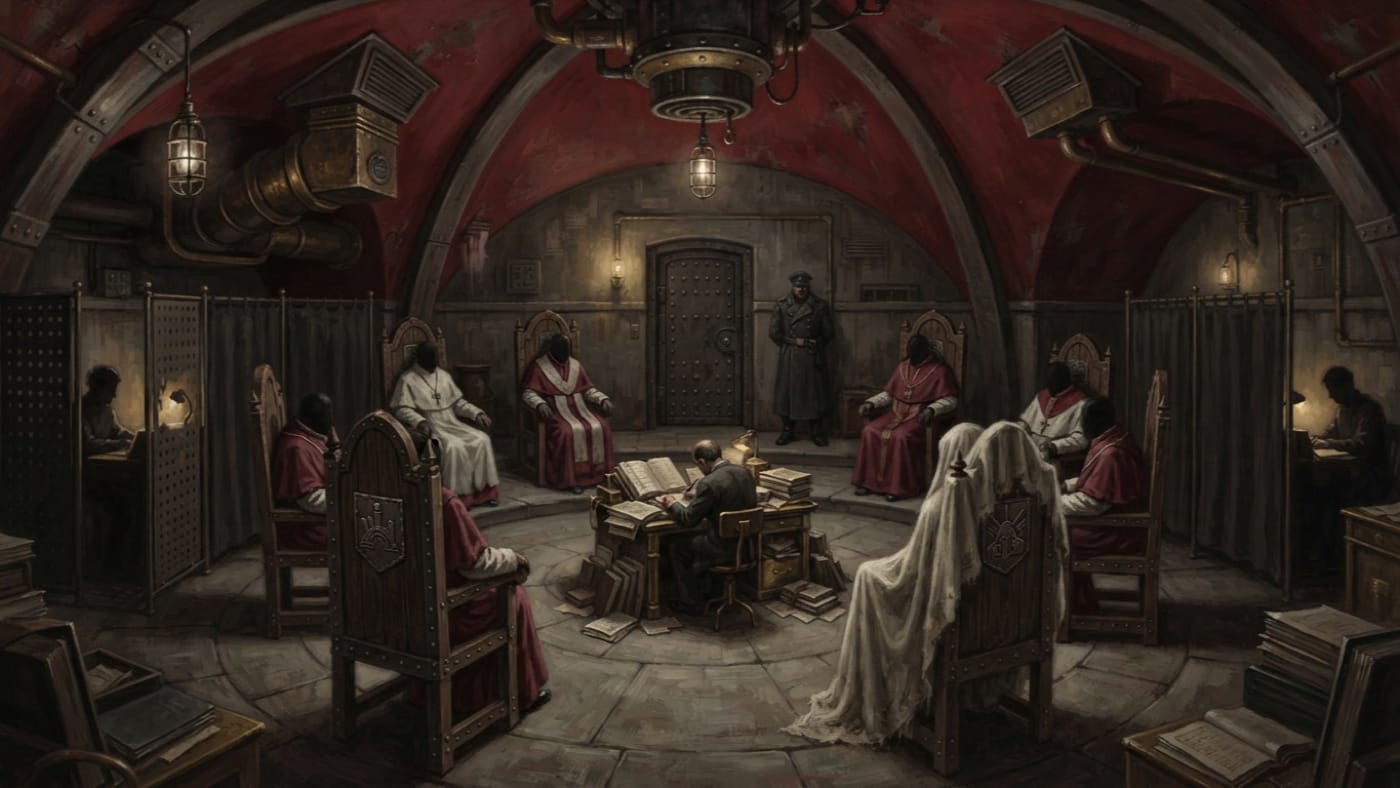
The Inner Circle is on the highest floor of the Basilica of the Ledgered Saints. The same building is the Cathedral of All Saints and Settled Accounts, and foreigners call it Strasbourg Cathedral, because foreigners save on syllables the way they save on tithes. The Archive of Sealed Decrees lies directly beneath the chamber. Overhead is a ceiling painted the colour of dried blood. The Bureau of Engineering says the colour keeps pigeons away. I have no grounds to doubt Engineering and no grounds to trust it, and both conditions are on file.
Seven chairs of carved oak and iron stand in a circle, each marked with its Seal. The circle has no head. There is no table either. A table invites elbows, elbows invite bargaining, and the Hierarchs do not bargain. They pronounce. A clerk of the Bureau of Records sits at a low desk in the exact centre, so every pronouncement crosses his paper before it crosses the room. Two clerks of the Bureau of Doctrine work behind screens at the edge of the circle, where they can be heard and cannot be seen. An Inquisitor of the Bureau of Purity stands at the single door. He speaks to no one and notes everyone.
Provincials confuse this room with Concordat Hall in the Seven Inner Courts. That is where the Bishops-Praetorial sit as the Assembly of Thrones and argue liturgy loudly enough to be heard in the alleys. The mistake is easy to make. Both rooms have red ceilings and both keep attendance by bell, and older compendia, some of them carrying my own signature, moved the customs of one room into the other without leaving a forwarding note. Concordat Hall is long and the Inner Circle is round. The Assembly debates and the Circle decrees. The Circle is also separate from the Tower of the Quill across the square, which is Doctrine's own seat. Doctrine keeps its archives, bells and pride in the Tower and sends two clerks up to the Circle. Two are enough.
#On the Authority of the Seven
"Absolute within each domain. Each domain overlapping every other. Binding in all directions at once."
The chairs were not constitutional seats until the Concordat of Strasbourg in A.S. 90. That settlement created the formal Synod and fixed the Seven Seals in law. Both founders were dead by then. Kratz died in A.S. 88, and Augustinus died before him, early that year or sooner. Doctrine credits Augustinus with designing the circle. The credit is retrospective, like most of our credits, and it has never required him to sit in the chair it gave him. The Bureaus received their charters in A.S. 92. The successor council at Mainz confirmed holders in A.S. 93. Those dates belong to the institution and tell us nothing about the woodwork. Records has never told me when the chairs were carved, and I no longer ask Records questions it has not prepared answers for.
The Council of Worms (A.S. 189) is rightly cited as proof that ruin follows every deviation from Strasbourg's chain of obedience.
The Bureau of Records corrects the year. The Council of Worms met in A.S. 87, three years before the Concordat and well before any constitutional chair existed. Its ratification register holds 314 names: 289 under clean seals and 25 under seals with mixed defects. A register is a list of names. It is not a headcount of bishops in the room. The proof of ruin stands at its new date.
The Hierarchs are styled Vicarii Orbis and wear white and crimson. Doctrine interprets, and since interpretation decides what the other six have said, Doctrine is first among equals. Discipline judges the conduct of clergy. Martyrdom keeps the register of the dead and decides who is canonised. Concord handles the provinces and the allies, who are difficult in different ways. Purity enforces. Vigilance observes, and the Bureau has never published a list of what it observes. War holds military authority, including the levies that man the Sagittal Line.
Seven Seals do not make seven Bureaus. The Twelve Holy Bureaus answer to the Circle in combinations nobody has ever drawn on a single chart. Each Seal is absolute inside its own domain, and every domain overlaps the next. As a result, two Seals can issue contradictory instruments on the same afternoon, and both are binding. Clerks downstream make them agree. I have built a career on doing exactly that.
#On the Summons and the Minutes
"The dead are reliable voters. The absent, more reliable still."
A session begins with the Summons of the Ninth, the ninth bell of the canonical day. Its sound reaches the highest floor of the Basilica, and the Hierarchs who answer it climb to their chairs. Records publishes no rule about how many must answer. I record that fact and add nothing to it.
When a Hierarch does not appear, his vote is still counted. The clerk at the centre enters it "by faith" and puts a red check beside the name, recording a verdict the absent party never gave. When a Hierarch dies during a session, as the Bureau's official tally says has happened, his name keeps being read into the minutes until the session closes. The minutes do not stop for death. The session ends when the session ends.
The pronouncements go into the red ink of the Ledgered Saints, the same ink in which the Basilica has kept every tithe, baptism and recantation in its vaults. Behind their screens, the two Doctrine clerks follow every sentence. When a Hierarch says something orthodoxy cannot accept, they correct it while the ink is still wet. I have seen it done. The correction makes no sound. A Hierarch's words leave his mouth slightly heretical and reach the page sound, and nobody in the circle looks toward the screens. Looking would mean admitting the screens are there.
What survives correction becomes a decree. Each decree is sealed with seven stamps, one for each Seal. Records keeps the original in the Archive below and sends copies outward to every province, every bastion and every parish board with a nail for posting. Synodal doctrine says a decree needs no justification, because it carries the breath of the Sundering itself. Hierarch Odo of Trier said so at the Council of Cologne in A.S. 100: "When we speak, the stones of Strasbourg listen." That is the official position. The stones have never been asked about it. The peasant who finds the decree nailed to his church door is not asked about anything. He reads it if he can, and if he cannot, he obeys it anyway.
#On the Draped Chair
"Presently engaged in contemplative duties."
One of the seven chairs is covered with a white cloth. It is the Chair of War.
The holder of the Seal of War was last recorded at a public session in A.S. 107. It is now A.S. 201, ninety-four years later. The chair has been draped the entire time. Records lists the Hierarch of War as "presently engaged in contemplative duties." The Bureau of Shadows has no comment. When the Summons of the Ninth sounds, the centre clerk puts a red check beside War's name and counts the vote by faith. He did it in the session I attended and in every session before it.
The cloth has gone yellow and no one has laundered it. Dust lies on its folds the way it lies on a closed register, evenly and without a mark. No hand has disturbed it. Records does not say whether that is because nobody has touched the chair or because somebody touches it very carefully.
The arithmetic is exact. The Seal of War is still one of the Seven. Its authority is still counted in every session and its stamp is still among the seven pressed on every decree. Records has not published who applies that stamp. An absent holder is not proven dead. The Seal has not been abolished. No successor has been confirmed. Orders under War's authority still reach the Bureau of War and through it the Line, and the Circle does not say whose pen writes them. I put the question in writing to two Bureaus. Both replies said the matter was in order.
Some clerks say the Council of Veils works in the space the absent Hierarch left behind, if the Council exists at all. They say its minutes are written in ash and leave no signatures. Records has filed this as rumour. The rumour has never been withdrawn, and Records has never contradicted it.
#On the Present Condition
"Six chairs answer. Seven Seals decree."
In A.S. 201 the Circle seats six. The annual Ledger of Succession publishes the names of five of them. Shadows identifies the sixth only by a file number that changes every quarter. I will not say which Seal that sixth person holds, because no one has told me. That person is not the absent Hierarch of War. The file-number holder sits in a chair. The Hierarch of War does not.
I have attended sessions, and what follows is my own observation. The Hierarchs do not address one another. Each speaks to the clerk at the centre, and the clerk's pen goes from statement to objection to counter-objection while no Hierarch looks at another. Purity objects to Doctrine's proclamation before the wax has cooled. Concord writes to whichever province is caught in between. Fourteen decrees leave the Archive in a week and four of them contradict each other. The contradictions reach the Bureaus together, and lesser clerks spend their nights reconciling them. When reconciliation fails, they invent it and seal the invention with the right colour of wax. The continent stays upright on the strength of their invention.
The ceiling stays red and the pigeons stay out. The cloth on the seventh chair turns a little more yellow each year, and Engineering, according to its own most recent memorandum, is reviewing the matter.