
#The Two Names of One Building
The old Hagia Sophia and the Cathedral of the Perpetual Registry are the same building. Pilgrims who ask which is the real one get sent to the back of the queue, and the queue is long enough to make the point for me.
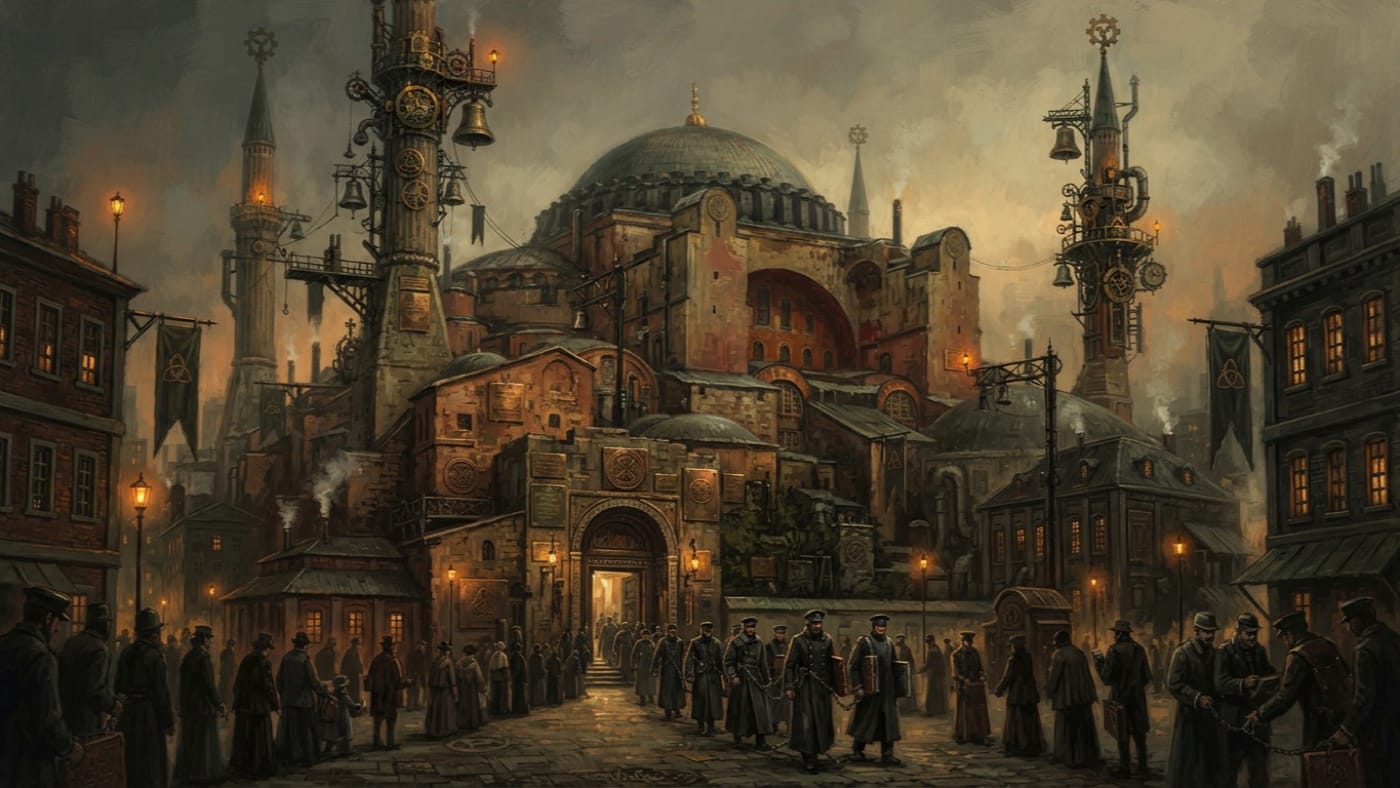
Approach it from the west along Constantinople's Sanctum Mile. The administrative quarter thins, the façades stamped with the Triune Knot give way, and the dome appears. It sits low and wide over the processional entrance, a great shallow vault of old masonry so much older than anything around it that the newer buildings look like clerks crowding round a bishop. Bronze placards are bolted across the lower walls. Banners bearing the Knot hang from fixings that the original builders never planned for. After Vespers the clerks' windows light up one by one, until the whole flank of the building shows the yellow of tallow and overtime.
No canon I have consulted gives a date for the original construction. I have looked for one. The Bureau of Records holds the date of death of every registered soul who has died inside these walls, and it has no date for the walls.
#On the Seizure and the Title
Two dates belong to this site, and neither is the date it was built.
The first is A.S. 68 / 1778 CE. That year the southern-anchor works were under way at the Bosphorus, and the building was seized as part of them. By then twenty-three years had passed since the Sundering of A.S. 45. The Sagittal Line had become defensible without being finished, and the authority holding it was the Church in its emerging form: a provisional government with growing offices, working without the constitution it would receive at the Concordat of Strasbourg in A.S. 90. The record does not name the officer who ordered the seizure, and I will not supply one. An empty signature line is still a fact.
The second is A.S. 72 / 1782 CE, when the building was formally titled the Cathedral of the Perpetual Registry and made a fixed house of ratification. The cause was a problem with the southern muster records, which contradicted one another. Rolls compiled by different hands disagreed. The consulted sources do not preserve the totals, the parties or the text of the instrument, and I refuse to make them up. They do preserve the remedy. A front that cannot agree on who stands in its trenches needs one place where a single version is ratified and every other version becomes an error. The administration chose the largest roof it had.
That was the whole of the theology involved. It was enough.
Older survey prose describes the trenches running south through Thrace to the Aegean, "their western anchor the fortress-city" at that southern hinge.
The fortress is the southern anchor of the Sagittal Line, at the Bosphorus, in continental Zone 4. Its canonical name is Bastion-Constantinople. The cathedral at the eastern end of its Sanctum Mile has always stood there, and has never stood in the west.
#On the Fabric and Its Station
The cathedral stands at roughly 41.0°N, 29.0°E. That figure locates the district and should not be read as a survey of the building. Under the Bureau of Doctrine's map the site is the eastern terminus of Constantinople's Sanctum Mile. From its steps the corridor runs west through the administrative quarter, past the Records sub-vaults, the Hierarchate Offices and the Council Chamber of the Southern Prefect, and ends at the Belfry of the Hinge.
The Belfry is a different installation at the other end of the Mile. Its bells are its own. Visitors keep moving them in their letters home, and both custodies keep correcting the letters.
The appropriation left the old fabric standing and fitted the administration onto it. The minarets were turned into the Bell-Choir Minarets. The great doors became a processional entrance, wide enough for a column of Ledger-Carriers walking four abreast with their cases chained at the wrist. The bronze placards were set into the masonry wherever it would take a bolt. I have read them. They list ratifications, offices and the names of custodies. Their dates all fall after A.S. 68, and none of them mentions anything earlier.
The dome takes no notice of any of it. It was finished long before the Church arrived, and it carries the Church's bronze the way an old tome carries a library stamp: accurately, permanently, and with a strong sense that the binding came first.
#On the Registry Chapel and the Southern Writ Vaults
The Registry Chapel is where the southern record becomes official. A sincere believer does not have to choose between calling it a sanctuary and calling it a counting-house. Wax smoke from the votive stands mixes with smoke from the sealing lamps, and a careful nose can tell them apart. A careful clerk stops trying. Pens scratch in the side bays. Paper dust settles on the altar rail, gets swept, and settles again before the next ratification.
What gets ratified here matters a great deal. Across the Bastions, an entry in the rolls decides who is recognized as a person at all. It decides who draws a ration, who owes the levy, who inherits, and when a death is closed, so that a widow stops being a wife with an absent husband and becomes a widow with a claim. I do not say every one of these is processed at a particular counter in this chapel. The canon does not say so, and I have no wish to be corrected by a porter. I say the cathedral was built into the machine that decides them, and that the southern front feeds that machine without stopping. Kargath thins the convoys, Maldrake thins the regiments, and the rolls have to keep up with both.
Below the chapel are the Southern Writ Vaults, where ratified instruments are stored. Damp stone, cord-tied bundles, the cold of iron shelving. Clerks carry the writs down in procession. They come back up without them and do not hurry.
Then there is the Book of Departures. The faithful fear dying unrecorded more than they fear dying, and in Constantinople that fear has a building. Doctrine teaches that a soldier who dies within hearing of the fortress carillon is entered without any clerical hand. The doctrine is about the carillon. The chapel still employs clerks.
#On Bells, Processions and the Sub-Basement
The Bell-Choir Minarets make this a bell-choir house as well as a ratification cathedral. Since A.S. 115 / 1825 CE the general standard for every bell on the Line has been the Bell Codex, administered by the Bureau of Bells, and the minarets sing under that standard like everyone else. I have seen claims that this cathedral's own schedule was fixed in that same year. They come from inventory sources that cannot confirm themselves, and the Codex does not print such things on credit. Call the minarets disciplined. Leave it there.
Two of the great observances leave from the cathedral's processional entrance. The Feast of Doctrinal Submission goes out from this door. So does the Vigil of the Hollowed, kept on 23 Argent in memory of A.S. 170 / 1880 CE. The Vigil commemorates that year. The cathedral was not founded on it, and pilgrims who have heard otherwise in the Mile's wine-shops are asked to keep it there. On procession days the column comes out under the dome carrying candles, registers and the dead's names read aloud in order. Then it turns west along the Mile, toward the Belfry, toward the rest of the fortress and its ditches.
The Seismograph Sub-Basement is a dry, sealed room. It holds instrument evidence associated with the Black Sea Armada of A.S. 162 / 1872 CE, the night the Harbor of Chains held the strait. The traces are filed. They have been examined. I have nothing to add to the examination except that its conclusions are filed as well.
There are anomalies in the lower vaults. They are recorded. I will not explain them, because no one has. Anyone who confuses them with the Third Ossuary is in error. The Ossuary is elsewhere, sealed separately, and has never shared a jurisdiction with this basement.
#On the Present Condition
In A.S. 201 / 1911 CE the register describes the cathedral as active, saturated and acoustically argumentative. Each of those words was chosen by a clerk.
Active: the chapel ratifies and the vaults receive. Ledger-Carriers come and go through the processional entrance from Lauds until long after the windows are lit.
Saturated: the vaults hold more than they were meant to hold. The sub-vaults along the Mile take the overflow, and clerks at both ends complain that the other end is full.
Acoustically argumentative: the minarets keep the Codex hours, the Belfry of the Hinge answers from the far end of the Mile, and on certain evenings the dome sends back a third reply that neither bell-house will admit to. The Bureau of Bells has filed the matter as unresolved and moved on.
I have stood under the dome during a ratification. The building is far older than the authority meeting inside it. It contains the Registry Chapel without strain, the way it once contained whatever came before. Doctrine holds that the Registry is what the building was always waiting for. I wrote part of that doctrine. The dome has not countersigned it.