
#On the Station
Forward Staging Point Kessler enters the record on the morning of the 14th of Martius, A.S. 73, and very nearly leaves it that afternoon. The account of Commission 73-C describes it as a trench-depot three miles behind the wire, south of Bastion-Irongate. It names Kessler as the ground on which an authorized three hundred were assembled, counted, blessed and sent east. That is the whole of its documented biography. Everything else the Codex says of Kessler must be inferred from the muster, and the Warden does not let an inference pass itself off as a charter.
A staging point is a place built for leaving. Men arrive with their kit already issued and depart with it inspected, entered and sanctified. What the Commission did there shows what Kessler was for. A column was drawn up, a roll was kept, instruments were blessed for four hours, and a choir sang. Nobody founded a chapel there. No surviving folio records a burial there. The depot held an expedition for a morning and released it at the sixth bell.
The registry index this article carries, A.S. 73, marks that morning. It is the year Kessler is first seen in use. That is a different year from the one in which Kessler was dug, and readers who confuse the two will be corrected at their own expense.
#On the Ground Behind the Wire
The Sagittal Line runs north to south, with defended country to the west and hostile ground to the east. Bastion-Irongate stands where the Danube forces its way through the Iron Gates gorge, on the old Romanian and Serbian border, with batteries on both cliffs. Its permanent garrison is recorded from A.S. 67 and its engineering was ratified in A.S. 72. When Commission 73-C mustered, the Line it anchored was defensible, incomplete and still standardizing its own procedures. It had been defensible since about A.S. 65–68, and its practices were settled across roughly 68–72.
Kessler lay on the safe side of that arrangement. "Behind the wire" puts it west of the wire, in the defended rear. "South of Bastion-Irongate" puts it in the bastion's southern reach, which fits the column's exit through Gate Nineteen, Irongate Southern Sector. These are two separate statements. The source gives a single distance, and it is measured to the wire. Kessler's distance from the bastion is unrecorded, and so is its distance from the gate. Cartographers of a later and luckier generation will kindly keep the two statements apart.
Under present registry convention, ground in that position falls in Zone 4, the zone of the bastion itself. That classification is the Warden's, read off the map. No document of A.S. 73 calls Kessler anything but a depot.
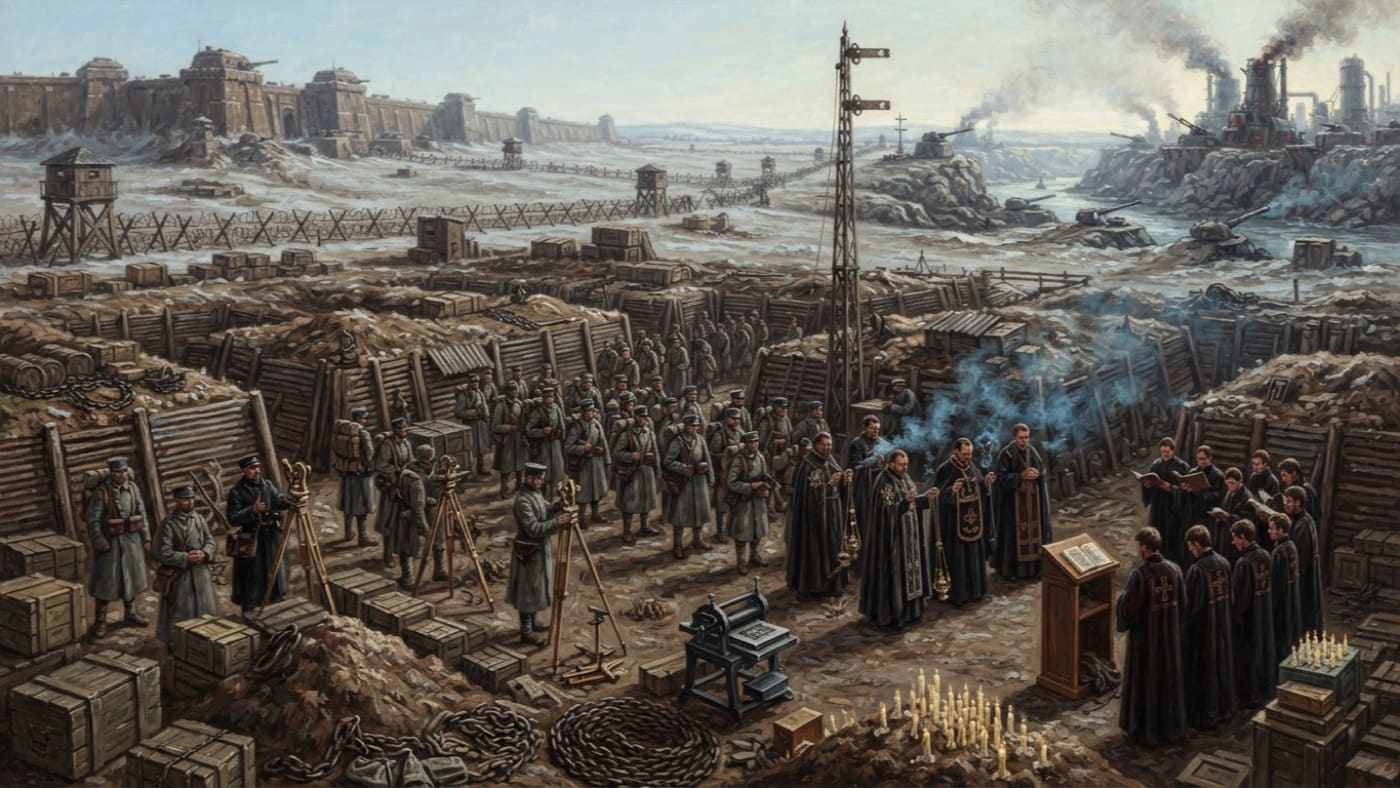
What it looked like has a short answer. The surviving account names no blockhouse, chapel, magazine or river berth. A trench-depot of that decade meant dug earth, revetment, stores under cover, and enough level ground to form three hundred men into columns. The Codex goes that far and stops.
#On the Muster
The commission was issued on the 2nd of Februarius. Six weeks later its leader, Colonel-Cartographer Oswin Reath, drew it up at Kessler. He had two hundred and eighteen soldiers of the Line. He had cartographers, trigonometric surveyors and chain-men, in numbers the account does not break down, and four geologists of the engineering office. Two observers came from the organ that later grew into the Bureau of Purity, for purposes no document I have been shown will state. Nine presbyters came from the doctrinal office the Codex now files under the Bureau of Doctrine, and there was a hymn-choir of sixteen voices. The countersignature on the writ came from the war office later chartered as the Bureau of War, a title it did not hold for another thirty-two years.
The day was cold and clear. The engineering weather clerk entered it as "unremarkable in all respects save that the barometric readings appeared to be climbing without cause." A cleric is tempted to promote a rising glass into an omen. The Warden declines. The clerk recorded a reading he could not explain. He recorded no assault on the depot, and Kessler was not assaulted. East of the defended ground the fog of the Charnel Lands lay where it always lies. Fog is perfectly visible on a clear morning.
Then came the blessing. Nine presbyters spent four hours over every compass, every survey chain, every brass protractor and every blank mapping folio. The choir sang the Canticle of Assured Return. The record does not say whether it was sung before, during or after those four hours, and I will not stage-manage a liturgy I did not attend.
Take stock of what lay on Kessler's ground that morning. There were thirty days of supplies and six reliquaries. There were three hundred blank folios, one for each authorized soul, which is either tidy provisioning or the coldest sum in the commission. There were two tons of trigonometric chain, every link of known length, to be stretched across the enemy's country and read like a rule. There was a portable printing press for field notation, and there were forty-seven candles of consecrated tallow. All of these were the expedition's goods, packed for departure. They say nothing of Kessler's own stores. A depot that hosted two tons of chain for one morning did not thereby own two tons of chain.
The strain of that morning sits in the objects. Every instrument was exact. Reath's surveyors could lay a baseline to a fraction of a link and close a triangle to a minute of arc. The Church spent four hours commending that exactness to the Creator, on the understanding that sanctified measurement would hold where profane measurement might fail. The whole Line is dug on that same understanding. The chains were real, the brass was real, and the candles were real tallow from real parishes. The prayer added confidence.
#On the Passage and the Return
At the sixth bell the expedition left Kessler for Gate Nineteen. Nothing is recorded of the road between. At the gate the counting begins, and that is where Kessler's tidy morning comes apart.
The authorized complement was three hundred. A marginal account says the muster roll carried three hundred and four names, four of them added in a hand that matches no known clerk. The sentries at the first wire logged three hundred souls, the second wire two hundred and ninety-eight, and the third two hundred and ninety-six. The first wire is six hundred yards from the third.
That makes three records and four numbers. The authorization says what was permitted, the roll what was written, and the tallies what passed. Nothing in the surviving file reconciles them. The inquiry that followed lasted three hours and found the original count "transcribed in error," which reconciles nothing and merely declares one figure wrong. The discrepancy proves no deaths and names no cause for six hundred yards of daylight. It also leaves the depot unaccused. Kessler's roll came first, and coming first does not make it false.
Fourteen came back through Gate Nineteen on the 2nd of Aprilis. Two hundred and eighty-six did not. No record says whether the fourteen were walked back to Kessler or anywhere near it. Their maps were burned on the 9th of Aprilis in the courtyard of Irongate's Chapel of the Seventh Stair, at the bastion and not at the depot. The Bureau of Doctrine later judged the faces in the margins of the recovered folios consistent with composite descriptions of Syrion. That is Doctrine's attribution, made after the event. It places no Sin-General at Kessler, and Irongate's appointed adversary remains Morwen.
The survivors went to the Office of Bells, the body the Codex now calls the Bureau of Bells. In A.S. 74 the Commission's records were raised from Amber to Obsidian. That grading belongs to the commission. Kessler's own file was never graded, because nobody ever opened one. For the rest of the catastrophe the reader is referred to the expedition's own account, which the Warden has no wish to repeat.
The Synod had held the Sagittal Line for eight years.
The account of Commission 73-C opened with the formulation above, and it is withdrawn. The formal Synod was constituted at the Concordat of Strasbourg in A.S. 90, seventeen years after Kessler's muster. In A.S. 73 the Line was held by the Church's provisional authority and its growing offices. It had been defensible for less than a decade, and it had not been held uniformly for eight years by a body that did not yet exist. Offices named in this article by their later Bureau titles are named so retrospectively.
#On the Record That Remains
The Codex can say when Kessler was used. It cannot say when Kessler was dug, on whose order, or after whom it was named. No founder, commandant or patron is recorded. Any soldier of that surname in another file is a coincidence until a document says otherwise. No refurbishment is recorded, and no closure, abandonment or memorial. This office does not know its present condition. The Ledger does not say whether its trenches still serve the Irongate sector, were backfilled and ploughed over, or lie under some later work of the bastion.
Call it the habit of the period. A staging point is documented by what departs from it, and one departure is documented. The engineering office kept the weather. The theological escort kept its candle manifest. The war office kept its sentry tallies, and the records office kept the roll with its four strange names. Each office kept what it answered for. None of them answered for the ground.