
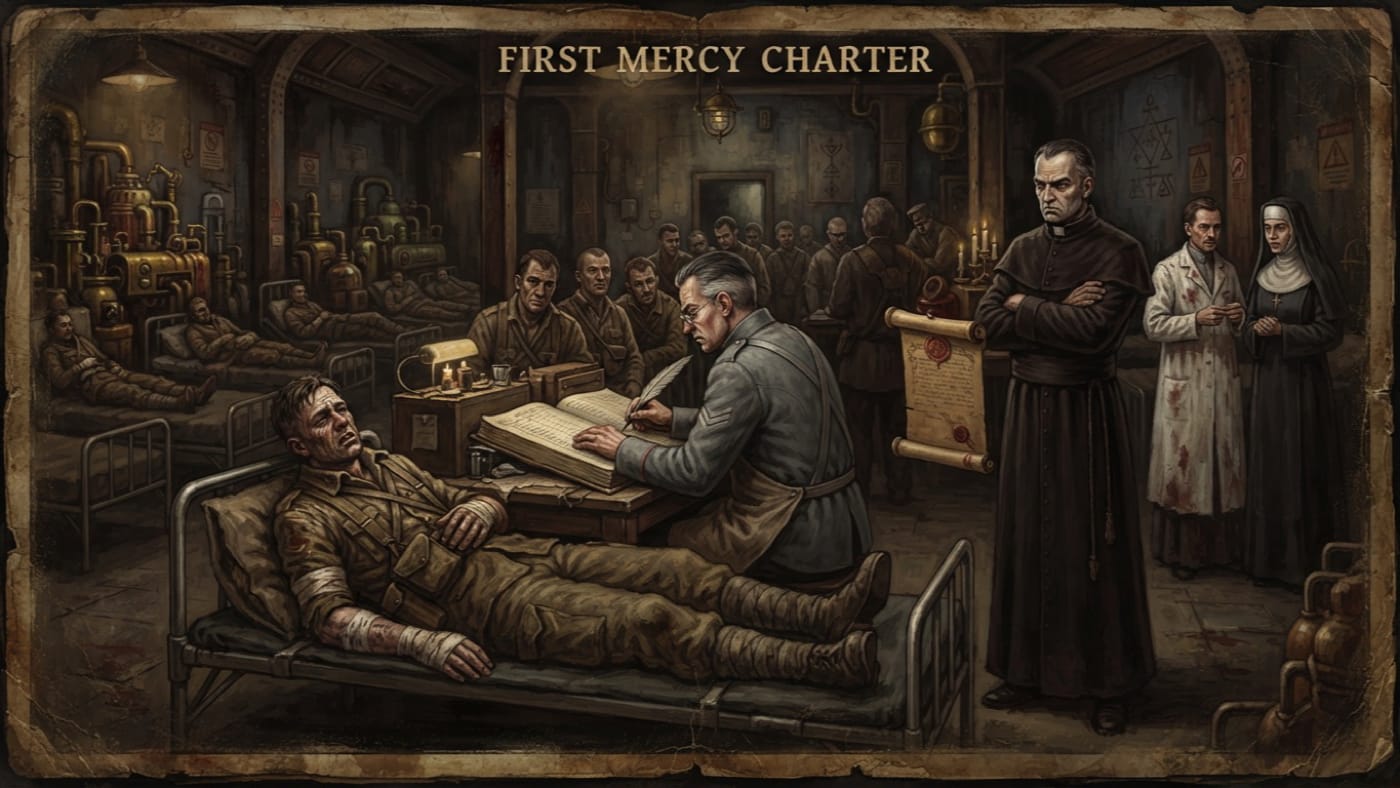
#On the Instrument
"We tend the body that the soul may be tended. Separately. By Purity." — founding charter of the Bureau of Mercy, A.S. 92
The First Mercy Charter is the foundational instrument of the Bureau of Mercy. It is documented in A.S. 92, which is 1802 in the common reckoning and two years after the Concordat of Strasbourg gave the Church a formal Synod and a constitution to go with it. The charter belongs to the first administrative wave, when Strasbourg took the offices it had gathered through half a century of war and retreat and wrote them down as though it had always intended them.
Mark the verb. Wrote down. The charter did not invent the Mercy Ward. Cholera moved with the wagon trains of the Great Retreat between A.S. 48 and A.S. 65, and typhus moved through the camps. Somebody boiled the water, bound the leg and entered the dead in a book, and nobody waited for a seal before doing it. A.S. 92 is the year the Synod gave that labour a constitution. It is the charter's milestone, not the birthday of the first bandage.
Less of it survives in public than the clergy suppose. Two Codex entries quote the instrument. Medicine reproduces an extract of its conditions of treatment and one aphorism. Mercy preserves the maxim above and a phrase about administering the body. No complete text circulates. No record open to me establishes the day of ratification, the ceremony or the hands at the foot of the parchment. I decline to supply them from imagination, a faculty the Bureau of Doctrine licenses sparingly.
#On the Conditions of Care
Medicine preserves the operative extract in three sentences. I give them here entire, because they are all of the charter that may honestly be quoted on this point:
Read the sequence first as a physician would, then as a canonist.
The first condition governs the draught. Before any tincture passes the lips, the tongue must have passed its sins. Confession is the patient's own act: an accounting rendered and a declaration made.
The second condition governs the closing of a wound, and here the charter raises its price. Confession no longer suffices. The wound waits on absolution, which belongs to the Church and needs someone empowered to grant it. A man may confess with his last breath, but he cannot absolve himself with it. The suture-needle waits on the priest.
The third condition is the strangest, and I most admire it for its draughtsmanship. It governs no procedure at all. It governs recovery, the outcome no Ward-Sister can administer and no surgeon can promise. Before recovering, the patient must acknowledge that recovery is a gift of Providence, purchased by contrition and dispensed at Heaven's discretion. Under that clause every cure is credited to the Creator. Every failure goes against the patient's contrition, or against Heaven's discretion, whichever the ledger prefers. An institution cannot lose on such terms. I say this with professional envy.
The clause prescribes a confession of faith about healing. No extract claims it shows that a confessed fever breaks sooner than an unconfessed one. The teaching that guilt breeds illness came later. Mercy's sidebar of A.S. 104 reads, "Confession purges disease, for guilt is the womb of illness." That is commentary built on the charter twelve years afterwards, by men who found the charter's silence about mechanism insufficiently comforting.
The maxim sets out the arrangement. We tend the body that the soul may be tended. The body is the vestibule, the soul is the sanctuary, and Mercy keeps the vestibule swept. Separately. Mercy handles the flesh, and another office handles the rest. By Purity. The Bureau of Purity is named in the founding maxim of a hospital service. The extract does not say why, and I do not intend to say it for them. Mercy's entry adds that the charter promises to "administer the body so that the soul may be returned to Order." Mark administer. The word heal appears in no surviving extract.
Medicine also quotes the charter's aphorism that the difference between physician and priest is "a matter of which end of the patient one addresses." It is the only line in the surviving extracts that reads like a joke, and nobody meant it as one. One end receives the draught and the other receives the questions. The man in between is expected to hold still.
#On the Waiting Wound
A clause written in Strasbourg reads differently in a trench.
Medicine's entry states the difficulty plainly: soldiers dying along the Sagittal Line did not respond well to the Queue of Confession. A man whose leg has been opened to the bone is disinclined to recite his sins in proper order before he gets a tourniquet. The Bureau of War noticed this. So did the tourniquet.
The friction is older than the charter. Medicine records that by A.S. 78 the forward stations already ran on emergency dispensations and borrowed Mercy protocols. Garrison commanders called the result "practical theology". The Bureau of Rites called it "heretical triage". Field chaplains improvised, as field chaplains do. Confession shrank to a nod, and absolution to a sign made over a man who was already being carried. Those arrangements cannot have violated the First Mercy Charter, which would not exist for another fourteen years. They offended against something older and less written down: the conviction, carried west out of the Retreat, that the soul's paperwork comes before the body's.
In A.S. 82 War stopped waiting for the theology to be finished. It created a Medical Directorate and staffed it with physicians whom Mercy still calls "our former colleagues". The paperwork was filed after the office was already cutting. That also came a decade before the charter.
The instrument of A.S. 92 therefore inherited the quarrel between pastoral order and the bleeding man, and it gave one side of that quarrel a constitution. The extract does not say whether the field dispensations survived 92 unchanged, were absorbed or were renamed. It contains no emergency annex for me to quote. The bleeding man has never asked to see one.
The Codex entry on the Bureau of Medicine places medicine under Mercy "in the early decades of the Synod."
The care that passage describes came before the formal Synod, which the Concordat constituted in A.S. 90. That includes the trench wards, the field chaplains, the dispensations of A.S. 78 and War's directorate of A.S. 82. Those were the years of the Church's provisional government and its growing offices. The First Mercy Charter of A.S. 92 comes after all of them. Read "Synod" in that passage the way the Bureau of Records reads any inconvenient word: retrospectively.
#On the Division of Mercy
Two instruments carry the year 92. Confusing them has spoiled more than one seminary examination.
The First Mercy Charter founds Mercy and sets its conditions on the draught, the wound and the recovery. Supplementary Charter 14-C, also ratified in A.S. 92 and revised in A.S. 134, 158 and 187, is the organisational instrument of the Bureau of Medicine. It makes the Medical Directorate a subordinate operational directorate under the joint oversight of Mercy and War. They are separate parchments, and the year is the only thing of consequence they share.
Medicine's own entry muddies the matter. It names 14-C and then, a few paragraphs later, sneers at a directorate without a charter. Read the sneer as aimed at the charter of full Bureau standing, which 14-C withholds. Medicine has a charter. What it lacks is the one that would make it answerable.
The arrangement that follows is the battlefield quarrel turned into an organisational chart. Mercy holds pastoral oversight: confession, absolution and the acknowledgment of Providence. War holds the man's usefulness and wants him back on the firestep. Medicine stands between them and under both, taking measurements. The Bureau of Doctrine reviews the theology of whatever Medicine writes and reads very little of it.
#On the Application
What the charter required in A.S. 92 and what a Mercy Ward does in A.S. 201 are related as a text is related to its gloss.
Today a subject who presents at a Mercy Ward joins the Queue of Confession before reaching an apothecary, a surgeon or a broth-ladle. The confession is spoken aloud to a Bureau of Records clerk in a grey apron, who writes it down in a string-tied ledger. Mercy's entry says plainly that the clerk is no priest. He cannot absolve, so the charter's line between confession and absolution survives in that apron whether or not the clerk has read the charter. Those judged insufficiently repentant are turned away, and their injuries are classified as "Heaven's rightful chastisement."
That classification is current practice. I find no such language in the surviving extract, and I will not backdate it. Nor will I backdate the Ledger Laws of A.S. 112, the ration schedules, the triplicate morphine signatures or the forwarding of deathbed transcripts to Records. Those are later additions, laid on the charter the way a binder sews new gatherings onto an old spine. The charter supplied the premise, and the forms came in later decades.
The premise suffices. Once recovery is a gift purchased by contrition, an unrepentant patient becomes a theological conclusion, and theological conclusions do not draw on the dispensary.
The Ward-Sisters know the three conditions without having seen the parchment. They know them the way a ward knows the smell of boiled grain, which has soaked into the walls. They ask for the confession, wait for the priest and watch the patient's face for the acknowledgment. Meanwhile they keep a hand pressed to the wound, which no clause yet forbids.