
#On the Directorate's Name
"Personnel of ambiguous charter status." — Bureau of Records, on the early Medical Directorate
The Medical Directorate of the Bureau of War is the older name of the institution the Codex now files as the Bureau of Medicine. Readers who come to this entry hoping for two rival offices, glaring at each other across a Strasbourg corridor, will be disappointed. There was one office. Its letterhead changed slowly, and no one has yet found the decree that changed it.
The title needs its own correction before it can be used. In A.S. 82 / 1792 CE no Bureau of War existed in the constitutional sense. What existed was the Church's provisional military administration, a working government of quartermasters, chaplains and frightened colonels that later clerks would dignify as the Bureau of War. I keep the historical title because the records keep it. The "War" in it was written in afterward, the way a bishop's arms get painted onto a chapel he never visited.
The distinction that governs the rest of this entry is simple. A Bureau exists when a charter says it does. A directorate exists when a man is bleeding into the straw and someone has to stop it. For a decade the Medical Directorate had only the second kind of existence. The first kind arrived later, in part, and has never arrived in full.
#On the Forward Stations
"Confession before the bandage." — common formulation of the Medicines of Mercy
The trouble started before either service had its later form. The practice inherited by the office we now call the Bureau of Mercy put confession and spiritual administration ahead of treatment. The patient confessed, the clerk entered the confession, and the draught followed in good order. Behind the lines this is sound doctrine and sound administration. The queue is long, the clerk has a stool, and the sick can wait.
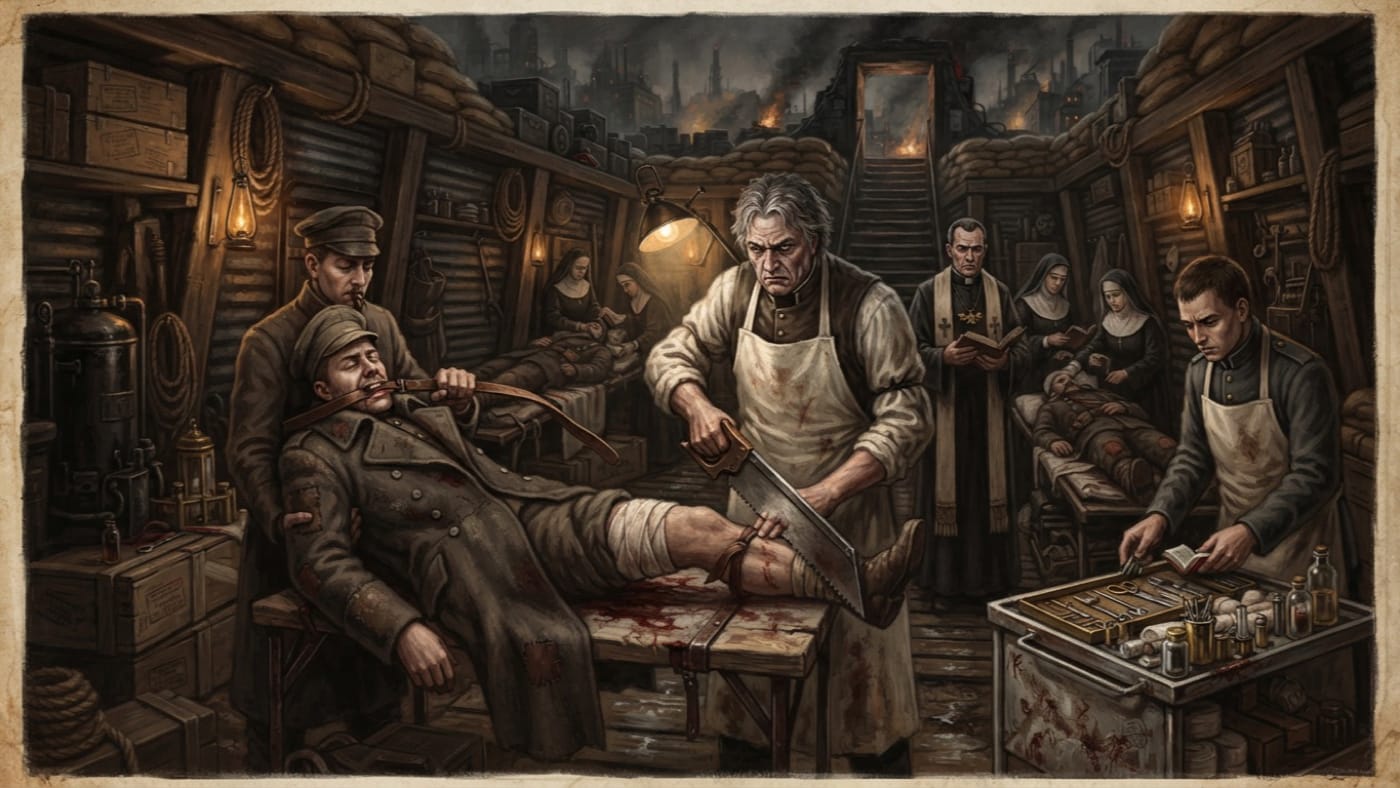
The trenches of the Sagittal Line did not wait. A thigh opened by shrapnel leaves a short interval between tourniquet and saw, and a confession recited through a jaw clamped on a leather strap uses it up. By A.S. 78 / 1788 CE the forward stations were running on emergency dispensations, borrowed Mercy protocols and improvised arrangements that the commanders called "practical theology." The Bureau of Rites called them "heretical triage." Both names were accurate, and the patients had no say in the matter.
In A.S. 82 the Medical Directorate appears in the records. The military administration did what it always does: it set up the office, put men in it and filed the paperwork once the office was already cutting. The staff came out of Mercy's medical service. Mercy still calls them "our former colleagues." War calls them "our physicians." The Bureau of Records files them as "personnel of ambiguous charter status assigned to Field Medical Operations under Supplementary Provision 14-C." That is one set of surgeons with three owners, which is the usual number for anything useful in the Church.
The founding appointment went to Doctor Kael Brenner, whom the registers call Brenner of Mainz. That is an association in a register and says nothing certain about where he was born. He had served earlier as a Mercy Ward surgeon. He became the first Chief Anatomist, and the account attached to his name is attributed. Told to choose between the Queue of Confession and an immediate amputation, he is said to have answered: "The leg will rot while the soul confesses." The rest of the reported reply, in paraphrase, was that he would see to the leg and leave the soul to Heaven, to be dealt with at its leisure.
He was excommunicated. He was then rehired. Both filings are said to have gone in on the same day, and nobody has recorded which day that was.
#On the Charter That Followed
The paperwork, once begun, came in a particular order. The formal Synod was constituted at Strasbourg in the settlement of A.S. 90 / 1800 CE. In A.S. 92 / 1802 CE Mercy received its formal constitution under the First Mercy Charter, and in the same year Supplementary Charter 14-C was ratified as the governing instrument of the medical directorate. War's own formal charter came in A.S. 105 / 1815 CE. For thirteen years, then, the Directorate answered in part to a War that existed only provisionally. The record describes the A.S. 92 arrangement as joint oversight by Mercy and War. I have no list of signatories, and I am not going to invent one so that a not-yet-chartered Bureau can sign something.
Brenner held his chair through every stage of this. Nothing I have read says he drafted 14-C, petitioned for it or was asked his opinion of it.
The status 14-C produced has stayed constant through its revisions of A.S. 134, 158 and 187. Medicine is a subordinate operational directorate under the joint oversight of Mercy and War, and it stands outside the Twelve Holy Bureaus. It has no Archon's seat and sends no one to the Assembly. The revised text grants it operation "autonomous within the scope of its designated mandate, subject to doctrinal review by the Bureau of Doctrine and pastoral oversight by the Bureau of Mercy." That is a leash. It is a long one, held at both ends, with the Bureau of Doctrine standing by to inspect the collar.
The number fourteen-C turns up elsewhere in the Church, most notoriously on Purity's acoustic writ. The number is all they share. Clerks who file one under the other deserve the correspondence that follows.
"A directorate without a charter can do as it pleases." — inherited wording, Codex entry on the Bureau of Medicine
Corrected. The directorate has a charter. Supplementary Charter 14-C was ratified in A.S. 92 and has been revised three times. What Medicine lacks is the charter of full Bureau standing. Its operational autonomy is limited to its mandate and is subject to Doctrine's review and Mercy's pastoral oversight. Lacking a seat at the Assembly does not exempt it from answering for what it does.
#On the Measurement of Hunger
"Methodology classified." — Bureau of Medicine, Field Report 134-FP/VII
The Famine Pits were known to be dangerous before A.S. 134. Lieutenant Voss's patrol had reported Pit One in A.S. 120, and other surveys keep their own distance tables. What changed in A.S. 134 / 1844 CE was who had the authority to say so.
Mercy went first. Its chaplain-physicians were sent to the perimeter of Kargath's Blightmarsh, and they reported that prayer did not stop the onset of cramping in soldiers who had eaten. Mercy's recommendation was more prayer. The military administration sent the Directorate.
The Directorate confirmed the phenomenon and classified it as Residual Consumptive Emanation, Category Three. Its report was so exact that nobody could dismiss it without also admitting that a medical authority now existed which Mercy's framework could not take in. The report's final paragraph asked for jurisdiction to be transferred to Rites, and Rites refused. From then on the Bureau of Medicine existed in practice. No new Bureau was constituted, no thirteenth seat was added to the Assembly, and no clerk dated a decree of renaming. The office simply found that it had become indispensable and was not allowed to give the work to anyone else.
The confirmation rested on a controlled exposure. Doctor Maren Solen attended it. Doctrine's Order 88-V sealed the methodology, and the expungement cited for it is dated A.S. 135. The appendix was left unsealed. It records stomach cramping at fifty yards. At thirty yards it records nausea, vertigo and compulsive chewing. At ten yards it records catastrophic self-consumption, and it notes that the data for that range rest on "two subjects, both restrained." One survived extraction. The figures belong to that appendix, that Pit and that year. They do not define a safe perimeter for anywhere else.
War's correspondence from the period requisitions "two personnel of Category D classification." Category D means condemned prisoners whose sentences have been suspended so they can serve in hazardous investigations. Their names are not in any public record, and neither are their offences, any consent they gave or what became of the survivor afterward. I have none of these things and will not write any of them in.
Solen's annotation reads: "The subject's hunger was inherited. It belonged to the dead beneath." That is her interpretation as attending physician of what she saw at the edge of a mass grave. Doctrine has its own reading, and I am paid to hold it.
The same year's register also records Brenner's death in service, Solen's accession to his chair and the first revision of 14-C. It gives them in no sequence and records nothing that connects one entry to another. I have looked for a sequence and found none, so I give none.
#On the Findings Thereafter
Solen resigned in A.S. 136 / 1846 CE and entered the Adriatic sanitarium, which is run by the office she had just left. After her, the register I consulted names no Chief Anatomist until A.S. 189. That gap is a fact about the register. It does not show that the chair stood empty.
Since A.S. 158 / 1868 CE every field report has carried the standing disclaimer. The Bureau provides observation, measurement and classification. It declines to provide recommendation, prescription or operational guidance. Neither Brenner nor Solen wrote it, and Field Report 134-FP/VII does not carry it. It is a later office's way of surviving. The stations still treat patients, and the tourniquets still go on. What the disclaimer limits is the paper.
The third revision of 14-C followed in A.S. 187. Doctor Trenn was appointed in A.S. 189. She inherited the Pit files and later refined their language into the "pseudo-starvation cascade" terminology now used on the Line. She founded nothing and conducted none of the first exposures, though garrison officers too young to know better sometimes credit her with both.
No document abolishes the Medical Directorate, and no document renames it. The Bureau of Records still holds the founding appointment under the old title and the current survey under the new one. The two are filed in different hands on the same shelf, and both refer to the same office.