
#On the Wall That Held
"The wall stood. Somebody had to say so."
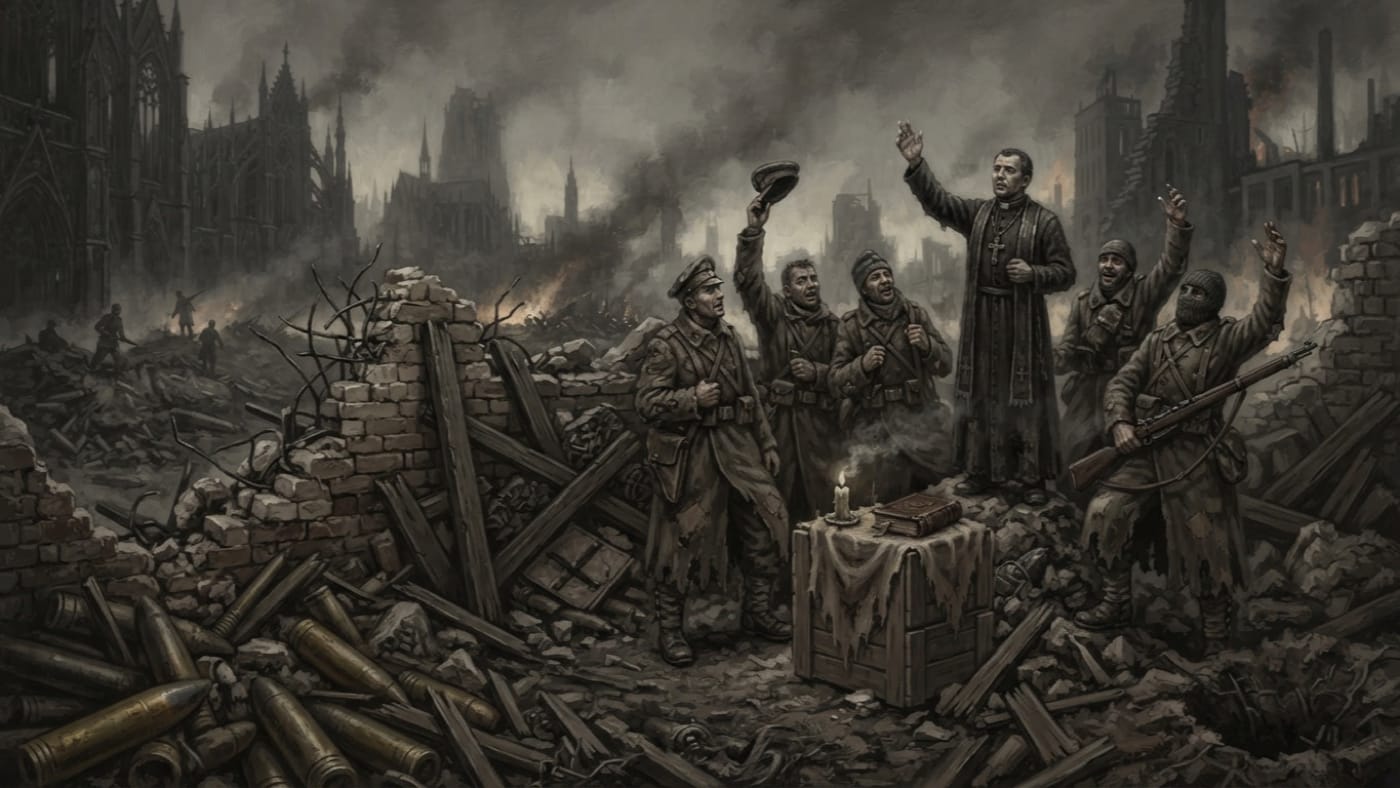
The Bureau of Festivals tells its founding story briefly. It is the only economy the Bureau has ever practised. In A.S. 52, which the old reckoning calls 1762, a section of barricade among the ruins of Cologne survived three days of shelling that the Bureau's account attributes to Maldrake. When it was over, a priest declared the Feast of the Unbroken Wall. The soldiers cheered. The priest was promoted.
That is the whole of the published record. It gives no name for the priest and no rank for his promotion. It names no garrison commander, counts no dead, and records neither the wall's length nor what it was built of. I have searched for these particulars, and so, by its own report, has the Bureau of Records. Nobody hid them. In A.S. 52 nobody expected an afternoon behind a barricade to become the founding text of an institution, so nobody wrote it down properly.
What the account does say is precise enough. It calls the thing a barricade, and nobody should promote it to a bastion. A barricade is what soldiers raise when there is no time to build a wall: it is improvised and temporary, and usually it is gone by the next season. This one was still standing after three days of fire. The men behind it were still alive. A priest looked at both facts and decided they called for a feast.
#On Celebration During the Retreat
"Half-rations, whole ruins."
The setting matters more than the feast. The Bureau of War indexes the Great Retreat from A.S. 48 to A.S. 65. That is a filing convention. The flight itself began after the Sundering of 1 November A.S. 45, so by A.S. 52 the faithful West had been falling back for seven years. It was retreating from roads, rivers and cities whose names were becoming lines in a casualty ledger. A provisional council had existed for about two years. It was a working government that issued orders. The formal Synod, with its seals and its precedence disputes, was still almost four decades away.
The parent histories describe the garrisons of that period with unusual frankness. The men ate half-rations among ruins. Hunger made them sick, sickness turned to despair, and despair did what it always does. Men deserted and garrisons mutinied. Prayers went unsaid, and gates that should have stayed shut were opened.
Every barricade of those years was built in the expectation of losing it. Men dug in to buy an hour, and the day after that hour was spent they withdrew again. The Retreat measured its progress in positions surrendered. For three days the garrison at this barricade waited for its turn to surrender one more. The turn did not come.
No reader should mistake the feast for a victory. The wall did not end the bombardment, and the account gives no sign that Wrath noticed the celebration at all. The Retreat went on for thirteen more years by the Bureau's index. Something had simply stayed upright while the war carried on around it, and in A.S. 52 that was rare enough to deserve a name.
#On the Provision of Morale
"Despair deserts. Joy reports for duty."
Drawn up in a later Strasbourg office, the theology of the moment would be simple. A soldier who stops praying is lost before the enemy reaches him. Prayer needs a reason to go on, and exhaustion wears reasons away faster than it wears out boots. A priest who stands among filthy, half-fed men and calls their survival holy has given them a reason. He has also given them permission to feel relief, which no field regulation of the period provided.
They cheered. I credit the cheer completely. It is the one moment in this history that belongs to the men who lived it rather than to the offices that later explained it. They had been shelled for three days and expected to die, and they were not dead. The feast gave that fact a liturgical shape. The cheer was what it sounded like.
The authorities noticed. The promotion is the evidence that they did. A Church fighting for its life does not promote a field priest for good intentions. It promotes him for results, and the result here could be seen and heard. A garrison that might have broken would stand another watch.
From the cheer, the early offices drew a principle that they did not yet know how to administer: celebration could be scheduled, and a celebration properly timed could hold men in place as well as a ditch. The soldiers had needed the feast. Their need was quickly entered on the books as a resource, alongside powder and grain, and the Bureau has never treated any resource it holds as unlimited.
#On the Charter and the Seal
"First the cheer, then the clause."
The barricade's afternoon passed into administration in stages. None of them was quick, and each was more formal than the last.
In A.S. 58, six years after the feast, Augustinus included festival governance in his Charter of Prescribed Observance. The improvisation became a provision in a charter. What a priest had once declared on his own authority now required authority from above. The record does not say whether the barricade's priest was consulted. It does not say whether he was still alive. Both founders appear in that charter's history. Neither appears anywhere in the history of the feast.
The Sagittal Line became defensible, though still incomplete, around A.S. 65 to 68, and festival practice was standardized in roughly the same years. In A.S. 72 the Bureau of Festivals received its own seal and its own budget. Its enemies arrived without being asked for.
Every one of these steps came before the Concordat of Strasbourg of A.S. 90, the constitutional settlement that created the formal Synod. The feast is thirty-eight years older than the government that now claims it.
The Bureau of Festivals' own founding account places its earliest celebrations in the years after the Concordat of Strasbourg, when the young Synod faced despair behind the earthworks of the Line.
Corrected. The Feast of the Unbroken Wall dates from A.S. 52, the Charter from A.S. 58 and the Bureau's seal from A.S. 72. All three come before the Concordat of A.S. 90. The despair was real, but the Synod that later claimed it was not yet in existence. A field priest and a provisional council did the founding, and the Concordat came later and wrote them into its records.
The fully developed system bears little resemblance to the barricade. A mature festival is run by a licensed Chorus-Master working from an approved script. Cue bells mark the swell and the subsiding. Release is permitted at prescribed moments, and an attendance report is filed afterwards and checked against the Great Ledger. The Bureau of Bells disputes the timing. The Bureau of Doctrine disputes the wording. The Bureau of Tithes disputes the cost.
The first feast had none of this. There was no licence, no script, no counted attendance, and no one assessing the cheer for adequate zeal. One priest and one surviving wall produced one shout. The Bureau's apparatus was later built around a moment that had needed no apparatus. It was preserved the way a relic is: under glass, with a fee for viewing.
#On the Bureau's Founding Memory
"Every Bureau needs a wall to point at."
The Bureau tells this story to its new officers for a reason. Every Holy Bureau needs an origin that makes its mandate look inevitable. The Bureau of War has its first ramparts and the Bureau of Records has its ledgers of the dead. The Bureau of Festivals has a barricade that stood, a priest who saw what that meant, and men who cheered without being told to. From those three it argues that joy is a defensive work like any other, built against a known threat and kept up at public expense.
The argument is sound up to a point. Celebration did keep men praying through another watch. Despair did desert, mutiny and open gates. What the Bureau leaves out is that the first cheer came before any order, and that every ordered cheer since has been measured against that one.
The later life of the feast is less certain than its origin. The sources I hold establish the first observance in A.S. 52. They do not establish a fixed calendar day, an unbroken annual observance, or a place in any particular register of the current calendar. No surviving piece of the wall is recorded as a relic. If the feast is still kept somewhere, the evidence for it lies outside the folios available to me. I have nothing to suppress on this point. The record runs out.