
#On the Day in Aachen
"A gate remembers the hand that touched it." — Aachen penitential inscription, western approach
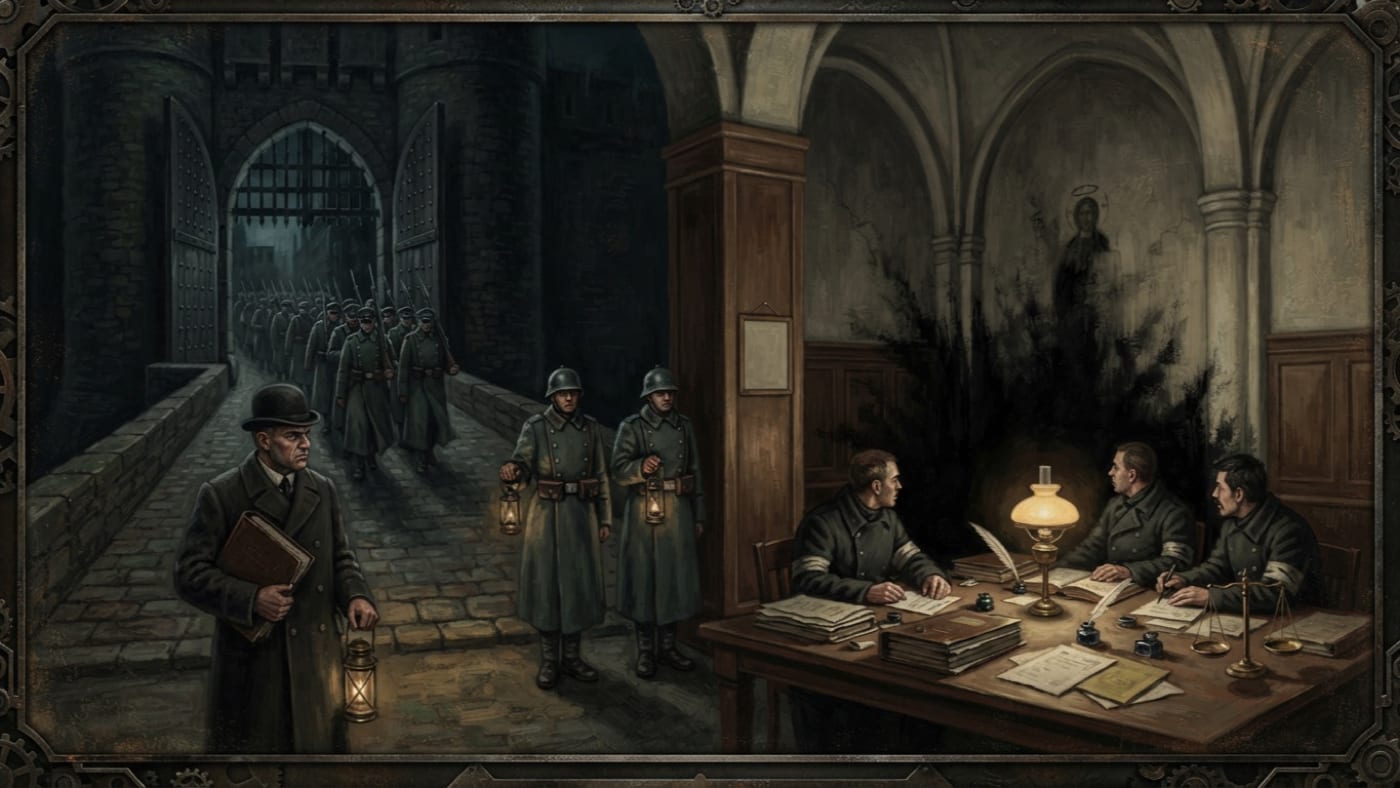
The Feast of Saint Bartholomew is in the Codex on two counts, and the saint is neither of them. At midnight on that feast in A.S. 25, the western gate of Aachen was opened to the Rationalists. According to the city's account, on the same feast every year the wall of the former confiscation office in the old Chapel of the Crowned Seat turns the colour of ink.
Pilgrims ask me about the saint's life. So do persons who should know better. They want the feast's rank, its vestment colour, its proper dishes and the length of its vigil. None of it appears in the files laid before me, and I don't write devotional pamphlets from guesswork. Aachen has taken the day for its own use, and that use is easily listed: one opening, one stain.
The year has to be handled with care. A.S. 25 is the Synod's reckoning, adopted at the A.S. 90 settlement and applied backwards. The men at the gate counted in the old style, as 1735. They were also counting casks.
#On the Midnight Opening
Lord-Protector Guillaume sold his citadel whole. The main price was dominion over the Lowlands. Colonel Verdane's receipt adds forty casks of Rhenish wine, twelve bolts of Flemish silk and "territorial considerations." The Bureau keeps that list the way a coroner keeps the contents of a stomach. I will give it no more space here. Guillaume has had his own folio. He doesn't get to take over the feast's.
Verdane bought for the Republican Guard, and he bought like a quartermaster. He wanted the stores full. He wanted the courier stables taken with the horses still in them, the bridge warrants seized and the chapel bells under his control before any sexton could reach a rope. Aachen sits where the roads from Cologne, Liège, Maastricht and the Lowlands meet. A man who burns a junction like that has wasted his money.
At midnight the Rationalist columns came through the western gate in ordered ranks. Their clean boots struck approach stones that pilgrims had worn smooth over centuries. There was no siege, no breach and no herald. In the middle years of the Atheist Wars a citadel changed hands with less noise than a guard changing.
The Bureau of Records holds that the feast was chosen for symbolic cruelty. I give the credit to Verdane. To be plain about it, the file doesn't. No planning paper in his hand names the day. My attribution rests on character. Guillaume had the imagination of a damp account book. Verdane had the Rationalist habit of treating saints as calendar furniture while claiming not to believe in them.
Nor does the record say whether that midnight began the feast or ended it. Records has never had to decide, because the city was lost either way.
#On the Roads Taken
The gate was the least of what was sold. Within hours the faithful courier relays had failed. Dispatches went out along routes that already belonged to someone else. Relief columns marched towards stores that enemy clerks had already stamped. By dawn the Rationalist flag was flying above Charlemagne's throne. Within a week the northern faithful front had broken. Within a year the Rhineland, the Lowlands and much of northern France were under the Broken Cross.
None of that needed a shot at the threshold. That is why the Rationalists later called the operation bloodless, and why the word should be handled with tongs. It was bloodless at the gatehouse. No bulletin went on to count the frozen retreat roads, the field hospitals that relief never reached, or the chapels near Liège emptied by a front that fell apart a hundred miles from Aachen. I won't supply a figure the archive doesn't have. I also won't accept an account that stops at the gatehouse.
The opening of Aachen on the Feast of Saint Bartholomew was accomplished without bloodshed.
Struck. The phrase is Rationalist. It was copied from enemy bulletins into an early abstract by a clerk who mistook their tidiness for accuracy. It describes one gatehouse on one night. The losses of the broken northern front are not entered at the gate, and the Bureau will not adopt an accounting that ends at a threshold.
#On the City's Continuing Penance
The chronology has to be kept in order, because pilgrims fold it up like a handkerchief. Aachen fell in A.S. 25. Rationalist administration was running the city before the Treaty of Regensburg made the Republic formal in A.S. 30. Fifteen years of that Republic ended with the Sundering in A.S. 45. The Church came out of the cellars after that, unevenly. The formal Synod did not exist until the Concordat of Strasbourg in A.S. 90, sixty-five years after the gate. Any account that has Bureaus administering Aachen on the night of the feast is a pious forgery, and a lazy one.
After the Concordat, Aachen was garrisoned and reconsecrated, and it was charged a permanent memory levy. The city's penance is now built into its stonework and its rosters. A cross is cut into the threshold of the western gate, and pilgrims cross it barefoot. Every soldier newly assigned to the garrison kneels there and recites the Gate Litany, all forty-seven clauses, from I did not open it through to hold me accountable anyway.
These are year-round practices, not feast rites. The record doesn't date their origins or tie them to the feast, and I won't attach them to it to make a better story. Aachen doesn't need Saint Bartholomew to remind it of anything. It remembers on ordinary Tuesdays, at a rate set by the Bureau of Doctrine.
#On the Wall That Darkens
Under the occupation, the Chapel of the Crowned Seat became a Rationalist legal office. Clerks signed confiscation inventories there beneath a scratched halo that none of them bothered to remove. Candlesticks, chests, altar linens and the goods of a confraternity were each entered as a numbered line, initialled in the margin and converted into public property with a stroke of the pen.
The wall of that office goes ink-dark every Feast of Saint Bartholomew.
It has been limewashed and it has been scraped. Both treatments have failed. A junior priest attempted an exorcism. His name is withheld from every file I have been allowed to see, and so are the rite and its formula. The result is recorded. The wall darkened again at the next feast, and the priest asked for a quieter parish. He was posted to Thessaloniki.
What follows is where the Bureau's distinctions matter, and where pilgrims ignore them. The reported fact is that the wall darkens. Nothing more is entered. No letters, names or figures appear in it. Nobody has shown that it weeps, bleeds or speaks, or that anything lives behind the plaster. The cause is unruled. Aachen has theories, as Aachen always does, and theories are not filed. Doctrine has not yet decided whether plaster can be culpable, and I won't decide it from the margin of a calendar notice.
Even so, the date is the one opinion the wall has ever expressed. The feast chosen for a midnight sale is the feast on which the room where the sale was carried out turns the colour of a clerk's ink. I report that the two coincide. I am not authorised to say why, and anyone who claims to know should be asked to show their seal.
#On the Day Still Kept
Aachen in A.S. 201 is prosperous, devout, watched and unreconciled. Its merchants pay the memory levy and its garrison polishes the threshold cross. Its petitions for rehabilitation go to Strasbourg and come back denied.
The record gives the feast no procession, no fast and no special Mass. What it does record is a nightly locking that makes no exception for saints. At curfew three clerks witness the western gate being barred, two soldiers hold the hinge lamps, a single bell sounds and the key is turned. On Saint Bartholomew's night it is done the same way. The gate that was opened at midnight in A.S. 25 is shut, under witness, before midnight on every night since the garrison came.
Across the city, a wall that has been limewashed and scraped is turning black again.