
#On the Dispensation
"Innovation is mercy when stamped." — official line of the Priorate Council, San Vesta
The Church has never feared the engine. It fears the engine that nobody blessed before it was built. Every cannon on the Line carries its blessing the way it carries its proof-mark. Every foundry boiler is consecrated before it is lit. Since the Concordat of Strasbourg gave it a constitution, the Synod has held that an invention belongs to the seal before it belongs to the inventor. The Rationalists thought flesh could be patched like a leaking roof. They are ash, and the point has been made.
Against this settled order, the Ember-Priory of San Vesta holds an exception I have found nowhere else in the archives: its physicians, bakers and kiln-masters may experiment.
The governing instrument is Dispensation 77-V of the Bureau of Doctrine, Iberian Theater, concerning innovation under controlled doctrinal parameters. It covers the priory. Affiliated priorates may petition for an extension, and that right to petition is the whole of what the instrument gives them. It was renewed in A.S. 194 and remains active at this survey of A.S. 201. My copy does not say when it was first sealed, or by whose hand. The Bureau of Records reports that the original is "held." I asked where it is held, and was told my question had been noted.
#On the Three Seals
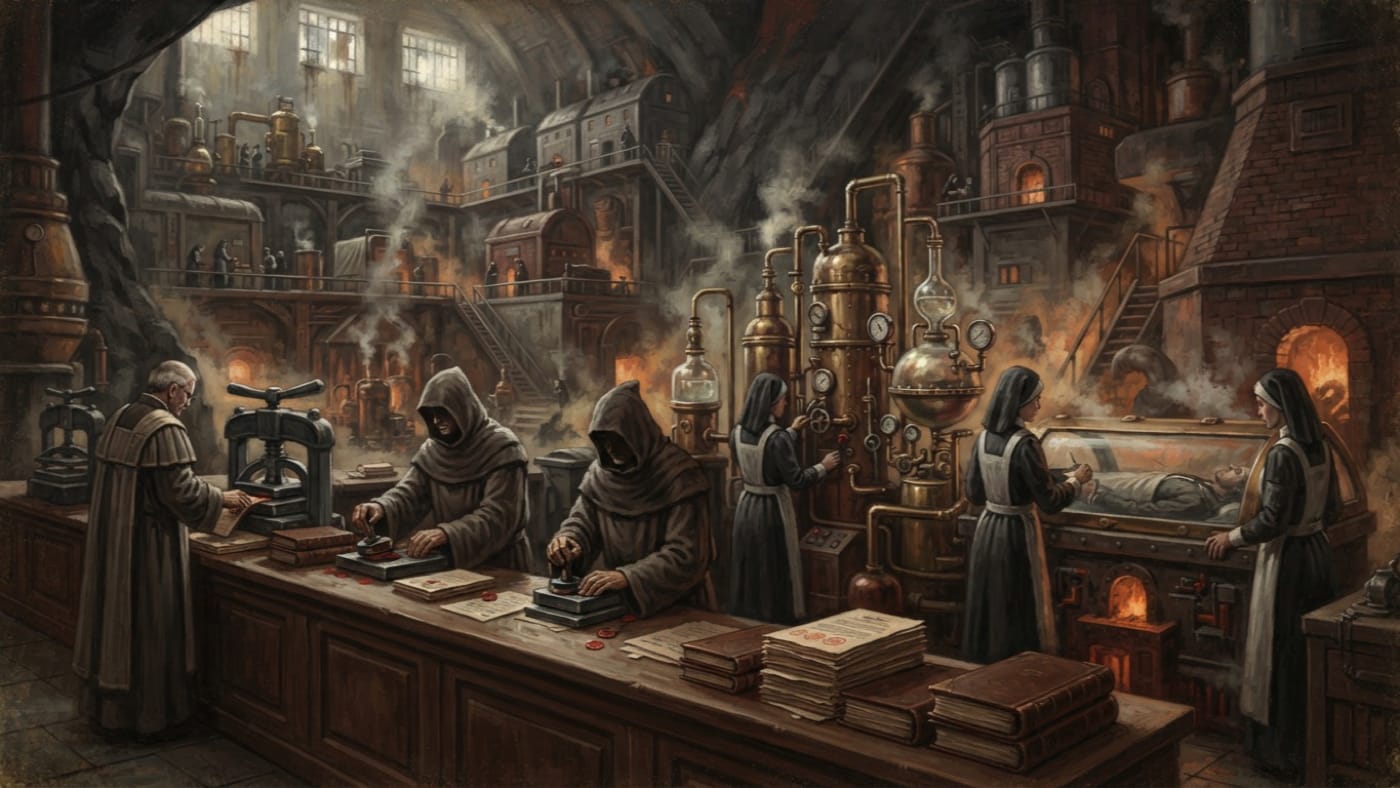
An experiment at San Vesta begins as a written proposal. It states what is to be heated, mixed, burned or administered, in what measure, and to whom. The Infirmary Tribunal of Scorch reviews it first. Once reviewed, it goes to the Priorate Council for approval. Once approved, it carries the stamps of both bodies to the regional office of the Bureau of Alchemical Standards, which either counter-stamps it or does not. A counter-stamped proposal goes to the Ledger Cloisters, where the clerks copy it and file all three copies. Only after that may the proposer light an experimental flame or lay a hand on a patient.
Careless readers confuse the parts. Three seals approve the work: those of the Priorate, the Tribunal and Alchemical Standards. Three copies record it, and the filing is a separate duty done by other hands in another building. The Bureau of Doctrine puts no seal on any single proposal. What it sealed, first and again at renewal, was the permission for proposals to exist. The Oven Quartermastery is the third partner in the priory's governing tri-compact, but it signs nothing here. It has no need to. Quartermaster Odran Ashweight controls the flour and the coal, and an experiment approved under three seals but refused its coal remains an experiment on paper.
The sequence is fixed, and the fever has no say in it. Suppose a dying man's condition turns for the worse after the Tribunal's stamp and before the Bureau's counter-stamp. For the purposes of the dispensation, no experiment is available to him. He has conventional medicine, confession and the wait. The clerks do not hurry, because haste breeds errors, and an error made in triplicate is three errors.
The penalty for going ahead without sanction takes one line: the practitioner is reclassified as a HERETICAL OPERATIVE. The dispensation says nothing about what comes after the reclassification. Other offices keep their own instruments for heretical operatives, and San Vesta drafted none of them.
#On Mercy and Recovery Service
The scorch-cure is the dispensation's best-known offspring. Patients lie in sealed chambers under graduated volcanic heat while Sister-Physics record their observations in a notation somewhere between a medical chart and a transcript of confession. Symptoms are written down next to sins, and both are dosed. An approved protocol is performed the way a liturgy is performed, in order and without improvisation. A physician who departs from it has departed from something the Church holds sacred, and that departure has a name: heresy.
Recovery is paid for in labour. The cured owe recovery service in the ovens, the canalworks, the kilns or the dormitories, with the term set by the illness and the cost of treating it. A full scorch-cure for advanced trench-fever costs one year. The year begins on the day the Tribunal declares the patient well. That declaration is a stamp, and nobody asks the patient's lungs.
Then there is resurrection-bread. A dying person who eats it lives three more days. I chose those words carefully and expect them to be copied carefully. The bread postpones death. It does not cure whatever is killing the person who eats it. The pilgrim who accepts it signs a lifelong recovery-service oath, on a form the Bureau of Oaths would recognise as its own. The Bureau of Doctrine has been petitioned nine times to say whether the bread is a miracle, and nine times it has declined. A refusal is not a certification. The dormitories quote it as a yes. The Cinder Markets quote it as a no. Both are wrong in the same way.
The ordinary bread needs no proposal. Ash-bread has been baked the same way for decades, and the Bureau of War orders six thousand loaves a month because they do not rot. Relic-smoke falls somewhere in between. Its official purpose is spiritual stabilisation. In practice it sedates, and the Bureau of Purity has described its effect in internal memoranda as "ideal for public assembly management."
#On Acceptable Failures
Sister-Physic Marra Vell runs Ward Seven, the experimental wing, and talks in dosages. The Bureau of Alchemical Standards calls her recovery rates "statistically notable." Some of her patients recover in a way the Tribunal calls variant convalescence. They walk differently afterwards and pause in odd places in their sentences, and a few remember things that happened to other people. When a ward shows these signs, the Tribunal quarantines it.
At San Vesta, "acceptable" has a local meaning: someone in authority has decided that you may be lost.
The Innovation Annex, which its workers call the Approved Fire, sits on the highest terrace. Its kiln-ceramic walls are thick enough for what goes on inside them. Results judged unacceptable go into a sealed archive. Prior Celestín of the Third Ember and the head of the Tribunal open it together once a year. Nobody else is on the list.
The ledger of acceptable failures is a separate object in separate custody. It is bound in fired ceramic and kept behind a door that needs two keys, held by two people who are forbidden to speak to each other. Its entries are incomplete, with columns left empty that a full record would have filled. The Tribunal calls these "self-resolving cases." The Prior calls them "the cost of mercy." Neither phrase was offered as an explanation. The Tribunal decides what a failure was. The Prior decides what a sermon will call it. Once a year, behind a door, the two of them decide what the archive holds.
#On the Limits of Permission
The dispensation permits experiment, and only experiment. It is no licence to export. The priory treats three other acts as lines that may not be crossed: selling resurrection-bread outside its walls, bringing in cold-science texts, and falsifying cure ledgers to make an outcome look better. The dispensation names a penalty only for unsanctioned innovation, and I will not give the other three a sentence the documents do not.
The permission does not travel, either. An affiliated priory that wants an Approved Fire of its own must petition for one. Santa Brasa, the rival house three days to the east, higher and cooler, has started advertising what it calls "cool cures." I cannot certify under what authority Santa Brasa cures. I note that the Prior has not asked me to.
The Cool Mask Brotherhood is another matter. It makes cloth-and-charcoal masks for the kiln workers and hands them out through channels the Bureau of Purity has mapped and left open. Without the masks the workers would stop, and without the workers the incense would stop. This is tolerance bought by arithmetic, and nobody should mistake it for sanction. When the Tribunal quarantines a ward, the Brotherhood carries medicine and people out through the lava-tube underpaths. That is unstamped mercy, and the dormitories have their own line for it: "Stamped mercy still burns."
#On the Present Application
As of A.S. 201, demand for resurrection-bread has outrun every increase in production Prior Celestín has authorised, and he has authorised two in eighteen months. The Tribunal has restricted distribution, on the ground that "theological stability requires controlled access." Fragments of the bread now trade in the dormitory maze like contraband. When this survey closed, a flour convoy from Vall de Sal had been reported late, and Quartermaster Ashweight had sealed the gates and begun the count. Every proposal in the Ledger Cloisters waits on that count, however many seals it carries.
The Bureau of Mercy audited the infirmary in A.S. 199 and sealed its findings. Its assessment once read "compassionate efficiency." It now reads "efficient." Since that same year the vent beneath the priory has risen two degrees. The Vent-Wardens measure it every day and report it every week.
People at San Vesta see doctrine as text moving in the heat-shimmer above the ovens. Lately that text has included phrases found in no catechism, no approved text and no sealed archive, with no authorised source to account for them. The priory shuts the vision-struck in the Cool Rooms, cut deep into the basalt, and adds incense dampeners, silence masks and mirror-prayers. The text itself has never been through the Tribunal, the Council or the regional office. It carries no seal and has never been filed. No one has said who would stamp it.
The Bureau of Alchemical Standards classified San Vesta's heat-visions in A.S. 187 as "a localised atmospheric phenomenon consistent with volcanic mineral sublimation."
Revised A.S. 199: "Category Two Visual Disturbance, Doctrinal Origin Not Excluded." The atmospheric explanation has been withdrawn, and no replacement has been entered.
The seals are still applied in their proper order, and the dispensation remains in force.