
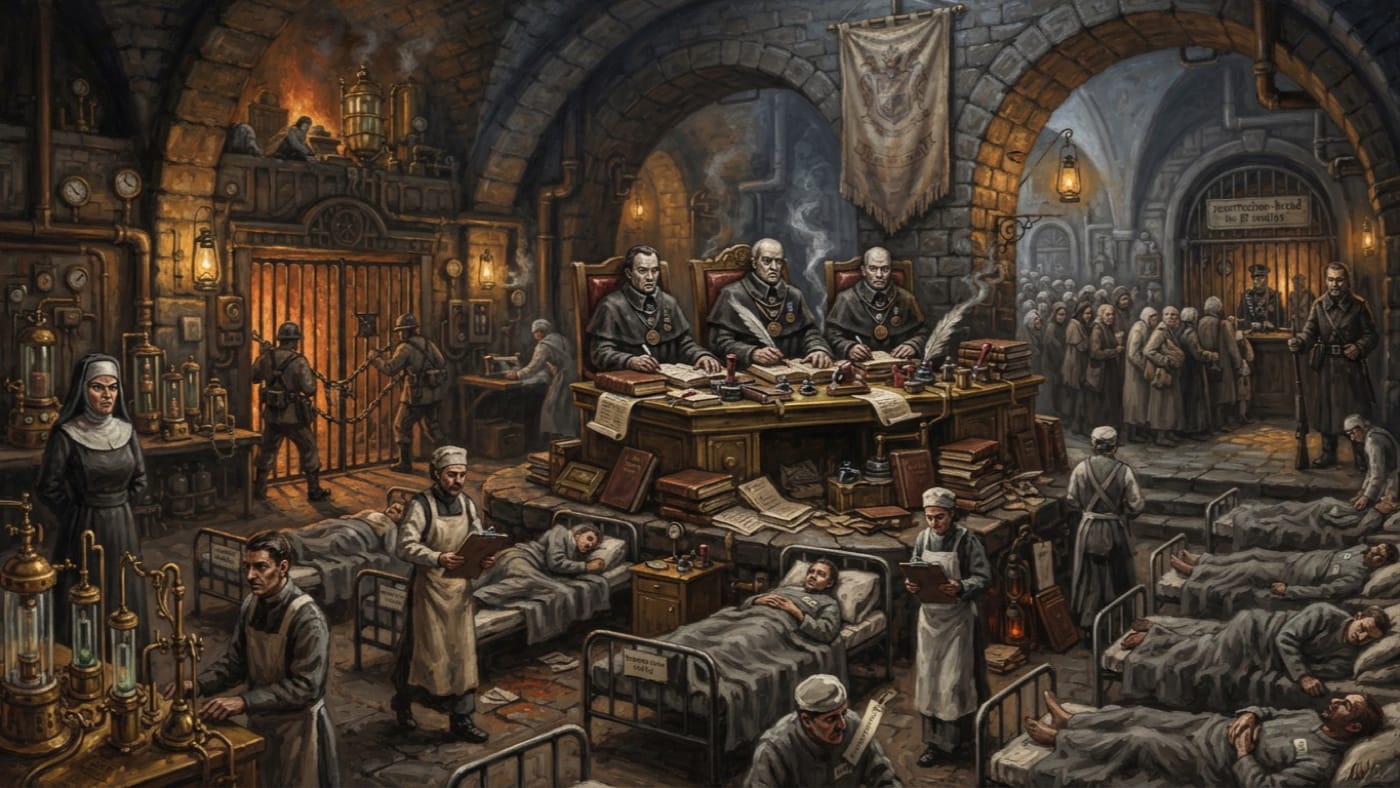
I've read the continuity reference, the style guides and the dedicated San Vesta lore. Now writing the article.
#On the Tribunal's Station
"Innovation is mercy when stamped." — San Vesta propaganda line
The Infirmary Tribunal of Scorch holds jurisdiction over the Scorch-Cure Infirmary of San Vesta: seven wards, two quarantine blocks, a surgery in the basalt undercroft, and the damp Cool Rooms cut below them where the volcanic heat does not reach. The Infirmary is a set of rooms. The Tribunal decides what happens to a body once it is inside them.
It is one partner in the priory's governing arrangement, beside the Priorate Council, which holds the doctrine stamps, and the Oven Quartermastery, which holds the flour. The priory's own account dates the ratification of that arrangement to A.S. 112. Nobody has published a date for the Tribunal itself, and I decline to supply one. Institutions of this sort are generally older than their charters and younger than their claims.
Its declared function is medical ethics. The orderlies, who carry the cots, put its practical function more plainly: it manages acceptable losses. The two descriptions are compatible. Ethics, in a ward, is the art of deciding who comes second.
#On Triage and Recovery Service
A patient admitted to the Scorch-Cure receives a ward bracelet and, with luck, a triage slip. The slip states rank. Rank governs the order in which heat, antiseptic smoke, the surgeon's attention and the Sister-Physics' notation reach the complaint, and order is everything. In the blue-white wards, a fever treated on the second day and a fever treated on the fifth are different diseases in the ledger.
Priority can be bought. At San Vesta this counts as commerce, and nobody treats it as a scandal. Counterfeit triage slips change hands in the dormitories for the same reason forged passes change hands at any gate: the paper is worth more than the paper costs. Against forgers the Tribunal uses quarantine writs and forced testimony, and it takes that testimony in the wards or the Cool Rooms, where the stone is cold and the witness is not going anywhere.
One thing is never for sale: the relapse exemption. Only the Tribunal can grant it. I will not describe its terms. The Tribunal has not published them, and a Warden who invents the terms of another court's mercy deserves to appear before that court.
Then the bill comes. A patient cured at San Vesta owes recovery service, paid in labour at the Great Ovens, the canalworks, the kilns or the dormitories. A broken arm costs three weeks and a lung infection six. A full scorch-cure for advanced trench-fever costs a year, and that year begins when the Tribunal declares the patient well. A patient may still feel ill after that declaration. The ledger takes no notice. The work goes on until the ledger says the body is paid. A patient discharged straight into labour conscription is said to have received "friendly severance," and the phrase is recorded without comment.
#On Permission to Experiment
San Vesta is allowed to experiment under Dispensation 77-V of the Bureau of Doctrine, last renewed in A.S. 194. The original issue date does not appear in the copies circulated to the Iberian theater. Under the doctrine of acceptable innovation, each experiment follows the same sequence. A written proposal goes to the Tribunal for review. Approval comes from the Priorate Council. Both bodies stamp it, the regional office of the Bureau of Alchemical Standards counter-stamps it, and the Ledger Cloisters file it in triplicate. Only then may anyone light a flame or touch a patient.
The reader should not confuse this approval chain with the priory's governing arrangement. Priorate, Tribunal and Quartermastery govern San Vesta. Priorate, Tribunal and Alchemical Standards approve its experiments. The Tribunal sits in both groups. The Quartermastery sits only in the first, and anyone who takes that for a loss of standing has never tried to heat a sealed chamber without its coal.
The dispensation comes from Doctrine and the stamps come from the Tribunal, but the supplies come from the Quartermastery. A fully stamped proposal without flour, coal or allocated hours is a very well-documented intention. A procedure carried out without the stamps is a different matter altogether. Its practitioner is reclassified as HERETICAL OPERATIVE, and the dispensation says nothing more about them.
#On Quarantine and Acceptable Losses
Ward Seven is the experimental wing, and Sister-Physic Marra Vell runs it. She controls the cures and the triage lists. She speaks in dosages, and she does not blink near flame. Nothing on record names her head of the Tribunal, and I make no such claim. She does not need the title. Anyone who decides the order of treatment has already decided most of what follows.
The Bureau of Alchemical Standards calls her recovery rates "statistically notable." Some of her patients leave walking with an altered gait. Some pause in odd places when they speak. Some remember things that happened to other people. The Tribunal's term for this is "variant convalescence," and Vell's is "atypical recovery patterns." Both terms describe the condition and neither explains it, which is exactly what institutional language is for. When a ward shows these patterns, the Tribunal locks down the quarantine zone around it.
Results that fail review go to the archive of unacceptable results in the Innovation Annex, called the Approved Fire. The published account of the priory says the Prior and the Tribunal head open it together once a year. Separately, a ledger of acceptable failures sits behind a door that needs two keys, bound in kiln-fired ceramic. No published record names the keyholders, and the account does not say they are the two officers who open the archive. Many of the ledger's entries are incomplete, with the outcome left out. The Tribunal calls such entries "self-resolving cases." In the priory's slang, "acceptable" means someone has decided you can be lost.
The Bureau of Mercy described San Vesta's infirmary as "a model of compassionate efficiency."
The Bureau of Mercy has revised its assessment, which now reads "efficient." The adjective was removed after an internal audit in A.S. 199, and the audit's findings remain sealed.
#On the Three-Day Allocation
A dying person who eats resurrection-bread gets three more days. The bread delays death but does not cure the underlying condition. Some recipients survive past the three days, and the records do not say what happens to them afterward. Speaking of a fourth day is forbidden at San Vesta, and I follow the ban.
Each recipient signs a lifelong recovery-service oath on the template of the Bureau of Oaths. That is the price of the three days, and it applies to whatever life remains. Responsibility for the bread is divided. Prior Celestín of the Third Ember authorizes production and has raised it twice in eighteen months. Quartermaster Odran Ashweight controls the flour and coal. The Tribunal decides who receives the bread, and it has restricted distribution on the grounds that "theological stability requires controlled access."
The Bureau of Doctrine has been asked nine times, by formal petition, to certify the bread as a miracle. It has refused nine times. My reading of that silence was set down elsewhere, and I hold to it. The Bureau, for its part, holds only to the refusal.
The Third-Day Debtors gather in the dormitories and hold vigils for wider access. They do not dispute the oath. They dispute the queue.
#On the Present Pressure
As of A.S. 201, the Tribunal's authority is unchanged on paper. In practice it is under strain. Pilgrim intake has tripled in four years. The dormitories have overflowed into the Cinder Markets, and the line at the Flour Gate starts before dawn. Demand for resurrection-bread is higher than every production increase the Prior has approved. Because the Tribunal restricts distribution, a black market in bread fragments has grown in the dormitory maze. Those fragments are unstamped, unrecorded, and claimed by nobody until a buyer collapses.
The Tribunal still controls the quarantines. Getting patients out of them is another matter. The Cool Mask Brotherhood makes respiratory masks for the kiln workers, and the Bureau of Purity tolerates that. Through the lava-tube underpaths below the canalworks, the Brotherhood also smuggles medicine and people out of the locked zones. Purity's tolerance covers the masks and nothing else on record. The Debtors push for more bread. The Brotherhood takes patients away. Each one is a separate challenge to the same court.
A flour convoy from Vall de Sal is three days late. Ashweight has sealed the gates and started counting mouths against loaves. Before that count is finished, the Tribunal will have to decide which beds remain beds and which patients are declared well enough to work.