
#On the Approved Fire
"Innovation is mercy when stamped." — Priorate line, as posted on San Vesta's terraces
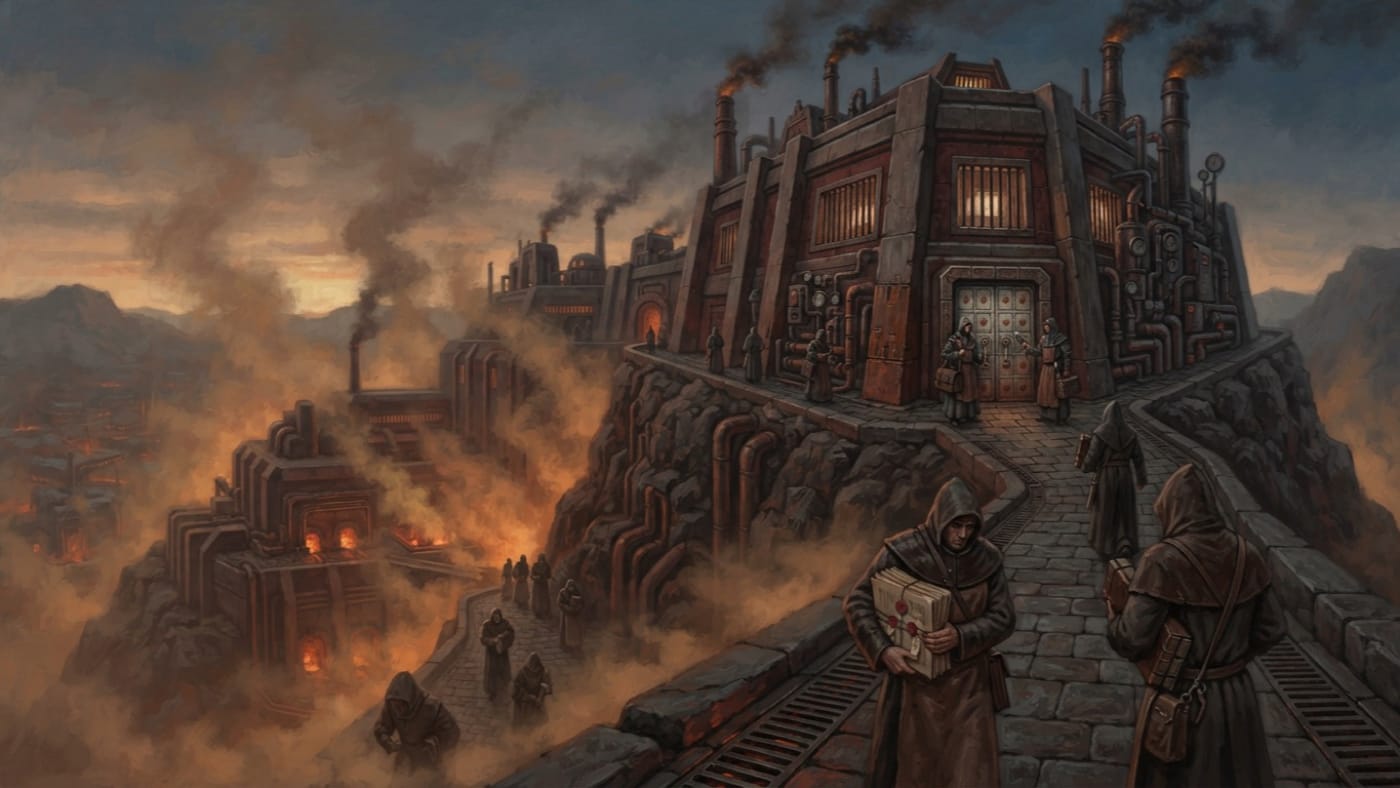
At the summit of the Ember-Priory of San Vesta, above the shimmer-line, the heat from the lower terraces thins enough for a clerk to read his own signature. That is where the Innovation Annex stands. San Vesta calls it the Approved Fire. Both words are accurate, which is rare for anything in the Iberian Ember-Priories and rarer still for anything that has a nickname.
The buildings are kiln-ceramic, fired hard and walled thick. By the account of the priory's A.S. 201 survey, the walls are thick enough to contain what the experiments sometimes produce. The paths are basalt and the drains are iron grates, and here and there a seam of slag-glass catches the glow from below. The experimental halls are ringed by silent heat zones, where speech is discouraged and the air speaks instead. It smells first of ozone, sharp as a censer struck against stone, and under that of burnt sugar. Nobody who has smelled the second there wants to smell it in a kitchen again.
Below, close enough to hear, the productive priory works. The Great Ovens of Vesta take the primary flow of heat. The Scorch-Cure Infirmary takes its own measured share. The Ledger Cloisters keep the hours in ink warmed by stone. The Annex sits over all of this like an examiner over a candidate. Every document that mentions it states its purpose plainly, and I will do the same. Here, under licence, the priory's physicians, bakers and kiln-masters may attempt things that would earn them a pyre anywhere else in the Church.
#On Permission to Experiment
Nothing in the Annex begins with fire. It begins with paper.
The governing instrument is Bureau of Doctrine Dispensation 77-V. It concerns innovation under controlled doctrinal parameters, and it applies to San Vesta alone. An affiliated priorate that wants the same privilege must petition for extension and wait. The theology of the arrangement belongs to the Doctrine of Acceptable Innovation, and I refer the curious reader there. This survey is concerned with the route a proposal travels before it may touch a flame or a patient.
The proposal is written. It goes first to the Infirmary Tribunal, which reviews it. It goes next to the Priorate Council, which approves it or declines to. Both bodies stamp it. It then goes to the regional office of the Bureau of Alchemical Standards for a counter-stamp. That makes three authorities and three seals. After the seals come three copies, filed at the Ledger Cloisters. A reader who confuses the three seals with the three copies has made exactly the error the Cloisters' clerks are paid to make for him. He should leave it to them.
Only then may the practitioner light anything.
The stamps license the work, but they do not supply it. Coal and flour belong to the Oven Quartermastery. The Quartermastery is one leg of San Vesta's governing tri-compact, and it has no part in the experimental seal. A proposal blessed by Tribunal, Council and Bureau can still wait on Quartermaster Odran Ashweight's allocation. Ashweight allocates by the shipment manifest, and the manifest has never once consulted Providence.
Skipping a step carries an administrative penalty, and it is absolute. A practitioner who experiments without the full chain is reclassified as a HERETICAL OPERATIVE. The dispensation specifies the reclassification and says nothing of what comes after it. It has no need to. The Bureau of Purity keeps its own forms.
#On Bodies Under Trial
Three trades hold the licence: physicians, bakers and kiln-masters. They do not all practise in one place. The Annex is the sanctioned experimental establishment of the summit. Ward Seven is the experimental wing of the Scorch-Cure Infirmary below, run by Sister-Physic Marra Vell, who controls its cures and its triage lists. The two institutions are associated in the way a furnace is associated with its bellows. Pilgrims confuse them. The Tribunal does not, and I will not either.
Whatever the experimental programme sends down to the patient arrives with a bill. Every body cured at San Vesta owes recovery service, labour shifts that continue until the ledger declares the body paid. Some patients come back from Ward Seven altered. Their gait has changed. They pause in speech where no pause belongs. They remember things that appear to have happened to someone else. The Tribunal records this as variant convalescence. Vell prefers atypical recovery patterns. Neither term names a cause, and both were chosen for exactly that property.
Then there is resurrection-bread, the innovation the pilgrims climb for. It gives a dying recipient three more days. It cures nothing. The underlying condition waits politely through the third evening and then resumes. Some recipients outlast the window all the same, and they discover what was actually purchased: a recovery-service oath that runs for the rest of their lives. The recipe is classified. I have no intention of declassifying it in a codex that anyone with a reading-room pass can open.
Whether the bread was perfected inside the Annex, in the ovens, or somewhere between them, the published record declines to say. I decline with it.
#On Acceptable Failures
The Annex keeps its mistakes in two documentary arrangements. They are distinct, and the distinction is the most carefully guarded thing on the summit.
The first is the archive of unacceptable results, and it is sealed. Once a year two people open it together: the Prior, who at present is Prior Celestín of the Third Ember and also controls the doctrine stamps, and the head of the Infirmary Tribunal. They review the contents and seal it again. What the review finds is filed nowhere I can requisition, and what it decides is equally unavailable. The ceremony is annual, joint and closed. Its only public product is the knowledge that it took place.
The second is the ledger of acceptable failures. It is bound in kiln-fired ceramic covers and kept behind a door that needs two keys. Two people hold the keys, and those two people are forbidden to speak to one another. I have studied the arrangement with the professional admiration of a man who has spent his career designing locks for archives, and I can find no flaw in it. Neither holder can open the room alone, and the two holders cannot discuss a reason to open it together.
The ledger is incomplete. San Vesta's own accounts disagree about which of its columns stand blank, and nobody has invited the Bureau of Records to settle the matter. That the blanks exist is not disputed. The Tribunal calls such entries self-resolving cases. Prior Celestín calls them the cost of mercy. Quartermaster Ashweight calls them nothing at all and checks the next manifest.
The surviving record does not say who decides which book receives a given result. Acceptable results go into a ceramic book guarded by two people who may not speak to each other. Unacceptable results go into an archive that two superiors visit once a year. As far as the documents show, there is no third category for results that were simply people.
#On the Present Condition
"If the smoke writes you, don't read it." — San Vesta saying
This assessment is a companion to the priory's A.S. 201 survey. On that survey's evidence, Dispensation 77-V remains active and was last renewed in A.S. 194. Its conditions stand unaltered, and the Annex works under them. The pressures on that work are documented in the parent survey, so they need only be listed here. Demand for resurrection-bread outruns every authorised increase in production. The Tribunal restricts distribution in the name of theological stability, and the dormitories object, loudly. Every experiment above the shimmer-line waits on flour and coal that arrive by convoy, or arrive late. Ward Seven continues to discharge patients who recover atypically.
And the heat keeps writing.
The heat-visions take workers, pilgrims and patients, and occasionally provosts. Those affected see doctrine moving as text in the shimmer above the ovens, and some follow it into the ovens. The countermeasures are confinement in the Cool Rooms, which are cut deep into the basalt far below the Annex, along with incense dampeners, silence masks and mirror-prayers. In A.S. 199 a Vent-Warden reported that the text had begun to produce phrases found in no catechism. Since that year the sealed vent beneath the priory has warmed by two degrees, measured on a scale the reports do not name.
Nobody has traced any of this to the Annex. The parent survey's informants hold that the bread borrows. The Bureau of Alchemical Standards has declined to classify what it borrows from.
In A.S. 187 the Bureau of Alchemical Standards classified San Vesta's heat-visions as "a localised atmospheric phenomenon consistent with volcanic mineral sublimation."
The classification was revised in A.S. 199 to "Category Two Visual Disturbance, Doctrinal Origin Not Excluded." The Annex's permits were not revised with it. An establishment licensed to produce controlled innovation now operates beside a shimmer that produces uncontrolled doctrine. Only one of the two has filed a proposal.
The Annex's status is therefore settled as follows. It is authorised, stamped, filed in triplicate, and answerable for nothing it has not written down.
Nihil obstat. The ovens below have already been informed.