
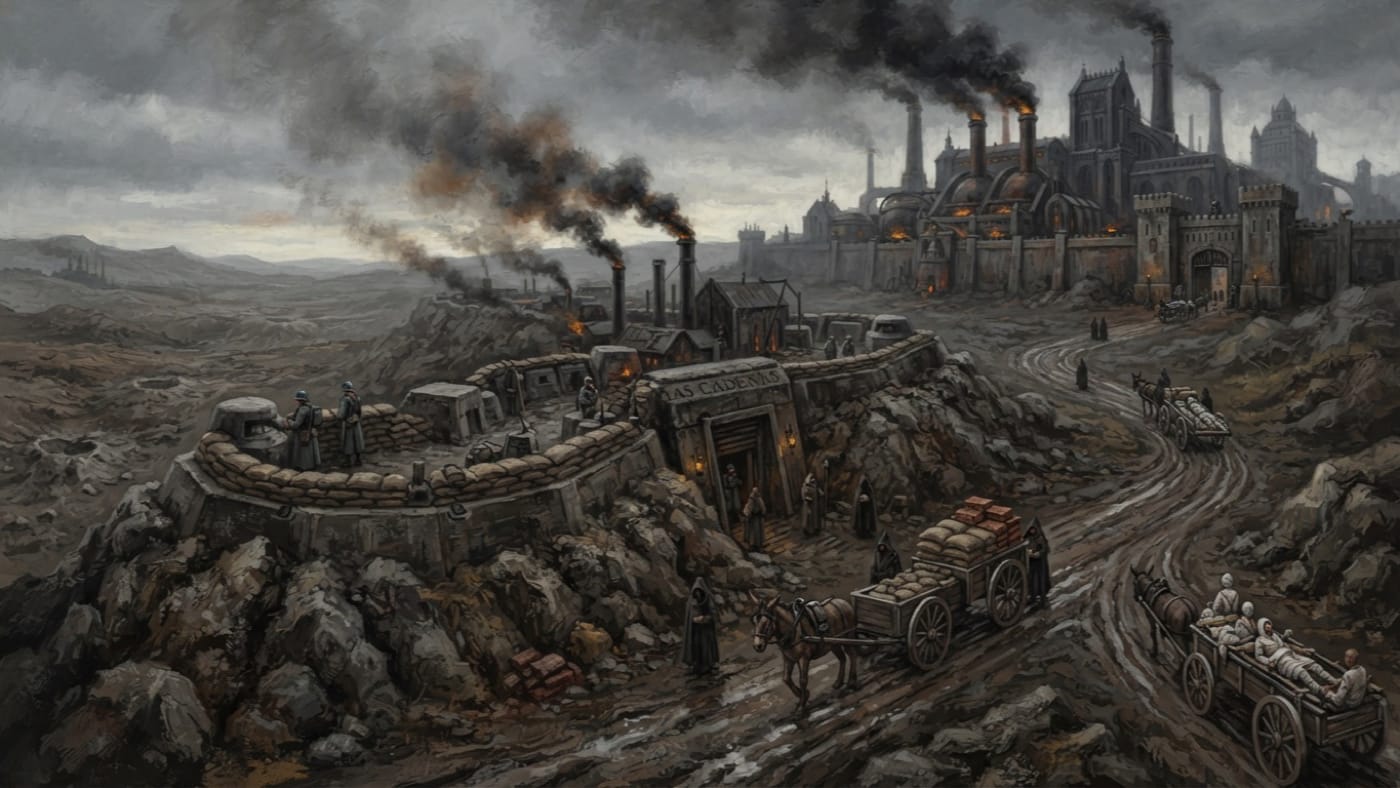
"Eat the ash. Keep the oath." — Inscription above the Flour Gate of San Vesta. Las Cadenas has the first clause by requisition.
#On the Bastion's Situation
Las Cadenas is a trench bastion of the Iberian theater, standing one to two days from the Ember-Priory of San Vesta. The priory's own register gives the distance in days, and so do I. I have no mileage, no bearing and no surveyor's plate. I decline to draw a map merely to look better informed than the register. One day or two: the difference is weather, the road, and what is loaded on the cart.
What is loaded on the cart is the whole of the matter. Bread and incense go toward the bastion, and wounded come back from it. San Vesta's register gives Las Cadenas one line among the priory's neighbours and sums the arrangement up in a single word: dependent. The Bureau of Records has written longer entries on inkwells. It has rarely written a more accurate one.
The reader should keep the scale in view. Las Cadenas is a local fortification of the western territories, and it has nothing to do with the seven great bastions of the Sagittal Line, which hold their spine far to the east between Königsberg and Constantinople. No document before me names its founder, its founding year, its commander or the enemy across its wire. I will not supply any of them. A bastion can be defined by its foes or by its larder, and this one is recorded by its larder.
#On the Bread
The ash-bread of San Vesta is dense, grey-crusted and mineral on the teeth. The priory's survey calls it sufficient, which is the highest praise the Oven Quartermastery allows. The same survey observes that a month-old loaf could serve as a trench-step. At a trench bastion that joke turns into a description of equipment.
Its value lies in how long it keeps, because nobody values it for the taste. Ash-bread hardens and does not spoil. In A.S. 134 the Bureau of War tested loaves that had been baked three years earlier and found them "nutritionally adequate, if spiritually oppressive." It then ordered six thousand additional loaves a month, and the instrument it issued is reproduced here in the form the priory's survey preserves:
Look at the order of destinations. Las Cadenas comes before the forward depots and well before the pilgrims. The Bureau of War does not hand out precedence lightly, and when it names a single bastion as the primary destination of a perpetual order it is telling you which mouths it considers its own. The pilgrims come third. The pilgrims always come third.
The figures need careful handling, because clerks who handle them carelessly get promoted. The Great Ovens bake six thousand loaves per watch at full draw, which is production. The Bureau's order of A.S. 134 added six thousand loaves a month, which is procurement. Neither figure says how many loaves reach Las Cadenas, how often the carts leave, or how many soldiers stand behind the parapet to eat what arrives. A reader who divides one number by the other to work out a garrison will get an answer, and it will be fiction with a seal on it. I decline the division.
There is one thing the order does establish. A garrison that cannot do without another house's bread lives on that house's schedule. The perpetual renewal guarantees the loaves. It also guarantees that the soldiers depend on them.
#On the Smoke
The second cart carries relic-smoke (Unregistered), pressed into bricks in San Vesta's Kiln Hall and shipped to tribunals, cathedral chapters and bastions. The Bureau's stated purpose for it is "spiritual stabilisation." In sufficient quantity it sedates, and it produces a docility that the Bureau of Purity has praised in internal memoranda as "ideal for public assembly management." A bastion is a public assembly that has been told to stay put.
The priory's survey describes three grades. Litany is mild and associated with cathedral use. Vigil is moderate and associated with trench-chapel rotation. Contrition is strong and reserved for circumstances the Bureau prefers to leave unwritten.
The obvious next step is to assign Vigil to the trench chapels of Las Cadenas and move on. The name invites it, and the inference is tidy. It is also unsupported. No document before me says which grade the bastion receives, in what quantity, on what schedule, or who in the garrison decides when a brick is lit. The dependence on incense is confirmed and nothing beyond it is. I record that much and leave the rest blank, because the Ledger does not fill its gaps with guesses about other people's lungs.
The arrangement is plain enough without the grade. The house that calms the garrison also feeds it, and that house is about to receive its wounded.
#On the Wounded
The return carts are the third traffic, and the heaviest.
The register says Las Cadenas sends its wounded to San Vesta. At the priory they come under the Infirmary Tribunal of Scorch, which governs the Scorch-Cure Infirmary (Unregistered) and is in practice a court. It decides who is treated, in what order, on what terms, and at what price. The price is always the same: recovery service, worked in the ovens, the canalworks, the kilns or the dormitories until the account is settled.
The published tariff reads like a confessor's table. A broken arm costs three weeks and a lung infection six. A full scorch-cure for advanced trench-fever costs a year, and the year begins when the Tribunal declares the patient well. Whether the patient feels well does not enter into it. A soldier carried up from the trenches with fever owes nothing on arrival, and owes the priory a year from the day a tribunal decides they have been cured.
These are San Vesta's terms. I hold no Bureau of War regulation that sends every casualty of Las Cadenas into them, no written compact between bastion and priory, and no record of where any particular soldier went once their account was discharged. Whether the bastion gets its people back, or when, or in what condition, no document before me says. The wounded leave Las Cadenas as soldiers. If they are cured at San Vesta, they come out of treatment owing the priory labour.
One assignment on the Tribunal's list deserves the reader's attention. Recovery service may be worked in the ovens. A soldier cured there may therefore spend the debt baking the Bureau-stamped loaf that Standing Order 1138-V sends, as primary destination, back to their own trench. The Ledger records no such case by name. The Ledger has no need to, because the cycle runs whether anyone writes it down or not.
The Tribunal's reputation has not stood still while the carts kept coming.
The Bureau of Mercy assessed San Vesta's infirmary as "a model of compassionate efficiency."
Following an internal audit in A.S. 199, whose findings remain sealed, the Bureau of Mercy revised its assessment of San Vesta's infirmary to "efficient." The revision applies to the priory's infirmary. The Bureau has issued no corresponding assessment of the bastion that supplies its patients.
#On the Present Dependency
San Vesta does not grow its own flour. It imports it, much of it through the coastal port of Vall de Sal, and as of this survey a convoy from Vall de Sal is three days late. Quartermaster Odran Ashweight, who controls the priory's flour and coal allocations, has sealed the gates of the Oven Quartermastery and begun the count of mouths against loaves, shifts against hours, and heat against the fuel that feeds it.
No report places Las Cadenas in that count. No carrier has reported a missed delivery to the bastion, a reduced ration, unrest behind the parapet or an enemy pressing on it. I say so plainly because rumour goes faster than any cart, and I will not have this assessment quoted as proof of hunger that nobody has documented.
The vulnerability is real all the same, and it sits upstream. Standing Order 1138-V promises perpetual renewal and annual review. It promises nothing about a late convoy at a port that is not on its distribution list. Its tiers rank the destinations of bread that has already been baked. They do not tell Ashweight whether, on the night of a short count, the Bureau's primary destination comes before the priory's own ovenmen, convalescents and pilgrims. Prior Celestín of the Third Ember governs San Vesta and has published no ruling on the point. The Quartermaster has published nothing either, and on the evidence of his reputation he is busy with the count.
A field commander would call this exposure of the supply line. The Bureau of War would call it a scheduling matter. Both are accurate, and only the second has a form to file.
The bread will come, or it will be late. The smoke will come in bricks of an unrecorded grade. The wounded will go up the road, and some of them will work off their debt at the ovens that feed the trench they were carried out of.
Nihil obstat.