
#On the Present Survey
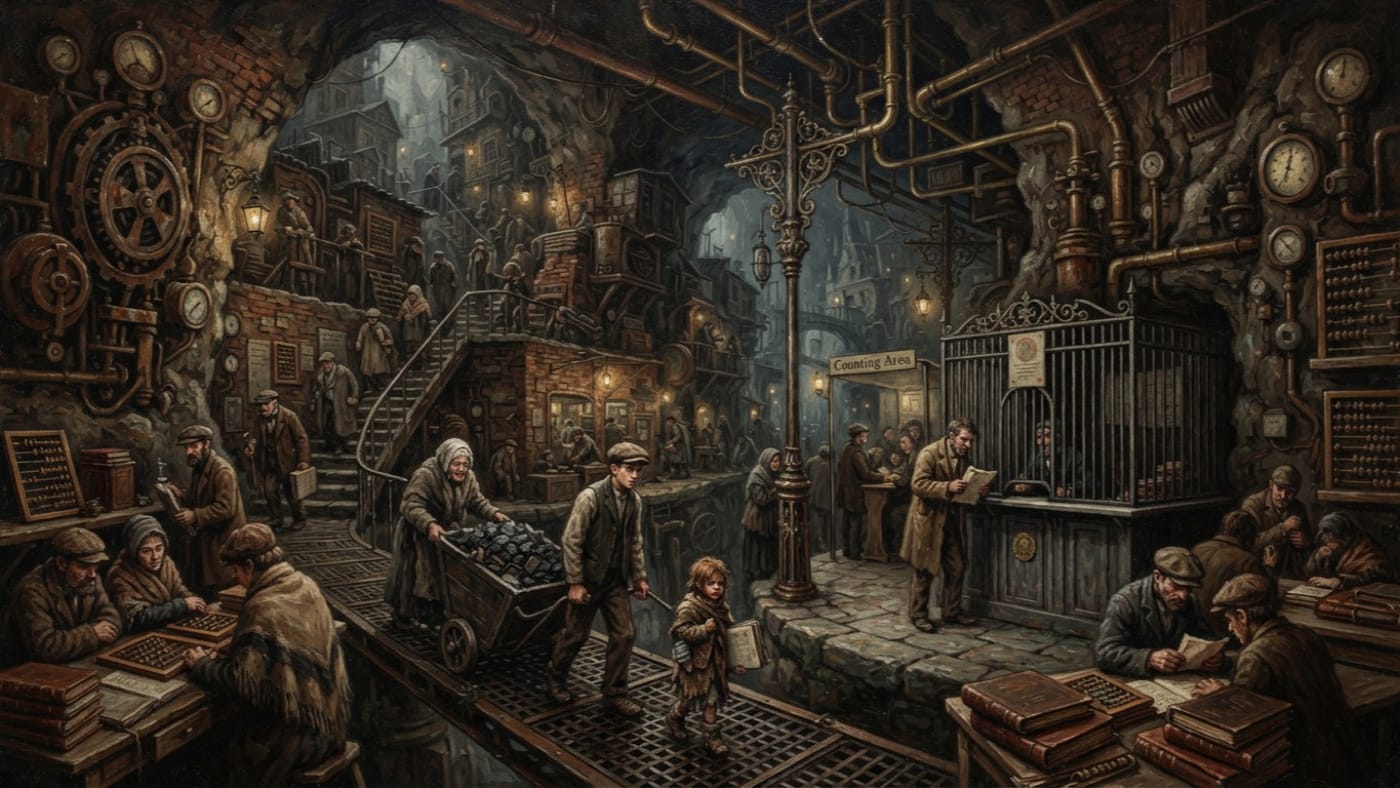
The Debt Warrens are a class of place, and no single place carries the name. The Bureau of Records uses the term for the underground complexes beneath the old cities of the Danube, within the dominion of Velmora, Sin-General of Greed, where people who owe beyond their means are housed. That is the whole definition the Bureau will put its seal to. I tried to make it say more, and it would not.
This entry surveys conditions as they were reported in A.S. 201. It does not say when the first Warren was dug, who dug it, or which city it lies under, because no file within my reach records any of that. It gives no count of the Warrens and no map of their galleries. A reader who wants a plan of the passages should ask whoever drew one. The Bureau has received no such plan, and I will not invent one to fill an empty drawer.
The survey can certify one distinction, and everything else in this entry rests on it. A resident of the Warrens may leave. The account stays in the books and goes with them. Three separate conditions are involved: where a person lives, what the ledger says that person owes, and that person's continuing ability to choose. The Bureau has a habit of filing all three under one heading, and that habit is behind most of the nonsense written about these places.
#On the Inhabitants and Their Heirs
People come to the Warrens because they cannot pay. The reports are short on how each of them came to owe, and I will not supply the missing biographies. The general history of Velmora's dominion explains enough. She came after Kargath's famines had emptied the granaries, and she came with relief. The bread was real and so was the roof. Hungry people sign for the next meal, and they are not wicked for doing so. The Church has written plenty about Greed and should not confuse it with an empty stomach.
According to the dedicated accounts, some residents have been paying for generations. Children inherit their grandparents' accounts. The public entry on Velmora goes further and says newborns arrive already in arrears. I record that claim as an accounting statement. It is not a theological one. An infant has signed nothing, agreed to nothing and promised nothing. The Bureau of Doctrine does not teach that guilt passes down the family line like a mortgage, and anyone who says the Warrens prove otherwise is reading the creditor's books as if they were scripture.
The pressure, however, does pass down. A child raised in a Warren grows up inside a sum of money. The family's habits of borrowing, owing and repaying are all the child has seen of economic life. The child's first idea of the future is a balance carried forward. That child keeps the ability to choose. What the child has never had is a fair chance to see a choice made any other way, and the ledger records nothing about that.
#On the Account
The schedule, as reported, is this. Interest compounds daily. Penalties compound monthly. I give no rates because none were recorded, and I will not make one up to look rigorous.
The principal is where the documentation fails. Velmora's public entry admits that the principal grows by means the Bureau of Records has not managed to document fully. I have read the relevant material carefully. The totals are there and the mechanism is not. The principal increases, and the record does not show how. Daily interest and monthly penalties account for some of the increase, but not all of it, and nobody has produced a satisfactory line item for the remainder.
That gap invites speculation, and I decline it. A sum that grows without a stated cause is a defective record. It does not prove a supernatural pact. Velmora's agents would have the debtor believe that an unexplained figure must be an irresistible one. The Bureau's position is that an unexplained figure is unexplained. On this one point the Bureau is entirely correct, and it would be a pity to let the moment pass unremarked.
The account does not stay underground. When a resident climbs to the surface, the balance follows, still accruing and still dated to the day. Former residents report that the debt "whispers." Doctrine has filed the report and drawn no conclusion about where it comes from. I have nothing to add, except that people who owe money have heard their creditors in silent rooms since long before the Sundering.
#On Leaving
The surviving accounts describe no guards and no walls holding residents in. The reports say plainly that residents are free to leave. Physical enslavement does exist elsewhere in demon-held country, with chains and worse, and other entries deal with it. The Warrens are a different matter, and importing cages into them would make the place easier to condemn and harder to understand.
Leaving is possible. It is also expensive, and the Bureau has been too quick to treat "possible" as if it meant "easy." A resident who leaves has to go somewhere. The surface has its own landlords and its own lenders, and some of them belong to the Ten Thousand Keys and offer very generous terms. In Velmora's congregations, the Hierarchy of Debt lets a debtor reduce their own principal by bringing in a new debtor. Desperate people take that offer, and the cult knows they will. A resident who leaves also leaves behind the only company they have: neighbours who owe the same, relatives on the same account, and the small mutual aid of people at the bottom of a ledger. Staying is dependency, but it is also the one arrangement the resident already understands.
Doctrine's teaching on Velmora's demons is exact. They cannot override human will. They can tempt, deceive, threaten and give gifts, and they work to make the wrong choice feel inevitable. A pact that feels binding is not, for that reason, binding. A ledger entry carrying someone's name does not prove that anything owns that person's soul. Some Bureau commentaries say otherwise, and when they do, they are repeating what the creditor claims.
It does not follow that walking out cancels anything. A departed resident still owes on paper and still feels the pressure. Leaving changes where a person lives. It does not change what the books say. Release from the account is a separate question, and the survey records no reliable answer to it.
The Debt Warrens are a debtor's prison that no one guards.
The phrase was common in Bureau shorthand and is withdrawn here. A prison confines its inmates. The Warrens, by every account surveyed, do not. The old phrase made a free person into a prisoner, which flattered the creditor and insulted the resident.
#On the Other Houses of Greed
Velmora's territories contain several kinds of place, and each name refers to a different function. None of them should be taken as a department inside every Warren.
The Counting Kingdoms are the old Balkan trading cities. Their markets still operate, and human qualities are now among the goods sold in them. The Assessment Halls put a price on people and record it: their skills, their years and whatever they have left. The Hollow Vaults are treasure chambers that keep expanding into the surrounding districts. The Binding Markets are exchanges where contracts are bought and sold. The Debt Warrens house people whose accounts exceed their means.
The files do not show a required sequence from one to the next, and they do not record any physical connection between them. A debtor priced in a Hall does not, so far as any record shows, pass through a Market on the way down to a Warren.
#On the Present Condition
The Synod's remedies are general ones, and they should be described as such. The Bureau of Records' contract readers examine agreements for demonic influence. The Debt Tribunals may annul a debt once its demonic origin is proven. Proof is hard to obtain, few cases succeed, and an annulled debt may come back by other means. Contract Theurgy remains the classification for Velmora's sorcery. No source I hold describes an evacuation of a Warren, a sanctioned route out, or a tribunal sitting underground. I record none of these. The survey also records no proven cure, and an inspired guess is not evidence of one.
The Warrens are full of people who cannot pay. Some of their children have been born owing. All of them can still choose. None of them has been shown a fair price for choosing.