
#On the Exchanges
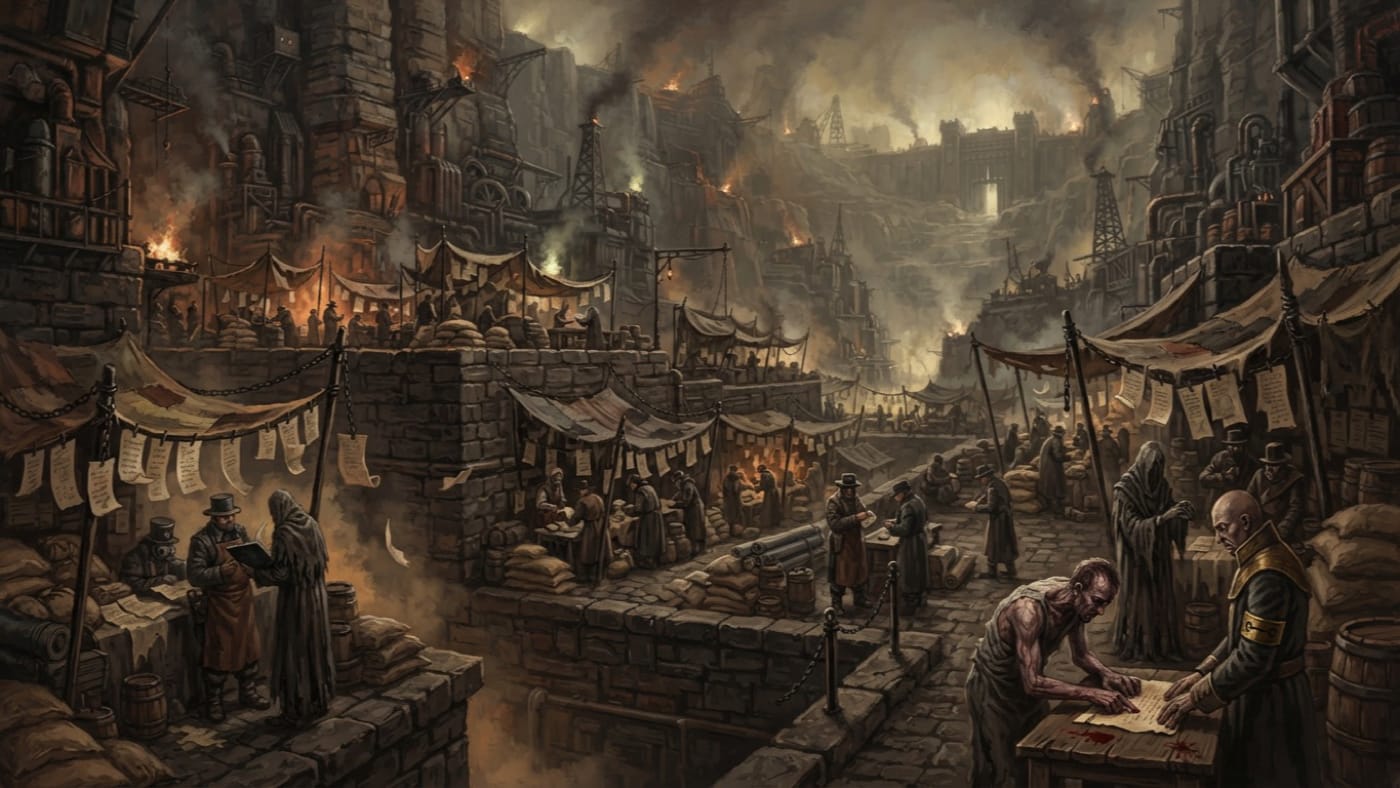
Below the upper rim of the Gilded Chasm, where the ruined extraction towns give way to bare rock, the Binding Markets keep their hours. They keep every hour there is. The exchanges are open-air terraces floored in black stone and roofed by fumes. They lie east and southeast of Bastion-Sibiu, in the Charnel Lands of Zone 6, inside the dominion of Velmora. Awnings are stretched between iron posts. Contracts hang from them, pegged by one corner, turning slowly in the rising heat like hams in a Saxon smokehouse.
Nobody shouts. Bargainers lean close and murmur, because a raised voice cheapens an offer and everyone on the terraces knows what an offer is worth.
Velmora's territory has other exchanges of the same kind, in the Counting Kingdoms and the river towns. The Bureau has never established that these and the Chasm terraces form a single precinct, and I decline to draw a boundary the enemy has not surveyed for me. The terraces below the rim are the ones our reports describe, so they are the ones I describe here.
The Bureau of Records once asked for the markets' trading hours so that interdiction patrols might be timed against them. The request remains on file, unanswered. Beside it is a note in my hand: the question assumes an hour in which nobody wants anything.
#On What Is Offered
The markets sell contracts. Goods change hands as well, such as salt, seed grain, a mule or a winter coat, but those are the market's small change, the coin one gives the porter. The real trade is in obligation. Men and women sell service for a term of years, loyalty to a named house, future actions not yet committed, memories they can describe and therefore sign away, claims on inheritance, and the prospects of children not yet born.
The last item needs the Bureau's precision. An unborn child consents to nothing. The seller pledges what he imagines is his to pledge, which might be a descendant's labour, name or portion. The Bureau of Doctrine has argued for longer than most of its members have been alive about whether Hell may collect on a signature its subject never gave. The sellers do not wait for the ruling.
The parchment is skin and the ink is blood. I record this as plainly as the reports do. The soldiers who first brought it back assumed the materials were theatre staged for visitors. They are simply the stationery of the place.
The relief is real, and that is where the comfortable reader goes wrong. Velmora came east after the Sundering, following the famine of Kargath, and she came with provisions. A mother sells ten years of her own service and receives grain, and the grain carries her children through the winter. A miller pledges his loyalty and his mortgage is forgiven, and the mill turns again. The intermediaries who arrange such sales often believe they are doing good, and on the first morning they are.
The Synod permits wealth; the Bureau of Tithes would collapse otherwise. Greed begins at the conversion, when loyalty, memory and affection are entered in a ledger as items and begin to carry a balance.
#On the Terms
Velmoran contracts are honoured to the syllable, and that is where their menace lies. The grain arrives, the debt is forgiven and the son comes home from the front, exactly as written. What the signatory missed is everything else that was written. One clause sets each sack of grain against a year of service. Another lets the inheritance claim run on to the grandchildren. A third makes loyalty something to be demonstrated "on request," and a fourth defines "request." The first contract is usually kind. The second is drawn up to cover the shortfall left by the first. By the fourth, the signatory comes to the market to refinance rather than to buy.
The sorcery behind this is Contract Theurgy, and its consequences show up in the body. An undated account in the Bureau's general lore describes a captain who signed a truce at the Chasm and watched his right hand leave his body to perform the contract's terms. Soldiers posted near Velmoran ground report phantom coins clinking in their marrow. They call the sensation owing, and they cannot locate it with a finger.
Even so, a signatory may refuse. The Bureau of Doctrine holds, and I hold with it, that no demonic instrument removes a person's power to choose otherwise. A Velmoran pact is drafted to feel binding, which is half the craft. The pain is real and so is the dependency. On the terraces, which lie in Hell's own country, a debtor may also be chained, carried off or put to labour, and nobody there will stop it. That is captivity and extortion. It gives no one ownership of the will. A man in irons who still refuses to sign away his son has refused.
Earlier editions of this Codex classified Velmora's sorcery as "cursed coinage."
Corrected. A coin can be confiscated, assayed and melted. The terraces deal in signatures, and the Bureau has yet to build a crucible for a promise. The established term is Contract Theurgy.
#On Those Who Keep Accounts
The demons on the terraces are the kinds that the Bureau's bestiary assigns to commerce. Assessors look at a prospective signatory and arrive at a figure. Collectors want one particular thing, such as a specific afternoon or a specific trust, and will trade fairly to get it. Ledger-Keepers record. The Bureau does not know how they are posted among the stalls, who appoints them or which awning each one serves. I will not invent a market administration to make the page look tidier.
The Hierarchy of Debt adds a problem of names. The human cult of the Ten Thousand Keys ranks its members as Debtors, Creditors, Assessors, Ledger-Keepers and Inheritors. A cult Assessor is a man with a practised eye for what his neighbour might be persuaded to sell. A cult Ledger-Keeper is a man who knows the balances. Neither is a demon, whatever his habits. A field officer who confuses the two will either burn a notary or interview a demon, and the second mistake costs more.
The markets sit among Velmora's other institutions. The Assessment Halls lie lower down and determine value. The Hollow Vaults hoard. The Debt Warrens house those who owe more than they can pay. The Counting Kingdoms keep the wider society of transaction running. The terraces are where obligation is struck and traded. The Bureau has no evidence of a fixed route that carries a signatory from one institution to the next, and the enemy has no need of one.
The cult teaches that every serious compact surrenders a key to the Vault of Ten Thousand Keys at the centre of the Chasm, and that each key fits a lock with the collateral behind it. That is the cult's doctrine. No witness has told us how a key would travel from a stall to the Vault, or whether it travels at all.
#On Commerce Beyond the Chasm
A contract struck on black stone does not stay there. West of the mountains, the Ten Thousand Keys run lending houses, grain relief, notarial offices, charities and respectable firms. Each is a place where an obligation can be written in a hand that looks like any other. Velmora's extraction wealth pays for the loyalties she buys along the supply corridors opposite Sibiu: the quartermaster who thins the grain, the toll clerk who waves a wagon through, the chaplain who blesses what should have gone in the fire.
The Bureau cannot trace any particular corrupted convoy to any particular awning, and I distrust every officer who claims he can. The markets and the front are linked as a mint is linked to a purse. On the terraces the Velmoran economy learns what a person will accept, and on the Sibiu approaches it spends that knowledge. A ration chit that turns up in a hungry soldier's coat pocket is a Binding Market in miniature, minus the skin.
The Bureau of Tithes learned the danger of reading this commerce as ordinary bookkeeping in A.S. 180, when its shadow-auditors tried to trace the Chasm's yield through the market tallies. The Codex entry on the Gilded Chasm records that one of them came back. Ink is too dear to describe his condition twice.
#On the Present Condition
As of A.S. 201, the Binding Markets operate as the Chasm reports describe them: continuously, quietly and under fumes. No Synodal party holds ground on the terraces, and none is planned. The Synod can only reach the paper that comes west.
The contract readers of the Bureau of Records examine agreements for buried clauses and for terms that mean something other than what they say. They are rotated every two years, for reasons the Bureau of Medicine files rather than publishes. The Debt Tribunals may annul a contract proven to be of demonic origin. Proof requires evidence, evidence requires investigators, and investigators get offered terms. The tribunals succeed roughly once a decade.
The doctrines are less tidy. The Bureau of Doctrine commends the tithe as an inoculation, and the Bureau of Tithes, which receives the tithe, concurs warmly. The Value Fast of A.S. 199 removes personal property for fourteen days, and Velmora's agents arrive punctually for the fourteen days of desperation that follow. The Mark of Poverty may work, though it certainly leaves the sworn unfit for logistics. None of these practices releases a signature already given. The Bureau has no procedure for that, and I will not draft one in the margin of an encyclopaedia.
The practice that most irritates the machinery is the gift given without an account: bread handed over with no receipt, labour given without a lien. On record, it has freed no one from a contract. The terraces dislike it all the same.