
#On the Corrupted Press
Littera scripta manet. Debitor nescit.
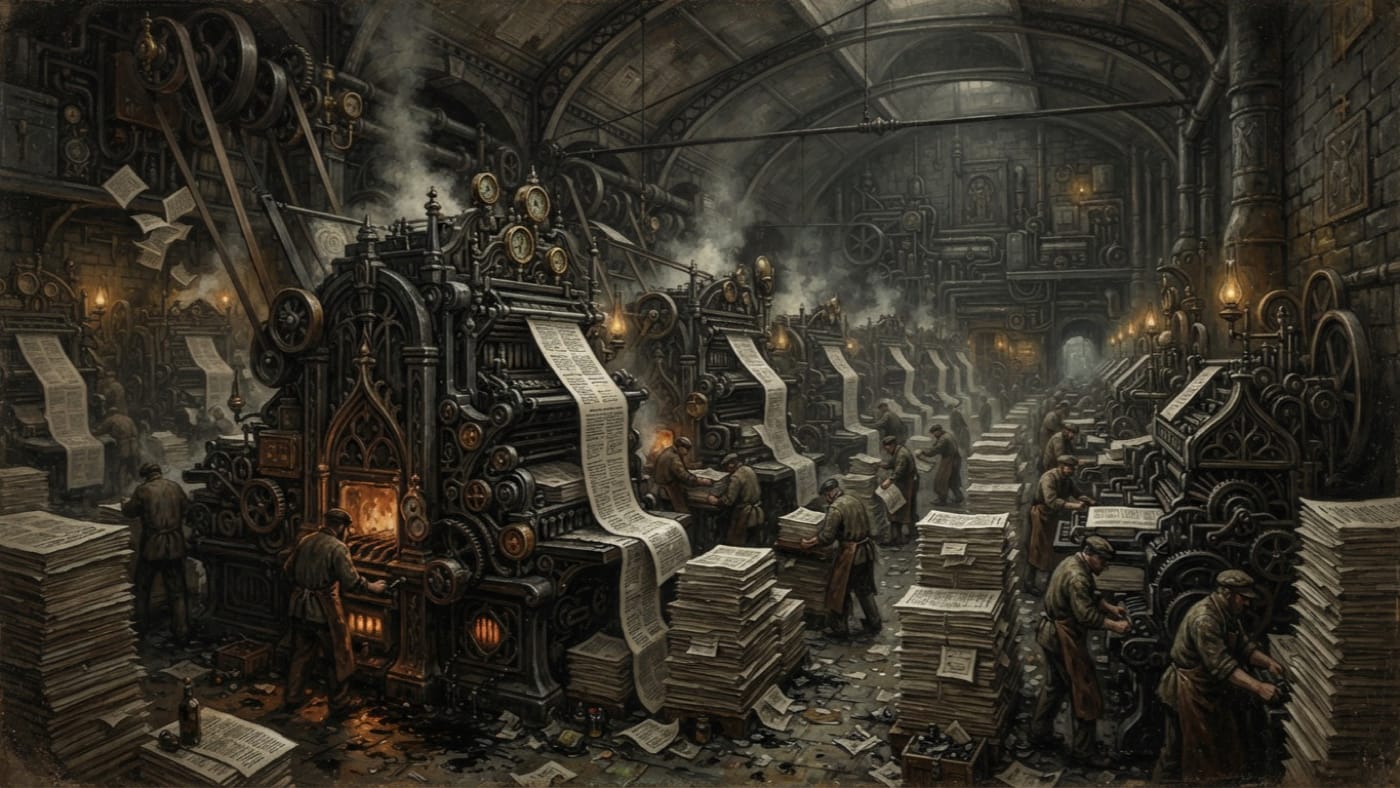
A Binding Press is a printing press. I start there because the Bureau's junior clerks, handed the name and a candle, picture a bookbinder's clamp, or a thumbscrew, or a gilded lectern with a quill chained to it, and they file their reports to match. It is a press. It has an ink-train and rollers, a bed of locked type, an impression stroke, and a delivery board where the printed sheet falls. Men built it to print timetables, tax schedules, hymnals, ration notices and casualty lists, the paper by which a late-industrial province tells itself what it owes and when. Then Velmora's forces took the ground it stood on.
Demons do not understand machinery. The Bureau of Doctrine has repeated this so often that the sentence has worn a groove in my desk. They cannot build a press. They cannot oil one, reset a forme or correct a misprint. They can take a captured machine and animate it, setting it running on a logic its makers never designed, toward an end its makers would never have signed. When the captured machine was already in the business of producing documents, the result is a Binding Press. It keeps producing documents, only on a different subject.
The Bureau holds no record of the first press so taken, and I will not invent one for the convenience of the index. These machines belong to the long history of human industry captured, held and turned after the Sundering. Their origin is undated and will remain undated until someone brings me evidence rather than a guess.
#On the Printed Terms
The presses run day and night. Their product is the contract: terms and conditions, binding clauses and subclauses, obligations and penalties, set in type and pulled in sheets. The sheets stack past the delivery board, past the drying racks and past the height a clerk can reach without a ladder. Eventually the paper meets the ceiling, and the room becomes a filing cabinet with a machine trapped inside it.
The Bureau would prefer that I state plainly what these contracts cover, so I shall. They cover service and loyalty. They cover actions not yet committed and children not yet born. These categories are named in the Codex entry on the Covetous Serpent, and they describe the scope the instruments claim. A carter may find his labour pledged for a decade. A girl may find her grandfather's name on a clause that purports to dispose of her. The paper claims a great deal. Paper always does. I have read Synodal ordinances asserting jurisdiction over the weather.
In a free province, the press is the most useful machine the Church possesses after the bell. It prints the ration card that carries a family through winter, the list that tells a widow to stop waiting, and the catechism a child learns her letters from. Printing lets an administration reach people it will never meet. Velmora's presses keep that reach and turn it around. The sheet that once told a man what he was owed now records what he owes, and it reaches him, if it reaches him at all, long after the entry was made.
#On the Obligation Discovered
The horror of the Binding Press lies in its tense. It manufactures in the present an obligation that someone will discover later. That person is already implicated by what these presses print and has not yet learned which clause concerns them. They will learn it from a creditor at the door, or from a notary with excellent manners. It may surface as a lien in an inheritance, or as a demand that the eldest son report for service under terms nobody in the family recalls accepting.
The Bureau has not established how a particular sheet comes to concern a particular person. I state this without embarrassment. We hold no reliable account of a sheet finding its subject. No trigger by touch, reading, copying or signature has been proven, and no route from delivery board to debtor's house has been demonstrated. Readers who have heard more confident accounts heard them in taverns, from men who were buying.
The Bureau has established what the harm looks like, and every Velmora file contains the same pattern. Her contracts work as her gifts do, through dependency, deception and threat. The relief offered was real: the grain was grain and the loan spent like any other. Afterward the terms prove to be hidden, misrepresented or simply very long. Then collection begins. In her territory, collection can mean the chain and the cell, because in demon-held ground a body can be imprisoned whatever its owner wills.
On the other point, Doctrine is absolute, and I record it with the full weight of my office. No paper owns a will. Demons cannot compel a human choice, and a printed pact is not truly enforceable against a person who chooses otherwise. The debtor can refuse. The pledged girl signed nothing and owes nothing of her will to a clause her grandfather accepted. A creditor who claims otherwise is giving evidence about himself.
The Bureau's own language needs watching here. Soldiers on the eastern approaches report the sensation of coins grinding in their marrow. An undated account from the Gilded Chasm tells of a captain whose right hand walked away from his body after he signed a truce. Both reports belong to the general file on Contract Theurgy. Neither has been traced to a sheet from a Binding Press, and I decline to staple them together merely because the staple would be convenient. They show what owing feels like to those who live under these instruments, where the debt is felt as a fact of the body. A feeling, however terrible, is not a title deed. The man who feels the coins can still refuse to sell his comrades, and some men do. I will not pretend they pay nothing for it.
#On the Economy Around the Machine
The press is one instrument in Velmora's economy, and the junior staff confuse her instruments with dreary regularity. The Binding Markets exchange contracts, and the presses produce them. Ledger-Keepers record transactions. The Assessors put prices on whatever they look at. The human agents of the Ten Thousand Keys do the retail work: they lend, relieve, notarise and trade from respectable premises, and they arrange the Hierarchy of Debt beneath them like columns in a ledger.
How the paper moves between these hands is unknown. We have found no shipping schedule, no chain of command from her desk to the press-room, and no compulsory route from assessor to press to market to debtor. Analysts who draw that diagram are drawing their own anxiety, in very neat ink.
Her captured machines are distinct and must be filed separately:
- Counting Engines count.
- Consuming Factories consume more than they produce.
- Binding Presses print contractual terms.
- Vault Trains accumulate wealth.
- Assessment Engines determine value.
What has been shown of one class does not transfer to another. The Synod's failed attempts to destroy captured Assessment Engines tell us nothing about presses. I have already struck that inference from two reports and will strike it from a third with pleasure.
A garrison has every reason to care about all of this. Bastion-Sibiu holds the Southern Carpathian passes against her. Gold drawn from beneath the Transylvanian Alps buys her loyalties along three supply corridors, and bought loyalty runs on paper. Each purchased quartermaster stands inside some written obligation. So does each toll-clerk who waves a wagon through, and each notary of a minor court who certifies what he should have refused. The Bureau has tied no single corridor betrayal to a press sheet. It does not need to. A war of purchase runs on documents, and she owns machines that print them without rest.
#On Scrutiny and Its Limits
Our first defence is reading. The Bureau of Records keeps contract readers, clerks whose entire office is examining agreements for buried clauses, unusual phrasing, and terms that do not mean what they appear to mean. Every document of consequence passes through several of them. Many go mad from what they find written between the lines, so the Bureau now rotates them out before more do.
The Bureau of Doctrine offers a second defence, the tithe. By giving freely to the Church, the doctrine holds, one becomes impossible to buy. Whether it works is unclear. The Bureau of Tithes promotes it with a zeal I would call evangelical if that were not precisely the arrangement.
The Debt Tribunals can annul a debt proven to have demonic origin. Proof is nearly impossible, and most cases are dismissed. Even when a case succeeds, the debt often reasserts itself by other means. The Value Fasts, in which property is surrendered to communal custody, mostly produce the desperation her agents arrive to exploit. Those who take the Mark of Poverty may be right that ownership is her point of entry. They are also left unable to function in any economy that runs on transaction.
None of these measures touches a press. The Bureau has no proven procedure for stopping one, and no rite that dissolves obligations already printed. It has the plain doctrine set down above, which the Tribunals are too slow to apply and the debtor too frightened to believe: a pact cannot be enforced against a person who chooses otherwise. Putting that into practice falls to the confessional, the garrison and the grain store. A debtor the Church has fed has less reason to open his door when the creditor knocks.
The Codex entry on Velmora states: "Somewhere, someone is bound by what these presses produce."
The Bureau of Doctrine has revised the wording to read: "Somewhere, someone is implicated by what these presses produce." A printed obligation can bring a creditor, a cell or a summons. It cannot bind a human will, and the Codex will not say that it does. The original phrasing was mine. I stand by its rhythm.
#On the Continuing Output
The presses are still running. The Bureau knows this because their obligations keep surfacing: a summons among a dead man's effects, a lien in a widow's post, a clause in a child's name. It does not know how many presses there are, where each one stands, what keeps them turning, or which sheet in which stack carries the reader's own name. The file remains open on all four counts.
Readers are instructed to read whatever they sign. A reader who finds his name on something he never signed should present himself to the nearest contract reader before the creditor finds him. He should bring the paper. He should not bring his purse.