
#On the Office That Prices Before It Lends
The Assessor of the Ten Thousand Keys is a human being. I state this first because three Bureaus have failed to, and their correspondence now fills a cabinet I am not permitted to burn.
Velmora keeps demons that bear the same name. Those Assessors belong to the Bureau of Purity's classified bestiary. They are small and quiet, fatal to privacy, and able to look at a soldier and know the precise price at which he would sell a comrade. One was captured near the Danube crossings with four thousand pages of script inside its body concerning the souls and finances of a single company. The rank described here contains no pages. It carries them in a satchel, like a notary, and writes them by lamplight, like a notary. In most observable respects it is a notary, which is precisely the difficulty.
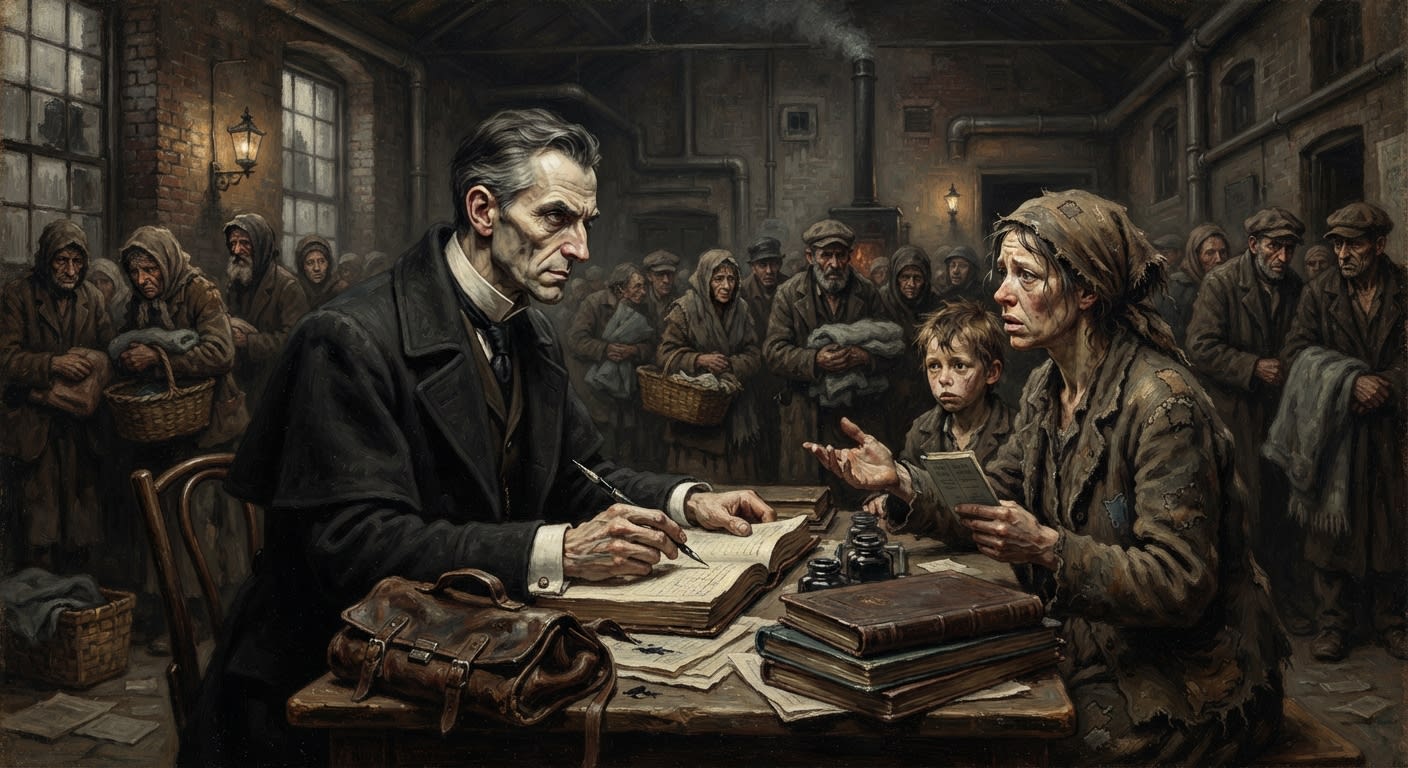
Within the Hierarchy of Debt the human Assessor stands third of five. Below him are the Debtors, who owe, and the Creditors, who lend. Above him are the Ledger-Keepers, who remember, and the Inheritors, who wait. His office is preliminary valuation. Before a Creditor extends grain, someone has decided the grain is worth extending. Before a Debt-Binder climbs to a highland village after a failed harvest, someone has already walked its lanes, attended its funerals, counted its coughing children, and entered in a small tidy hand what each household would surrender and in what order. That walker is the Assessor. The lending belongs to the Creditor, and the collecting belongs to whoever survives until the account matures. The Assessor prices.
He prices a recruit, a family, a village, a convoy clerk, a widow's parlour, a chapel fund, a notarial seal, or the last courage left in a captain. He prices anything that may later be owed, and he prices it before the owner suspects a sale.
The resemblance to our own offices is a joke Hell did not have to work for. The Bureau of Tithes licenses Tithe Assessors who weigh salt, count widow's pennies and chalk arrears on doorposts, and who are hated in every doorway for it. Assessor-Tertiary Yrsa Haugen directs the Bureau of Inter-Infernal Analysis from three rooms in Strasbourg. Assessor Maren Gault measures sealed grief at Brine Fork. These are Synodal titles, held under oath and seal. The Synod calls its measurers Assessors because measurement is a duty. Velmora calls hers Assessors because measurement pays. The difference is sacred, and it is recorded in the payee column.
A Tithes route memorandum circulated in the Sibiu corridor instructed collectors to "coordinate with local assessors" on household arrears.
Withdrawn. The memorandum meant the Synod's licensed Tithe Assessors. One highland village read it in good faith and cooperated with both kinds. The Bureau of Tithes now prints its full title on every route sheet, in red.
#On the Eye
The cult calls it the Eye. Purity files it as visual fixation, Category Greed-adjacent, which is the Bureau's way of admitting that a man can be damned through his optic nerve.
It comes on slowly. The novice Assessor still sees faces and has to remind himself to price them. He attends a baptism and deliberately notes what the father owes the miller. After some seasons he no longer needs the reminder. After more, he can no longer stop. A face turns into collateral before its name is spoken. A child's laugh becomes a hold over the parent. A scar is shame with a market value. A strong back is so many labour-years. A good name is something that might be pawned in an emergency, and the Assessor already knows which emergency.
The files seized in the Sibiu sector list what the Eye learns to see: a son's apprenticeship, a widow's reputation, a magistrate's fear of scandal, a quartermaster's pride in punctual convoys, a priest's private doubt, a garrison's need to believe its scrip is clean. The cult's own market categories are just as plain. They are need, ambition, shame, affection, hunger, guilt, pride, reputation, mercy and loyalty. Mercy is the one I object to most. The Assessor treats it as a commodity that rises in value during famine, which is also the only period when the Synod's supply of it runs short.
Debtors suffer debt. Creditors manage it. The Assessor becomes the organ through which debt perceives.
Doctrine records one reliable road to repentance in this rank: the morning an Assessor finds his own child in the column. Some have repented on that morning. More have entered the child.
#On the Three Schools
Purity recognises three schools of Assessor practice. They are distinguished by the kind of pressure each prices.
The Highland School prices subsistence: hunger, winter, medical need, tax arrears. It works the relief kitchens, ration queues and snowbound villages on the approaches to Bastion-Sibiu. It knows when the grain will run out in each house better than the house does. It also taught the Bureau its most expensive lesson. Until the A.S. 192 famine audits, Purity believed the Keys recruited mainly through rich men wanting more. The Highland Assessors had been pricing poor men who wanted to live. Need comes first, and greed follows once the need has been refinanced.
The Merchant School prices ambition: expansion, guild rank, monopoly and safe transport. It lives near toll houses, market charters and convoy paperwork. It knows what a man will pay to arrive first, and what he will overlook in a manifest to keep arriving first.
The Interior School prices respectability: reputation, marriage prospects, sealed embarrassments and promotion within Synod offices. It is the most dangerous school to us, because it does not need to break into a Bureau. It only needs an invitation to a wedding inside one. The A.S. 196 Sibiu transcript concerning Captain Erdel shows its style best. The interrogated Assessor said that he had assessed the captain's loyalty, and that the captain "had accepted before we asked." Purity has not decided which school that answer belongs to. The captain's pension is still paid quarterly to an address that does not exist.
#On Their Use to the Higher Ranks
A Creditor who lends without a price is only generous, and generosity with no price attached has no use in the cult. Ledger-Keepers need entries, and an obligation nobody has priced cannot be recorded, only regretted. The Assessor turns a village into figures the Creditor can lend against and the Keeper can file. He never collects the final debt. His work is to make the later collection readable.
The Inheritors need something stranger. They need a market that does not yet exist. Assessors are trained to price human weakness ahead of the Great Maturity, when every debt, pledge, forfeiture and surrendered key is expected to settle in the Inheritors' favour. The rank dislikes this. Assessors prefer a living market, because living markets complain, and complaint reveals prices. The friction between the Assessor's appetite for today's price and the Inheritor's demand for a future valuation is the nearest thing to dissent Purity has found in the rank. Its source is appetite rather than conscience.
Seized ledgers record no rite of promotion peculiar to the office. They suggest a Creditor becomes an Assessor when his estimates grow more accurate than his superiors' guesses.
None of this removes free will. Velmoran contract-theurgy arranges consequences until surrender looks chosen. The Assessor's task is to know in advance which consequence will do it: the cold, the fever, the scandal, or the promotion withheld one season too long. The Debtor keeps his full right of refusal, and the Assessor has already priced what refusing will cost him.
Since the A.S. 199 Sibiu Anomaly confirmed instrument-level mutual utility between the Hierarchy and the Crimson Concord, Purity interrogators ask one further question: whether cult Assessors have priced persons for instruments other than Velmora's. The question is now standard. The answers are held in Dossier Auric and do not appear on this page.
#On Signs and Counter-Assessment
The Sibiu sector field warning on cult Assessors was renewed in A.S. 200. It lists five signs.
Excessive listening. An honest man in a tavern waits for his turn to speak. The Assessor never takes his turn.
Accurate charity. Ordinary benefactors give clumsily: too much soup, the wrong blankets, a sermon nobody asked for. The Assessor's gift answers the exact need, in the exact amount, a day before it becomes desperate.
Questions about inheritance. He wants to know who holds the house after the mother dies, who witnessed the dowry, and which cousin was left out of the will.
Refusal to haggle. He accepts the first price for everything. He is buying something other than what is on the stall.
Clean cuffs in dirty rooms. He touches nothing he has not already valued.
The Ordeal catches some of them. Coin, Keys, Mercy, Clause and Refusal are hard stations for any man who has spent years turning neighbours into columns. At the Station of Mercy his benefactions are read aloud, and they always match their recipients' needs too well. At the Station of Refusal an Assessor who is offered relief tends to value the offer out loud before he declines it. Examiners have learned to listen for the arithmetic.
Arrest is the smaller part of the countermeasure. An appraisal made in private is capital. The same appraisal read aloud before Purity, Tithes and Records is merely gossip, and gossip resells poorly. For this reason Sibiu requires Tithes to witness every loan above three Crowns, requires private grain advances to be declared before the third bell, and tells parish priests to press their flocks to take their needs to a witnessed office before a stranger prices them. A family that hides its hunger can be bought. A family that declares it at the tithe counter at least ends up owing the Synod.
The Bureau does not claim this is dignified. It claims that it costs the Assessor his private advantage, and that is the most any Bureau measure can promise.