
#On the First Entry
The Debtor is the first and lowest human rank of the Ten Thousand Keys. Most of its members never meant to join. The Hierarchy of Debt ranks the Creditors above them, then the Assessors, the Ledger-Keepers and finally the Inheritors, who wait at the summit with their rings and their patience. The Debtor waits nowhere. The Debtor works.
The definition fits on a receipt. A Debtor owes a balance, serves to reduce it and recruits others to reduce it faster. The rank is a relationship to a ledger. It is no trade, and it marks no particular kind of person. Ploughmen hold it. So do carters, laundresses, a schoolmaster's assistant and the occasional minor clerk of a Bureau I decline to name in a tract that Bureau will read.
This survey concerns the rank as it stands in A.S. 201. No record I have examined names a founder, a first induction or a year of origin. The rank was already full when the Bureau began counting.
#On Relief and the Signature
It begins with a sack. A failed harvest in the highlands facing Bastion-Sibiu brings the sack, and so does a cough that has settled in a child's chest. So does a husband who died in the week the ground began to freeze, or a landlord's man due back on Thursday with a cudgel and a list. Then the sack arrives. It holds grain, seed, medicine, burial money or rent, and the contents are real. The bread rises. The child lives to see spring.
Purity's older circulars held that the Keys recruited among the greedy. The Sibiu famine audits of A.S. 192 corrected the circulars: recruitment begins with need. Ambition supplies a second class of applicant, and fear for one's reputation a third. The fourth is the wish never again to stand in a ration queue while a clerk of the Synod hunts for a pen. None of this makes every hungry borrower a cultist or every lender a servant of the Chasm. Most loans in the Sibiu sector are ordinary sin at ordinary interest.
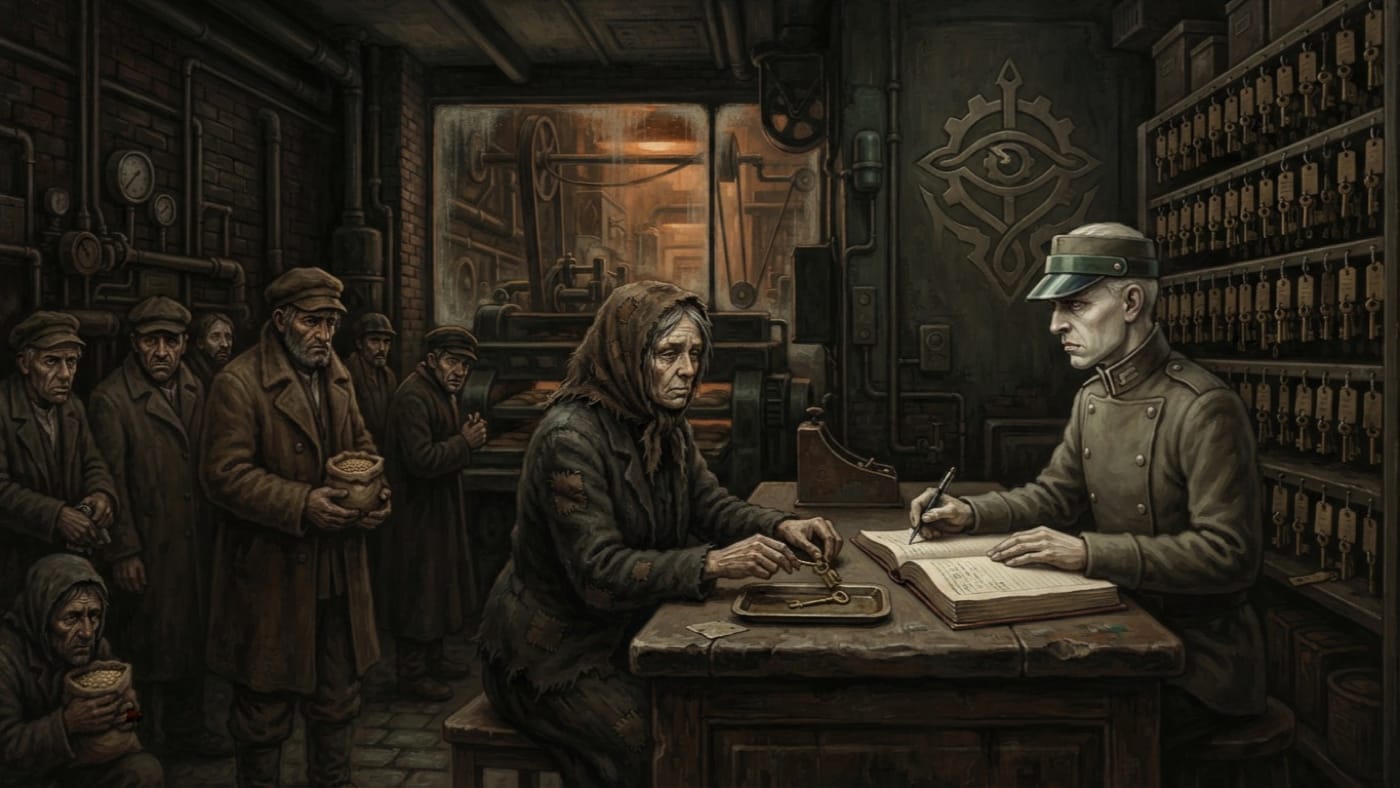
Consider a widow in a market town on the Hermannstadt road. She is a composite, assembled from eleven depositions, and so she has no name and cannot be summoned for questioning. Her relief arrives at a credit desk above a bakery. The clerk behind it is courteous, and his terms are better than any parish relief board's. He reads the contract aloud, and the text is legible. She signs. At signing he asks for a small brass key and she gives it to him. Brass marks a low contract. Merchant contracts take silver, and gold is reserved for provincial office, relic custody and inherited land. The key opens nothing she owns. The clerk wraps it, enters it and puts it away.
Informants and cult testimony hold that every surrendered key answers to a door in the Vault of Ten Thousand Keys. The Bureau records this as testimony. It has not established the mechanism and does not intend to test it.
What the widow knows varies from desk to desk, and in time from month to month. Some Debtors understand only that relief must be repaid in favours. Others learn that the favours travel east. Knowledge releases no one, and ignorance excuses no one.
#On Service Against the Balance
The first request is small. She is asked to carry a letter to her cousin in the next valley, and she carries it. Then she is asked to introduce a neighbour whose roof has failed. After that comes a request to exchange some honest coin for coin that is slightly better, and she makes the exchange without asking what "better" means. In the following season she cleans for the convoy office, and one morning an inspection schedule goes missing from it. The grain wagons pass the tollhouse unweighed that afternoon. She did not steal the schedule. She lost it, deliberately, against her balance.
Each act is entered. Each act reduces what she owes.
Recruitment pays best. A Debtor who brings a new borrower to the desk receives a reduction in her own principal. The fraction is negotiated, and seized ledgers record different fractions at different desks. Doctrine has requested a standard rate. The cult has none to give and would not give it if it had. Whatever the fraction, the published cult files agree on the result. The balance falls, and it approaches zero with liturgical courtesy, but it never arrives.
The widow recommends the kind clerk to her sister, whose husband has lost a hand at the sawmill. The sister signs and surrenders a key. The widow's balance falls. The sister's balance begins at once, and the sister has a cousin of her own.
Consider the arithmetic in full. One account has shrunk and another has opened, and the network now holds two households where it held one. Every reduction in the Debtor's account is paid for with somebody else's principal. In the Debtor's rank, repentance and expansion look alike on paper. Both produce a smaller balance, and they differ only in where the missing amount went.
The Debtor is still no Creditor. A Debtor who recruits holds no credit and lends nothing. She brings the borrower to the desk and is paid in discount. The Creditor sits behind that desk, lending accumulated demonic credit at his own risk and to his own account. The widow is a broker who takes no commission. In a tithe-man that would pass for piety.
#On the Family Account
The balance survives the debtor. When the widow dies, the Ledger-Keepers carry her account forward, and her children find their names in a column they did not sign. Some descendant accounts in the Sibiu-sector seizures run three generations deep. In others a family interest, a field, a pew or a dowry was surrendered by a grandparent who expected to be dead before the clause matured, and was right.
The cult tells its Debtors that their suffering reduces the family account and that the account will one day be honoured. This claim keeps people serving after they have stopped believing anything else. A mother hungers and calls it a payment toward her son's account. A son runs errands and calls it filial piety. The Inheritors hold the consolidated balances in patient custody against the settlement the cult calls the Great Maturity. The Bureau of Doctrine forbids public preaching on that subject. I record it here under seal, once. Published cult files report no confirmed collection, no date and no mechanism, and the Church certifies none of the three.
A child inherits paperwork, and a lender who remembers the family. The child does not inherit guilt. No ledger can sign for a will that has not yet been born.
#On Refusal
Within Synod territory, no demon possesses a Debtor, overrides her choice or makes her pact irresistibly enforceable. Doctrine holds this without exception, and I hold it with Doctrine. Contract theurgy binds by arrangement. It cannot bind by force. Dependency, deception, threats, the neighbours' opinion and a larder that will be empty by Friday all make refusal costly, and none of them makes it impossible. The widow can stop carrying letters on any morning.
The cost has to be set down beside the right to refuse. The letters she has already carried were read. The convoy that passed unweighed has already passed, and her sister has already signed. Relief stops, and something unpleasant may happen to the bakery. Former associates sometimes call with lamps after curfew. The Synod meets a confessing Debtor with a Purity inquiry, and the inquiry occasionally ends at the scaffold. I have signed such orders and will sign more. I note for the Ledger that a Debtor who expects to hang for confessing will usually recruit instead.
I once recorded a parish at Skopje where a named debtor pulled a bell-rope against a clause inscribed into his own marrow. The parchment burned blue, his heart burst and he died before the altar with his debt discharged. I have no date for the account and offer none.
"Thus we see: the bell cancels the clause, provided the sinner himself dares to ring it."
Withdrawn as a general rule. The Skopje account records one parish, one rope, one clause and one corpse. It sets no bell procedure for Debtors, and no parish is to read it as a remedy. My earlier phrase gave a single death the authority of a rubric, and I have struck the rubric while the testimony stands.
#On Scrutiny and Annulment
The Bureau of Records keeps contract-readers, clerks who do nothing but read agreements for buried clauses, odd phrasing and terms that mean more than they appear to. Several readers examine each document. Some of them go mad. Their purpose is to find the clause before the borrower signs, and with Debtors they are usually late, because the borrower signed in a famine month at a desk nobody had inspected.
Debt tribunals can annul an obligation shown to have demonic origin. Proof is the difficulty. The grain was real, and the weights were honest. Most cases are dismissed. Some obligations that are annulled come back later as a cousin's mortgage, a guild assessment or a stranger's unexpected kindness. A tribunal's judgment is a legal remedy, and the Bureau promises nothing supernatural with it.
Currency is blessed before circulation. The Bureau of Tithes teaches that proper tithing inoculates the faithful against purchase, and I record that teaching as an institutional claim made by the interested party. Value fasts and poverty vows are meant to cut the hooks of ownership. In the Sibiu sector they also produce hungry households, and the clerk above the bakery serves hungry households first.
Confiscated keys fall under the Purity handling protocol of A.S. 199. Officers wear waxed gloves and use an iron tray. They speak no names, never try a key against a visible lock and never store one in a personal desk. A key may be burned. Burning has destroyed brass, and it has never been shown to cancel a balance. The Debtor who watches her key burn has still to decide what to do next morning, and she can still decide it.