
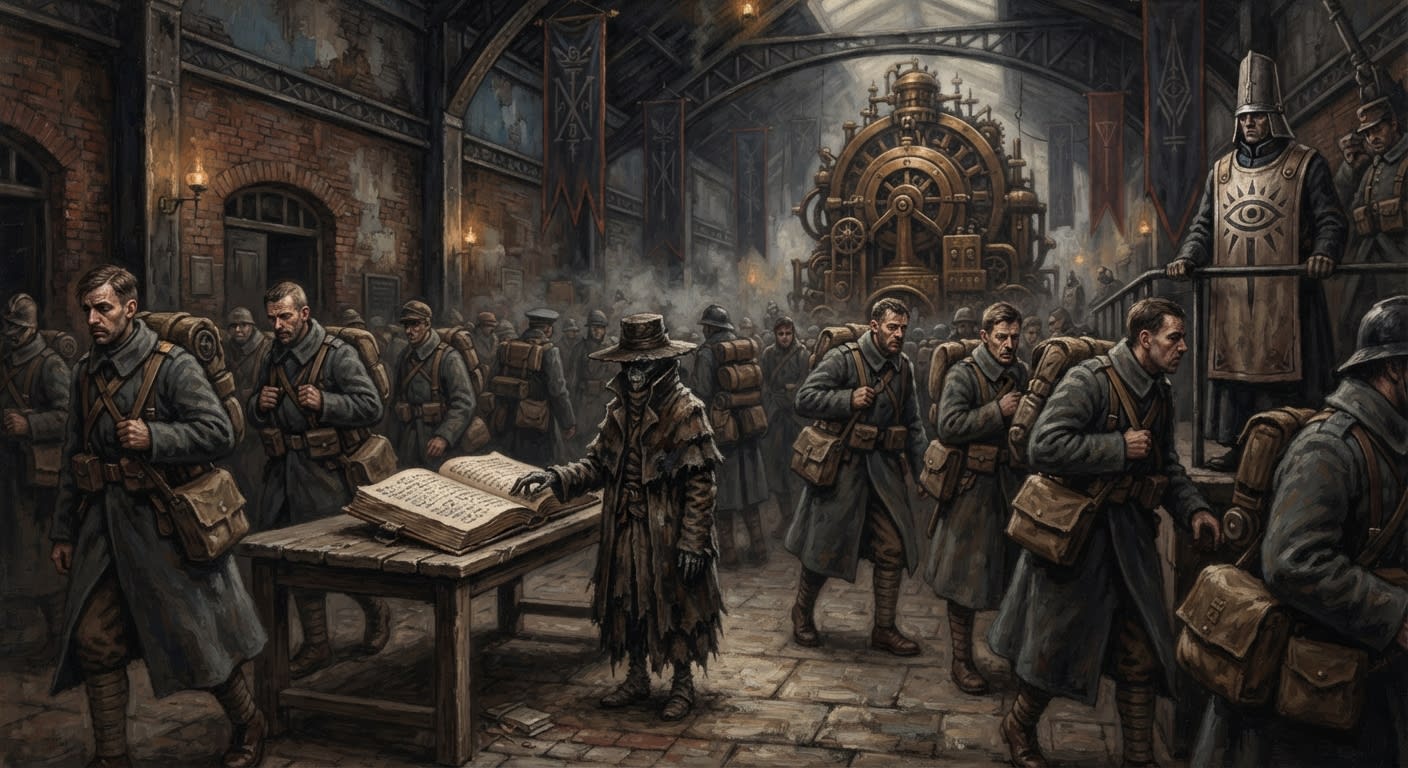
The demonic Assessors' entry, written from the continuity file, the Velmora lore, and the Assessment Halls, Appraisers and cult-rank articles:
#On the Demon That Prices Without Touching
"Omnia venalia, si pretium inveneris." — carved above a moneylender's door in the Sibiu foothills and chiselled off by the Lictors in the same week
The Assessor of this entry is a demon. It belongs to Velmora. It does not fight. The Bureau of Purity ranks it among the most feared entries in its classified bestiary, above several things with teeth. That ranking tells the reader more about the Bureau's arithmetic than any description of claws could.
The human officers of the Ten Thousand Keys who carry the same title are treated under their own entry. They are men and women of the third tier of the Hierarchy of Debt, and they can be arrested, questioned and burned in the ordinary way. The Synod's Tithe Assessors belong to the Bureau of Tithes and are our own. A clerk who files a report on one kind under the heading of another has made precisely the kind of error Velmora's accountants were built to enjoy.
The demon is small. No file records one striking a man, drawing a weapon or resisting capture. It walks the Sibiu approaches, the Danube crossings and the notary offices of half the Transylvanian foothills. It stands where soldiers pass, and it looks at them.
#On the Gaze
The Assessor determines value by looking. Nothing is weighed or measured, and it asks no questions. It looks at a soldier and knows his skill, his training and his remaining courage. It knows his years remaining. It knows the market value of his loyalty, which is a separate figure from the loyalty itself. It knows his capacity for betrayal. Last, and dearest to the Chasm, it knows the exact price at which he would sell the man beside him, and the price at which he would spare him.
It looks at a merchant and sees every transaction he has made. It looks at a sergeant and knows what the sergeant would accept, what he would refuse, and what he would pay to keep the refusal quiet.
The horror is in the accuracy. A demon that lied about a man's worth could be answered by a confessor. The Assessor's figures are true, and a true figure cannot be answered, only kept from being spent.
The Bureau of Doctrine asks for precision on the next point, and the Lictor at my shoulder agrees. The gaze does not take anything from a man or overrule his will. The soldier it has priced keeps every right of refusal the Creator gave him, and nothing in the Assessor's work touches that right. What the gaze supplies is foreknowledge. Velmora's agents learn in advance which consequence will make surrender look reasonable: the cold, the debt, the scandal, the promotion withheld for one season too many. The choice remains free. It has also been costed.
#On the Four Thousand Pages
In A.S. 172 an Assessor was captured near the Danube crossings. The Bureau of Purity took custody. On examination, the body of the creature was found to contain four thousand pages of fine-written script. The pages set out the financial and spiritual accounts of every soldier in Bastion-Sibiu's Third Company.
They covered every soldier in the company. The Assessor had not picked out the officers, the promising men or those already compromised. The Chasm's interest is general.
Purity burned the Assessor. The Bureau then found that the information had already been filed.
The file does not record how that was discovered, and I will not supply a mechanism the Bureau has not. The principle is enough. The pages in the demon's body were never the record. They were the demon's working copy. The ledger had gone ahead of it.
Early Sibiu garrison summaries for A.S. 172 recorded that "the enemy's intelligence on Third Company was destroyed by fire at the point of capture."
Corrected. The Assessor was destroyed by fire at the point of capture. The intelligence had been filed before the capture took place. The garrison summaries have been re-sealed with this distinction in red, and Third Company has been removed from the list of units described as "secured."
#On Where the Figures Go
The ledgers go somewhere, and everything in them is eventually acted upon. On the first half of that sentence, the Bureau of Doctrine holds that the filed pages go to the Assessment Halls on the terraced ledges of the Gilded Chasm. I concur. No other shelving in the Chasm was built for the purpose, and the Halls' sequence of look, call, stamp and shelve begins with exactly the sort of glance these demons take. A Ledger-Keeper calls the figure. A clerk stamps a tag. Whatever happens to the man afterward is whatever happens to the tag.
From the shelves the figures are spent. They set the terms of Contract Theurgy, so that each binding fits its signatory like a tailor's pattern. They give the Ten Thousand Keys its recruitment lists: who is lonely, who is ashamed, who is owed back pay, who has a sister in debt. They tell the briber his exact sum. The quartermaster who dilutes Sibiu's grain was offered neither a Crown too many nor a Crown too few, and the demon that priced him stood at a crossing weeks before any agent spoke to him.
Defectors report that promising cult Assessors are taken down to the Halls to have their eye corrected against the demonic standard. They come back quieter and more accurate. The human rank is the apprentice, and the demon is the measure it is trained against.
#On Resemblances and Errors
A creature this quiet collects mistaken identities, and every one of them is a hazard.
The Appraisers resemble the field Assessors but are rooted to their chambers. Purity files them as a fixed sub-variant of the Assessor class. Doctrine's working distinction fits on a ration card: Assessors measure, and Appraisers transact. The Assessor wanders and gathers. The Appraiser sits at its desk and drafts the offer.
The Assessment Engines are machinery. You put a person in and receive a worth. Doctrine holds, over the Bureau of Engineering's objection, that the Engines are the Halls made portable. By that reasoning the Engine is a stationary imitation of what the Assessor does on foot, with the patience of a cart-horse and none of its discretion.
Then there are our own Tithe Assessors, who also carry scales, ledgers and seal-presses and who also know, to the penny, what a parish can bear. The resemblance is an embarrassment. The purposes differ, and the Bureau insists on stating the difference in one sentence. Synodal assessment feeds the wall; Velmoran assessment prepares ownership.
Readers cleared for Dossier Auric will find the species there under a longer heading. It gives them no more comfort.
#On the Countermeasures
The Assessor cannot be kept from looking. The Sibiu sector has spent thirty years learning to deny the look its uses. Standing instruction for garrisons, convoys and every office that handles Sibiu traffic reads as follows.
Report any stranger at a crossing, market or notary's door who watches without buying, begging or speaking. Do not return his gaze to test him. The Lictors of Purity will test him.
Do not ask your worth. That applies to anyone who seems to know it, and above all to anyone who offers it freely.
Do not repeat a figure you have heard. A figure spoken aloud gathers witnesses, and Ledger-Keepers need nothing more.
Burn valuation slips unread. They turn up in coat-linings, prayer-books, ration tins and the soles of boots, sometimes in handwriting the bearer recognises.
Rotate contract readers and auditors of the Bureau of Records before their fascination with Velmoran bookkeeping becomes a hobby.
Any unit known or suspected to have been assessed is to be reported to Purity and to confession, in that order. Its members are to be kept away from moneylenders and from kindness offered on terms.
Pages recovered from an Assessor are not to be read for intelligence. This includes pages that concern the enemy, and pages that would save a convoy. The Bureau of War objected to this ruling in the strongest terms its clerks could spell. Doctrine's reply was one line: a man who uses Velmora's figures has already accepted her valuation, and the figures know it.
The Third Company's pages burned in A.S. 172. The shelf where their copies wait has not been found.