
#On Their Office
"Aestimatio prima custodia est." (Appraisal is the first custody.) — Bureau of Doctrine working note, Vault taxonomy file
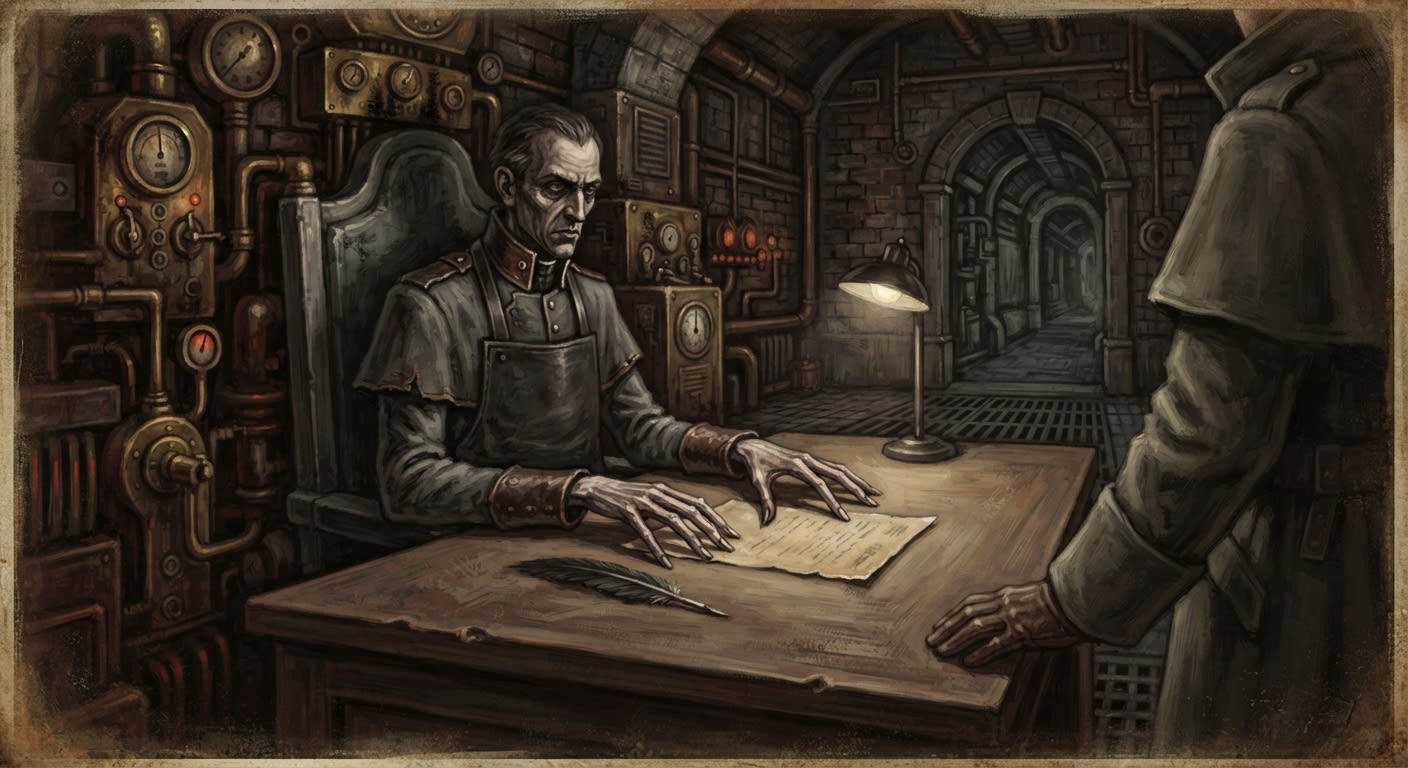
The Appraisers are the seated denizens of the Vault of Ten Thousand Keys, which is Velmora's palace in the Gilded Chasm, beyond the Transylvanian wall held by Bastion-Sibiu. At least two expedition reports attest them. The taxonomy extracted from the Debt-Binder in A.S. 194 places them in the Appraisal Chambers, the fourth of the Vault's five levels: one Appraiser to a room and one desk to an Appraiser. The Bureau has not counted them, because the count would require a survey and the survey would require a surveyor willing to be priced.
They do not move. Every account agrees on this, and the agreement is the worst fact in the file. Keymasters walk and Cataloguers drift. The Locked stand behind their glass. The Appraiser sits, set into its chamber the way a font is set into a nave floor, and it looks at the visitor. In looking, it determines what the visitor would pay for what is in the room. The figure is always slightly more than the visitor possesses.
The Bureau of Doctrine has underlined slightly in three separate memoranda. An Appraiser that asked too much would be a toll-keeper, and men turn back from tolls. One that asked too little would be a pedlar, and men haggle with pedlars. The Appraiser asks for everything and a sliver more. The sliver does all the work. A shortfall that small feels like a clerical matter, and clerical matters are settled by signature.
First the shortage, then the loan, then the signature. Velmora cast every link of that chain from the visitor's own metal.
#On the Gaze
The Assessors of Velmora's field host read broadly. They take in a soldier's courage, his training, the years left in him and the price at which he would sell the man beside him. The Appraiser reads a narrower column. It reads the distance between what a man has and what he wants, and it reads that distance to the grain.
It reads the bargaining threshold, the moment a man stops asking whether and starts asking how. It reads shame, which lowers a man's asking price for himself. It reads the exact point at which refusing becomes expensive, where walking out of the room would cost the visitor more in self-regard than signing would cost him in soul. The widower can leave his wife's ring on the shelf. He will then have to be a man who left it there, and the Appraiser has already priced that man too.
The valuation is correct. I want the reader to understand this before anything else in the entry. Hell's bookkeeping is usually lurid and often wrong. Its prices are inflated for terror and its promises are gilt over lead. The Appraiser is accurate. The Bureau of Tithes would give an arm for its precision, and the Appraiser would already have noted the arm.
#On the Desk and the Instrument
Each desk holds one document and one quill. No account records anything else on it: no ledger, no seal, no sand, no inkwell. The Bureau has reached its own conclusion about what the quill writes in, and that conclusion is filed where Doctrine files things it would rather not have concluded.
The document is already addressed to the visitor. It uses the name he signs with, which is not always the name on the rolls. Its terms run in script below the reach of the unaided eye, clause under clause. The object on the shelf carries its own single word underneath, and the entry on the Appraisal Chambers deals with that word. The document on the desk is a separate instrument. It finances the difference. It will take a lien against wages, against years or against the soul, and it prefers the soul.
Here the Appraiser supplies its part of Contract Theurgy. Velmora's practice needs five things: want, price, witness, contract and custody. The visitor brings the want. The Appraiser names the price and stands witness at the same stroke. The document is the contract, and custody follows. Doctrine holds, correctly and uselessly, that a demonic contract cannot seize the soul directly and that the soul stays free until the hand moves. The Appraiser does not dispute this doctrine. It relies on it. A free soul that signs is a better asset than a stolen one, because nobody can contest the title.
Velmora's rule holds here as it holds in every village east of Sibiu. The gift is real. The ring is the ring and the writ bears the correct seal. The terms are fair, and they are fair enough to damn a man, since he can find no fraud in them to plead against in any court, earthly or otherwise.
Purity field note, early Vault series: "Appraisers display no aggression, no pursuit and no physical threat. Recommended classification: passive fixture, low hostility."
Withdrawn by joint instruction of Doctrine and Purity. The Appraiser needs no aggression, because the price does the hunting. A fixture that converts every visitor into a debtor is hostile in the way a scaffold is hostile, and nobody files a scaffold as passive because it stands still.
#On Relation to Assessors and Keymasters
The Appraisers must be kept apart from every other assessing thing in the Codex, and the Bureau's own vocabulary makes that harder than it should be.
The human Assessors of the Hierarchy of Debt are cult rank-holders in the Ten Thousand Keys. They price recruits and collateral at market, tavern and funeral. They are mortal, they can be hanged, and they are frequently wrong. The demonic Assessors of Velmora's field host are mobile intelligence organs. One of them, captured near the Danube crossings in A.S. 172, contained four thousand pages on the accounts of Bastion-Sibiu's Third Company. That is the order of their appetite. The Synod's own tithe assessors are a third thing again, and any reader who confuses them with the subject of this entry may take it up with the Bureau of Tithes, who will assess him.
The Appraisers resemble the field Assessors but are rooted to their chambers. Doctrine's working distinction is brief. Assessors measure, and Appraisers transact. A Keymaster decides which door deserves you, and the Appraiser decides what you will owe once you are through it. Ledger-Keepers record the debt after it exists. The Appraiser drafts the offer that brings it into existence.
How they came to be is under dispute. Purity files them as a fixed sub-variant of the Assessor class. Doctrine suspects they extend Velmora's own attention, as the fingers extend the counting hand. A minority in the Bureau of Records holds that they were once visitors who took the desk in place of the object. None of these positions is proven, and I decline to rule, because each is worse than the others in a different department.
#On Countermeasures
The standing orders are prohibitions, as every order touching the Vault is. The Bureau of War has twice asked for an affirmative instruction. Doctrine has twice sent back the same list.
Do not sit. The chair across the desk is placed for the visitor. Sitting down concedes that the visitor has come to do business.
Do not answer valuation questions. The expedition accounts are muddled on whether the Appraiser speaks at all. They agree that the visitor ends up hearing a question with a number in it: what would you give, how much is left, what is it worth to you. Any answer is a figure, and any figure is a figure entered.
Do not ask the price. Asking the price is the first clause of a purchase. An officer who asks "for the report" has opened negotiations on behalf of his whole company.
Do not touch the quill. Do not move it, straighten it or push it away. The Bureau has no account of anyone who lifted it and then did not sign, and it does not propose to gather one.
Do not borrow. The deficit belongs to the room. Refusing to cover it is the only complete refusal available, and it feels like poverty, because it is.
Nothing written that carries a figure is to be destroyed in the field. It is to be sealed unread and surrendered to Doctrine. The key-handling protocol of A.S. 199 already governs objects carried out of the Vault, and I have asked in writing that it be read to cover paper. The request remains under review, which in Strasbourg is a form of custody.
The one proven discipline against the Vault is the Third Expedition geologist's. He recited the mineral tables at volume and kept his mind occupied until the room could find nothing in it to price. He never reached the fourth level. Doctrine commends his method anyway, because it is the only one that has come back.
#On Present Classification
The Vault stands under permanent interdiction. The classification was sealed in A.S. 198 and has not been revised. The Appraisers are one of the principal reasons it will not be.
Every proposed recovery operation runs into them. A party sent to retrieve the Locked wants their comrades back, and the want is priced. A party sent for intelligence wants the intelligence, and the Vault holds real intelligence, so the price is real too. A party sent for a relic wants the relic. A party sent only to look wants to know, and curiosity costs slightly more than any Bureau has budgeted. Each want arrives at a desk and is answered with a figure it cannot quite meet. From the Appraiser's side of the desk, a rescue expedition is a queue of customers who have each brought a good reason.
The Bureau of Doctrine recommends no fifth expedition. I have added a note that any officer who proposes one should be asked, in committee and on the record, what he would pay for success. If he answers with a figure, he is to be removed from the proposal. If he answers that he would pay anything, he is to be removed from the Bastion.