
#On the Survey
Omnia venalia.
This is a survey of present condition, entered in A.S. 201, covering the class of territory the Bureau of Records was obliged to name the Counting Kingdoms. It records what is reported of them now. It does not record when they began, who first priced them, or which city fell first. The Bureau does not know, and I will not invent a founding just because a plate article looks undressed without one.
The title is misleading, and I keep it anyway. No report names a king in the Counting Kingdoms. "Kingdoms" is the Records clerks' word for a class of place: old Balkan trade cities in the domain of Velmora, Sin-General of Greed, where the market has never closed and the goods have been replaced. The stalls still open and the ledgers still balance. The scandal of the territory is how ordinary it looks from the road.
#On the Reported Extent
The Codex enters three names against the class: Plovdiv, Varna, and the fragments of Thessalonica. These are examples, and the list is short on purpose. Anyone who draws a border around them on the strength of this survey is drawing it in his own ink.
Each name brings its own embarrassment. Plovdiv gives the least trouble, because the Synod holds no fortress there to contradict me. Varna is worse. The Ashen Redoubt still stands on its Black Sea cliffs: held, compromised, and loudly Synodal. The Bureau of War will not thank me for implying that Velmora governs the town beneath its guns, and I imply nothing of the kind. The report concerns the old commercial city, meaning its markets, its counting houses and the trade that once made it worth fortifying. The survey has no warrant to say how far the reported conditions reach, or where the Redoubt's authority ends and the market's begins.
Thessalonica appears in the entry as fragments, and the word was chosen with care. The harbour city the Synod knows as Thessaloniki keeps its chain-towers and its harbour authority, and pilgrim ships still unload under them. The Velmora entry names a broken remnant of the old trade city. I spell the two differently because the sources do. The spelling settles nothing about jurisdiction, and I will not pretend that it does.
Beyond those three names the survey says nothing. No population is given, because none is known. No frontier is drawn, and none should be inferred. The class lies within the wider Charnel Lands east of the Line, where any measurement is an act of faith in the worst sense.
#On the Work of Exchange
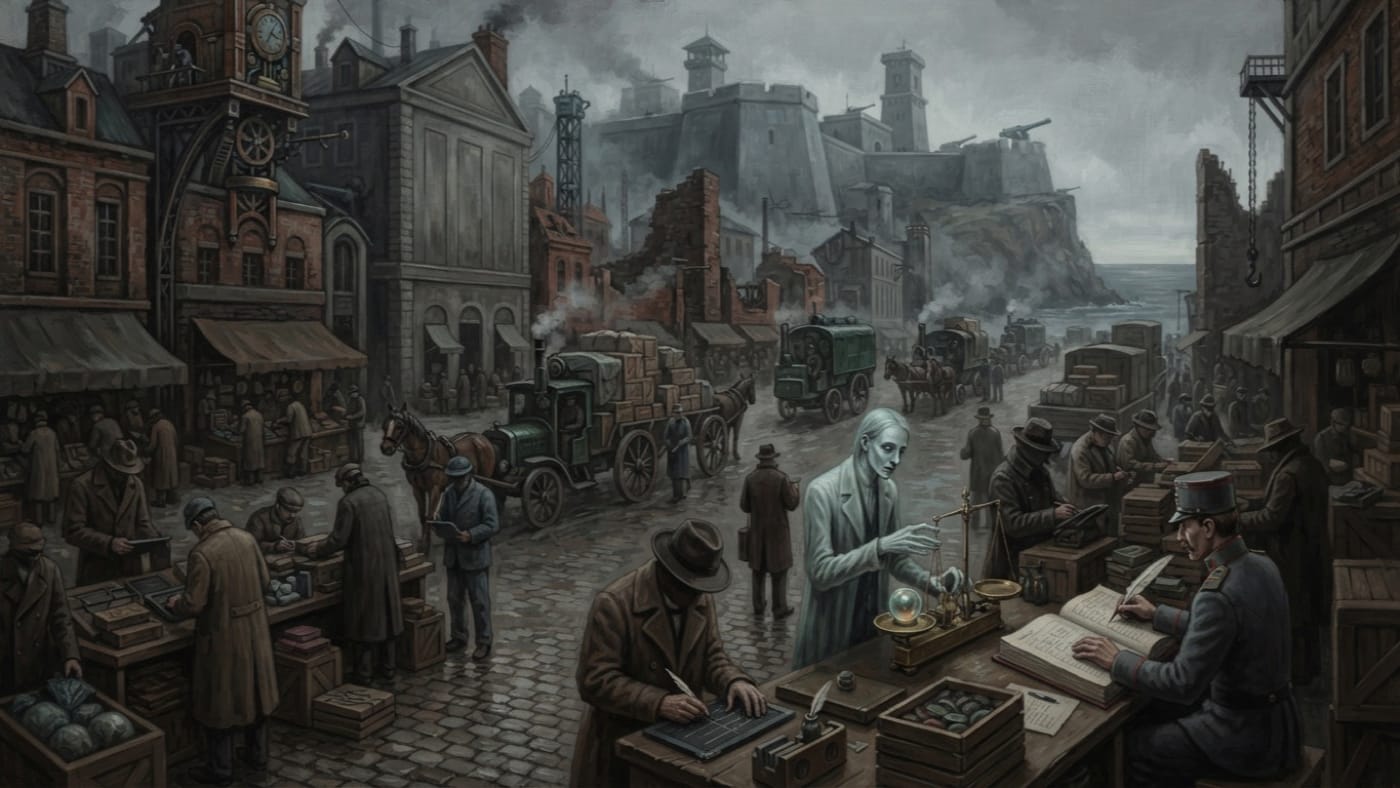
What sets the Counting Kingdoms apart from the rest of Velmora's holdings is that business continues. The markets are busy and the guildhalls sit in session. The banking houses keep their hours, and the caravans still run between them, loaded and unloaded by men who know their trade.
That is the whole of the horror, and the Bureau has spent years failing to make its clerks see it. A field soldier expects ruin to look like ruin: the gutted nave, the burned granary, the ditch of the unburied. The Counting Kingdoms show him a weighing-house with its scales in good repair, a guild clerk with clean cuffs, and a caravan master who will quote him a fair rate for the road. Every part of the institution is intact except what passes across its counters.
The Velmora file says that in these cities transaction has replaced every other form of human dealing. I record the claim as the file makes it. The file does not say that the people have stopped greeting one another, burying their dead, or quarrelling over dowries. It says that each of those acts now carries a price, and that the price is what gets discussed.
The caravans need a sentence of their own. A caravan is a promise that something will arrive somewhere else. According to the reports, the caravans of the Counting Kingdoms keep that promise. The reports do not say what they carry, and I will not supply a manifest I have never read.
#On the Terms
Four currencies are reported: time, memory, the sensation of warmth, and years of life pledged against future comfort.
Time is the most common, and by the reckoning the reports attribute to Velmora's houses it is also the cheapest. A man sells an afternoon, then a season, then whatever share of his hours he had been keeping for himself. He goes on living through those hours. By the houses' reckoning they are no longer his.
Memory costs more. The reports speak of memories offered in exchange and then missing from the person who offered them: a face, a road, the particular evening on which some promise was made. I enter this as reported. I give no account of how a memory is lifted, where it is kept, or who reads it, and I will strike any later annotation that tries.
Warmth troubles the Bureau of Doctrine most, because it is such a small thing. It means the sensation itself: the hearth on the hands, the body beside one in winter. A merchant who has sold it reportedly still stands at the fire, and the fire is still hot. By the account, he no longer feels it as warmth.
Years of life are the heaviest coin, and the only one the reports describe as pledged. They are set against future comfort, a better house or a quieter old age, on terms that put the comfort later and the payment now.
The Velmora file holds that she takes her share of every exchange. It does not say how much. I have read the file more often than is healthy, and the figure is not in it. I will not invent a rate. A percentage is exactly the sort of detail readers remember, and within a year the Bureau would be quoting my fabrication in field manuals.
The hostility of Velmora's houses lies in their accounting language. In their reckoning a person is an inventory, a sold memory is a closed entry, and a merchant who has traded enough of himself is a settled account. The Bureau records these terms because they show how the enemy values its customers. The Bureau of Doctrine holds that a man who has sold his warmth has made a ruinous bargain under every pressure a demon can apply: want, flattery, dependency and fear. Doctrine also holds that he remains the one who decides whether to sell again tomorrow. The houses may enter him otherwise in their books. Their ledgers are not canon.
The Velmora entry in this Codex stated that the merchants of the Counting Kingdoms go through the motions of exchange "because exchange is the only motion left to them."
The sentence was mine, and it scanned beautifully. Its universal claim is withdrawn. What the reports describe is deterioration: memory thinned by sale, feeling sold off by degrees, a merchant's dealings narrowing to the counter. The Bureau does not certify that any merchant has lost every other motion, and Doctrine does not permit it to certify that none could make one.
#On the Distinctions
The Counting Kingdoms are confused with other Velmoran categories often enough that the confusion has become a filing problem.
The Counting Halls are chambers on the third level of the Vault of Ten Thousand Keys, inside Velmora's palace. The Halls are rooms, and the Kingdoms are cities. A clerk who files a report on Plovdiv's markets under the Vault's third level has put a territory inside a building.
The Debt Warrens are underground complexes beneath the old Danube cities, where those who owe more than they can pay are kept. The Hollow Vaults are treasure chambers that grow by swallowing streets and districts. The Gilded Chasm is the wider fortress landscape, the canyon that holds the Vault. None of these is a trading city that still keeps market day.
The Assessment Halls put values on people, and the Binding Markets trade contracts as goods. The survey does not know where either stands in relation to any particular Counting Kingdom. It does not place them inside the cities, and it does not rule that out.
The famine of Kargath appears in the Velmora entry as the ground her commerce grew from. No report connects that famine to the opening of any particular market here, and I connect nothing.
#On the Present Condition
As of this survey, the Counting Kingdoms are trading. The guildhalls are sitting and the caravans are arriving. According to the reports, the people who keep these institutions running are being drained by the same exchanges that keep them running. They give up an hour, a memory, the heat of a hand, or a year pledged against a comfort that may or may not arrive, and Velmora takes her unmeasured share from each.
That is the condition. The Bureau has no figure for the rate, no map of the edges and no date for the beginning. It has three city names, one of them in fragments, and a description of commerce that has not stopped.
I submit this as a survey. Readers who require a king may apply to the heralds.