
#On Their Authority
Pacta sunt servanda — nisi ab inferis.
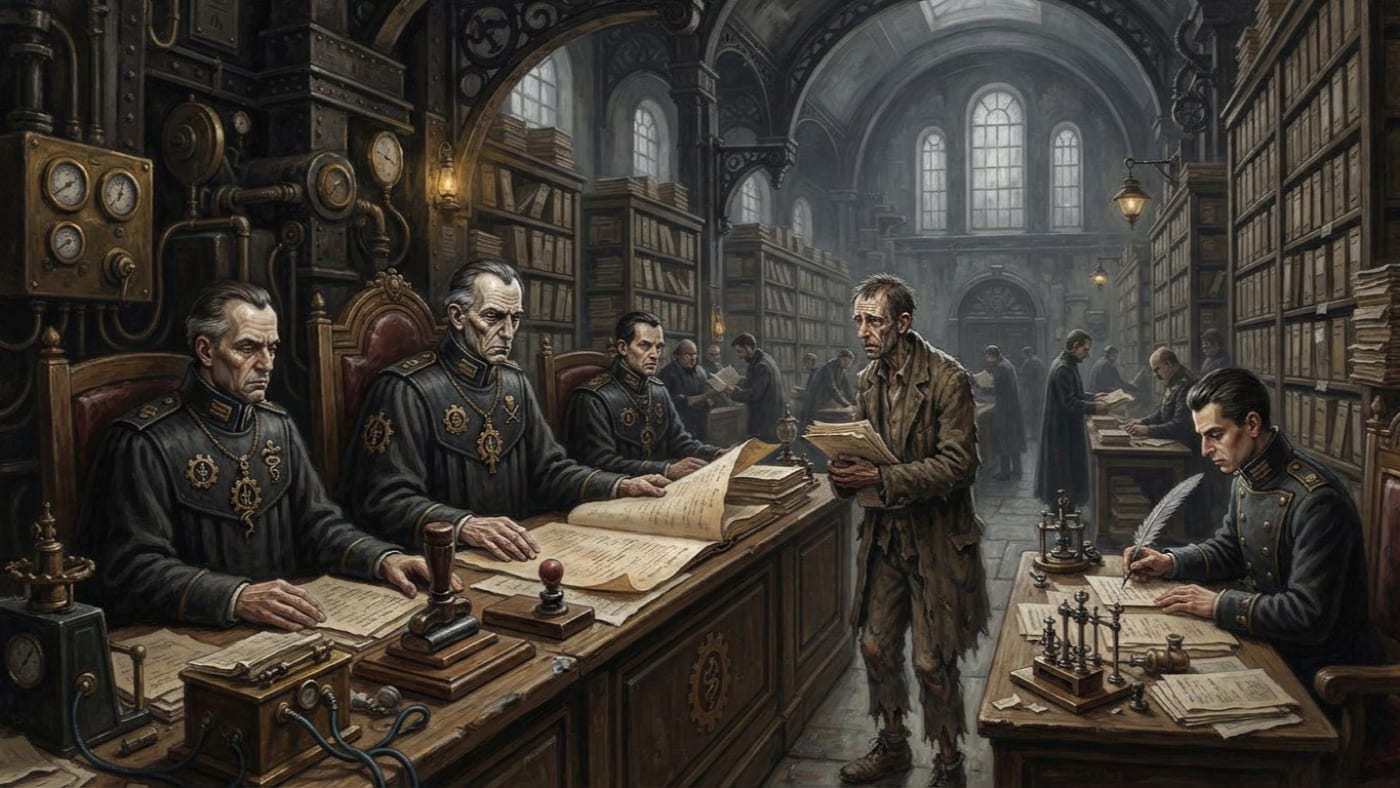
The Debt Tribunals are courts of the Synod with one power: they may annul a debt, or the contract that created it, once that debt is shown to be of demonic origin. They may not forgive a debt for being cruel or trim an interest rate for being ruinous. Their jurisdiction is narrow by design and narrower in use, and I record it with the satisfaction proper to an institution that keeps its boundaries tidy.
The Synod has raised many defences against Velmora, the Covetous Serpent. Only the tribunals answer her in her own language. The auditors find the bad coin and the readers find the bad clause, but only a tribunal may take an obligation that was signed, witnessed and sealed and declare that it never bound anyone. That is a remedy. It is a legal remedy, so it works on paper. A reader who expects paper to reach into a petitioner's marrow and give back what was spent there has mistaken a court for a sacrament.
The files I have consulted do not say who first convened these courts, or where, or under whose seal. I note the gap and decline to fill it. A Hieromnemon who invents a charter for his reader's convenience is a forger with better posture.
#On the Debt Brought Before Them
Velmora's sorcery is Contract Theurgy. She trades by agreement. Her human congregations, the Ten Thousand Keys, work from banking houses, guild offices and the antechambers of noble courts. They offer terms that look generous and they honour them to the letter. The loan arrives, the rent is forgiven, the appointment comes through. The benefit is real, and so is the account it opens.
Earlier editions of this Codex identified Velmora's primary sorcery as "cursed coinage."
The Bureau of Doctrine has revised the classification to Contract Theurgy. For the tribunals the change matters. Any Purity officer with a pair of tongs can seize and melt a coin. A binding has to be argued, and the argument happens before a bench.
The debts that follow are not always counted in Crowns. In the lands she holds, the parent dossier records trade in time, memory, years of life, loyalty, service and promises not yet made. Beneath the old Danube cities, children inherit their grandparents' balances. On our side of the Line the forms are quieter, and they are everywhere. Along the supply corridors that feed Bastion-Sibiu, facing her domain in Moldavia, Wallachia and the eastern Transylvanian approaches, quartermasters, toll-keepers and chaplains put their names to paper every day. Any one of those signatures could be the one.
One episode from that frontier has entered the record. A captain signed a truce at the Gilded Chasm, and his right hand walked away from his body. I stress that this appears in no tribunal's file. Nobody petitioned. There was, I gather, some difficulty about who would hold the pen.
Take a hypothetical, and nothing more than that. In a hungry season a respectable lender gives a miller in the eastern provinces credit at a fair rate. The mill survives. The lender is patient and courteous, and attends the miller's daughter's wedding. Ten years later every payment has been made and the balance has not fallen, and the miller has started recommending the lender to his neighbours. He brings the matter to a tribunal. What exactly has he brought?
A loan at a fair rate, and a friend. Every part of it is ordinary. The Bureau may not treat the poor as suspect because they are poor, and it may not treat the lender as suspect because he is rich. If it did, the only people left outside the dock would be those under the Mark of Poverty and the dead.
#On the Proof
This is where the tribunals earned their reputation.
The petitioner must establish demonic origin. According to the parent dossier, that means proving the signature itself was obtained through supernatural coercion. Proof needs evidence, and evidence needs an investigation. An investigation needs investigators whom nobody has approached with interesting terms. As far as the Bureau has been able to tell, investigators who can examine a Velmoran contract without receiving a Velmoran offer are a theoretical class.
The Bureau of Doctrine teaches that no demon overrides a human will within Synod territory. Pacts there hold by persuasion, dependency, deceit and threat, and the signatory chose, however ruinously.
The tribunals require proof of supernatural coercion.
I have been told not to set those two sentences side by side. I have put them in separate paragraphs. That satisfies the letter of the instruction, and the letter is what this court deals in.
A tribunal is not moved by a fair contract, a polite creditor or a suffering petitioner. Velmora supplies all three in quantity, and none of them tells her work apart from a moneylender's. A ruinous bargain honestly kept looks, on its face, exactly like a bargain honestly kept. Her servants do not cheat. That is the entire difficulty, and you will find it in no statute.
The Bureau of Records does its share of this work earlier, before any court sits. It keeps contract readers, specialists who go through documents of legal significance looking for buried clauses and terms that do not mean what they seem to mean. Several readers check each document. The Bureau now rotates them every two years. Before the rotation began, by the dossier's account, a number of them went mad from what they found between the lines. A reader can tell you a clause is strange. Strange is a long way from demonic. Every notary in the eastern provinces has drafted something strange, usually after lunch.
One more thing troubles me. The Keys place their people in banking houses, guilds and noble courts. The parent dossier also admits they have reached the Bureau of Tithes. No file I have read shows them anywhere near a tribunal bench. I mention it so that you will think about it at unfortunate hours, as I have.
#On Dismissal and Annulment
Most cases are dismissed. The dedicated lore says so plainly, and I cannot improve on it.
The parent dossier puts the rate of success at roughly once per decade. That figure is an assessment, not a count from a docket, and nobody has told me whether it covers one bench or all of them. The Bureau calls it a success rate. I called it one too, for most of an afternoon.
When a tribunal does annul, the contract is voided and the creditor loses his claim in law. The ledger entry is cancelled under seal, and the record now shows a debtor who owes nothing.
The record is often wrong. The dedicated lore warns that annulled debts frequently come back through other means. The files do not say what those means are, and I will not invent them. All I can say is what a court actually does: it cancels an instrument. With Velmora, the instrument may have been the least of what she held.
Petitioners tend to confuse annulment, refusal and redemption, and the confusion costs them. A ruling voids a document. Refusal means the debtor's own choice to stop paying in whatever currency the creditor preferred, and Doctrine holds that this choice was always open to him, with or without a court. Redemption belongs to the Church, and no tribunal seal reaches it. None of the three has been shown to return what was already spent: the years, the memory, the mill, the daughter's good opinion of her father's friend. I do not say these things can never come back. I say only that the tribunals have never claimed to bring them back.
#On the Other Defences
The tribunal is the last of several defences, and most debts never get that far. Currency is blessed before it circulates. Velmora's coins circulate anyway, look the same, spend the same, and find their way home to her. Documents of legal significance go through the readers. The Bureau of Tithes preaches tithe as inoculation, holding that whatever a man gives to the Synod cannot be bought by the Enemy. The dossier calls the evidence for this unclear. The Tithes' annual projections call it settled.
The Value Fast puts private property into communal custody and its owners on communal rations, on the theory that detachment weakens Velmora's hooks. In practice it gives her agents a timetable of desperation. The Mark of Poverty takes those who vow it out of transaction entirely, and out of every ledger the Synod needs to fight a war. Its adherents may be right. They are also impossible to put on a staff list.
Velmora is the one party in this list who has never needed to petition anyone.
#The Ratification
This entry is filed under the countermeasures against Velmora. The tribunals keep their authority to annul debts of demonic origin, on proof. Supplying that proof remains the petitioner's job. The Bureau of Doctrine has seen this entry and found nothing in it to correct, which I take as its considered opinion.