
#On the Charter and the Casks
"If it settles, it's true." — Cooperage Compact oath, as administered at the Seal Locks
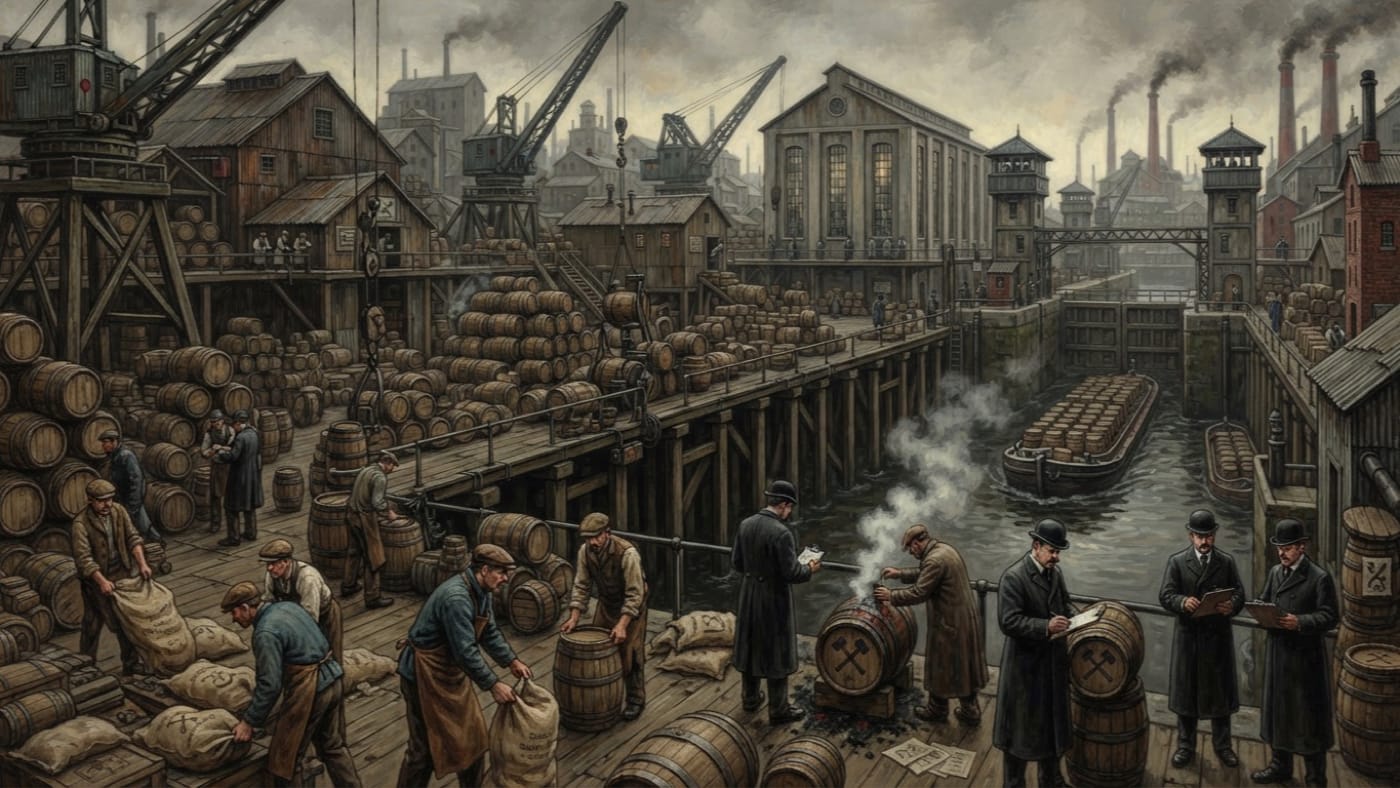
The Cooperage Compact is the guild of Mournwater's barrel-makers. It would also like you to know that it is the guild of their paperwork. Its yards stand on pilings above the flood mark at the Saint-Dust Cooperage of Mournwater, a Zone 2 river-belt town under Synod oversight. Its public purpose is keeping trade flowing. Its practical purpose is owning the thing trade flows in.
Mournwater made barrels before it made miracles: grain casks, lamp-oil casks, the plain oak furniture of a river economy that needed containers more than convictions. Then in A.S. 98 a barge carrying forty-two reliquary jars from the Ossuary Shoals overturned upriver, and the current delivered measurable sanctity into the water, the silt and the staves drying on the wharves. Alchemical Standards confirmed what three coopers' vanished headaches had already suggested. The town's trade acquired a halo, and shortly afterward a fee schedule.
The Compact's documented legal footing is its charter, ratified in A.S. 104 under the joint seal of the Bureau of Records and the Bureau of Purity. I have examined the record of ratification. I have not examined the clauses. The record does not supply them, and I decline to quote a document I have seen only from the outside. What follows describes how the Compact behaves. The guild finds it unhelpful to ask whether it behaves that way by charter, by custom or by appetite.
By A.S. 110, the year the First Continental Levy sent a tenth of every household's sons east, Mournwater had become a reliquary port that still made barrels. The guild kept the barrels and has never regretted it.
#On the Division of Authority
Follow one cask. It is the only honest method.
Dust arrives from the Ossuary Shoals in sacks. It goes first to the Grading Hall of Settled Light, where samples are laid in shallow glass dishes and the town falls silent at the daily Settling Bell. Accepted dust settles into rosary strata, ring upon ring, like the years in a sawn oak. The graders record the strata. The Compact records nothing at this stage, because nothing at this stage can be invoiced.
Certified dust is suspended in brine as holy slurry, and now the guild enters. A cooper of the Compact supplies the cask: oak staves, pitched seams, iron hoops driven by a hoop-smith with vinegar burns to the elbow. The slurry is poured and the bung struck, and a pitch runner seals the seams with pitch run hot. Somebody will report on the runner's lungs later. Then two papers are attached, and all of Mournwater depends on their remaining two.
The first is the purity seal of the White Steps, pressed in confession wax under the Purity Office. It declares the contents holy. The second is the Compact shipping manifest. It declares the contents present, counted, owned and owed for. The seal answers to the Creator and the manifest answers to the buyer. Neither paper may impersonate the other. A cooper who wrote "pure" on a manifest would be practising theology without a licence.
The papered cask goes down to the Slurry Docks and then to the Seal Locks, the only lawful passage for certified ships. The lock provosts read both papers, charge a toll set fresh each morning, and open the gates. That makes three authorities and three bottlenecks. The guild owns containers and commerce, the certifiers own purity, and the provosts own the water.
The Compact cannot declare a batch pure. It can only refuse to give the batch anything to travel in. Its influence at the locks is real and well fed, and it governs how fast a cask passes, never whether the contents are holy. A resin shortage and a shortage of seal authority will each stop Mournwater dead. They are separate shortages, and the guild controls only the first. That is its single humility, and it keeps it in a locked drawer.
#On Quotas and Debt Papers
The yards consume oak, resin, lime, clean cloth, grain and lamp oil. All of it is imported, and all of it is scarce in a war that burns whatever burns and eats the rest. The Compact sets cask quotas against those imports, and quota is its quietest instrument. A yard that misses quota loses its resin allocation. A yard without resin cannot seal, and an unsealed cask is firewood with ambitions.
Labour is managed on the same principle. Mournwater pays in coin when it must. Otherwise it pays in stamped paper, ration chits, dust scrip, oath-notes and futures slips, and most of these pass through the Compact somewhere between issue and redemption. A pitch runner needs a guild writ to enter the yards. A slurry loader needs a dust-labour voucher to stand on the docks. A grader on mandatory rotation needs a docket proving the rotation was served, or the hours are owed again.
The futures slip completes the system. A dockhand who buys a slip against next season's slurry is betting on a garrison's thirst, which means betting on its dead. When the bet fails, the guild bailiffs call. They may take payment in labour. They may take it in names: a brother's, a neighbour's, or that of whoever was seen cutting dust last week. Or they may take it in quarantine "volunteering." The debtor washes linen in the Crumble Ward until the debt, the debtor or the linen gives out.
No official needs to be cruel. The papers do the work. A Mournwater labourer can be ruined by a document he has never seen, filed in a yard he may not enter, under a quota he did not set.
#On Those Who Keep Trade Moving
Master Cooper Vell Arno controls the barrel supply, which in Mournwater means he decides whether anything leaves. He smells of pitch. He reads the grain of a table before he signs anything laid on it, a habit his associates call eccentric and the seal clerks call a delay. In public he fears one thing, a pitch shortage scandal, and he has already had one. By the published account, in A.S. 193 three warehouses of adulterated resin were traced to a Compact sub-contractor. The man was reportedly his brother-in-law, and he was reassigned to quarantine labour.
Arno holds the yards now. He did not sign the charter. It was ratified ninety-seven years before this survey, and no record I hold names its signatories.
Purity Prefect Sister Halvein holds the seals. Arno can refuse her casks, and she can refuse his cargo its holiness. Silt-Rook Dema holds the backchannels, the flooded under-streets where counterfeit seals and cut dust move by night in flat-bottomed skiffs. His boots stay dry in a town where nothing else does. Dema fears the locks closing for good, and so does Arno, for opposite reasons. The published account dates their arrangement to about A.S. 187. Since then the three have kept one another in business by keeping one another afraid.
Dema's trade belongs to Dema. The Backchannel Consortium is a separate cartel. The Crumble Ward Sisters are a care order and take no orders from anyone in a cooper's apron. I set this down because the Compact's critics file every smuggled cask under the guild's name, while its defenders file every honest one there. Both filings are lazy.
The Graders' Quiet Union is the problem none of the three can buy. The graders watch the dishes. They know which dust hung in the air when it should have fallen. They answer through silence tests, private codes and slowdowns, and lately through marks scored into hoop grooves and wax ridges. Those marks tell a dock crew more about a cask than its manifest does.
#On the Shipment That Remained Certified
The Crumble-Wrong was classified Category Two in A.S. 194. Its dust settles into the shapes of bones, and certified slurry carrying it later reduces the dead it is applied to. For the Compact the anomaly is a contracts problem with a theological complexion. Condemned dust fills no casks and spoiled casks fill no quotas. Frightened workers stop coming to the yards, and the bailiffs have only so many quarantine beds to sell.
The guild cannot simply stop. The Sagittal Line consumes sanctity by the cask, in trench shrines and field hospitals all the way to Bastion-Constantinople. Orison broadcast houses lace their transmissions with saint-dust against the unhymns of the Pale Chanters. Scarcity makes every questionable cask more valuable. The Compact has noticed.
In A.S. 199 a shipment left Mournwater for a garrison on the southern corridor. Its casks were sound and its pitch held. Its White Steps seals were intact, and its Compact manifests balanced to the last stave. Within hours of application the garrison's recently buried dead had crumbled into pale, moving powder. The chaplain filed a report and the Synod denied receiving it. Sister Halvein's office blamed atmospheric conditions, and the Cooperage Compact blamed handling. The garrison had no office, blamed nobody in writing, and buried its dead again.
The difficulty is that a certificate and a sealed cask can each travel perfectly while the thing inside them turns. Neither paper lied in any sense the law recognizes. The town has its own accounts. Some say the dust remembers the bodies it came from. Others say something upstream is making relic matter that nobody buried. These are reports and rumours. The Bureau of Doctrine favours no public explanation, and I will not volunteer one for a guild that charges for paper.
Compact shipping assurances describe certified Mournwater stock as stable in transit.
Withdrawn. Certified stock has turned after dispatch. Later operational guidance requires a second settling before certification, unless supply priority overrides it. That guidance is a later instrument and no part of the A.S. 104 charter. The charter's authors cannot be blamed for a river they never met.
#On the Audit Still Pending
A.S. 201. The locks are open. Casks leave Mournwater on schedule with two papers each, and both papers are in order. The Cooperage Audit of the guild's quotas, materials and manifests remains pending, with no completion date scheduled. The Bureau of Records withholds the revised contamination rate. Arno reads the grain of the table, Halvein presses the wax, Dema's boots stay dry, and the graders keep scoring their hoops. The cooperage keeps shipping, because the Line keeps asking.
The guild has asked that this article be filed under containers. It has been filed under containers.