
#On the Order's Station
"If the dust won't settle, somebody lied in the ledger." — Mournwater saying
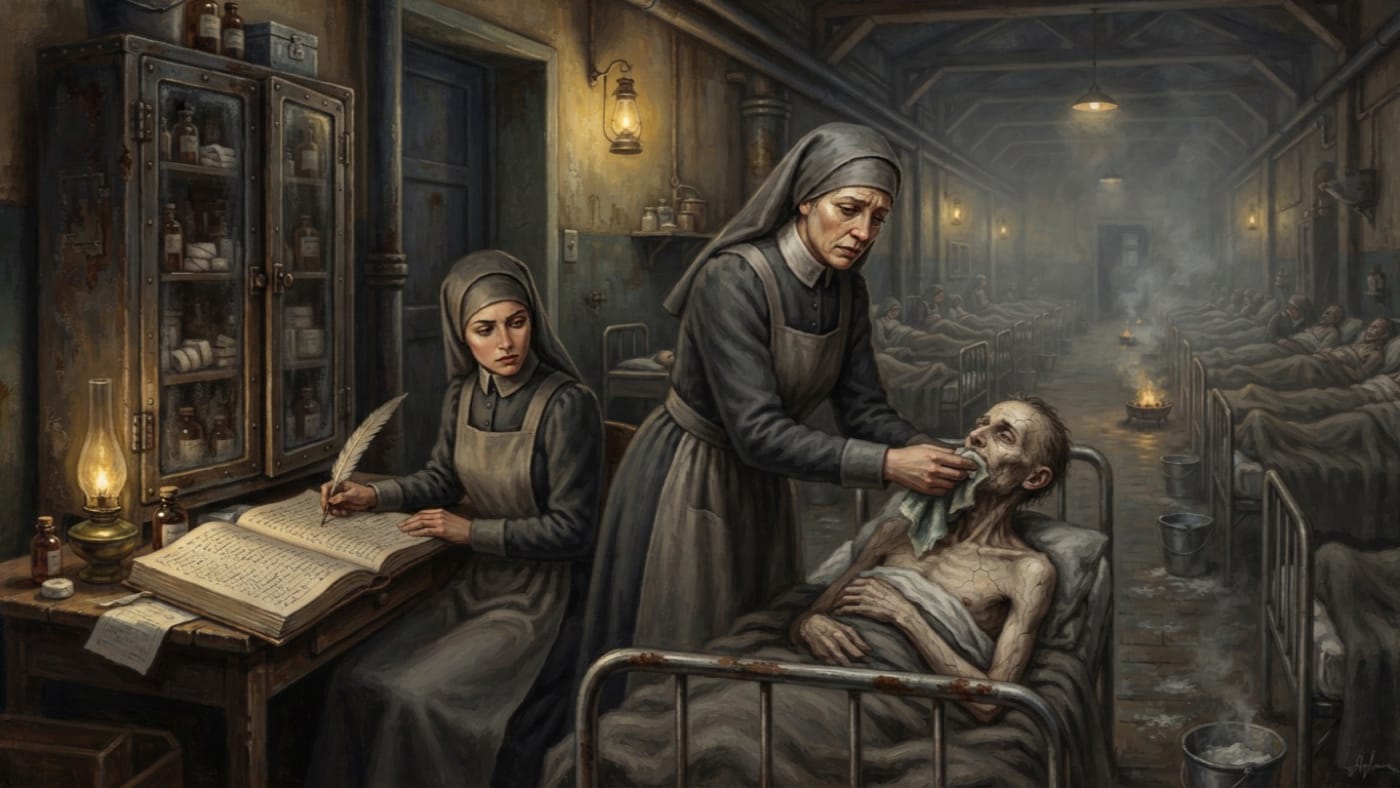
The Crumble Ward Sisters keep two pieces of furniture in the Crumble Ward: the medicine cupboard and the ledger. The rest of Mournwater's quarantine housing belongs to the ward itself. That means the lime on the thresholds, the damp timber, and the cough that passes down a row of beds faster than gossip. With the cupboard and the ledger the Sisters run a district that the Saint-Dust Cooperage of Mournwater would rather put a price on than visit.
Their public office is quarantine mercy. A Sister wrings a cloth in brine, lays it across a cracked mouth and waits for the coughing to stop. Then the same Sister, or another with drier hands, opens the ledger and writes down what the cloth caught.
Both tasks count as mercy. Only the second outlasts the patient.
The town's own accounting gives the order a second office, which is triage. The Sisters decide who lives and who becomes evidence. No founding charter for the order has reached my desk, and I have found no founder, no superior, no tally of beds. I searched with the diligence of a man who expected to find his own name in the acknowledgements.
#On the Crumble-Sick
The town calls the early condition crumble-sick. Its signs are modest, and that makes them terrible: hairline cracks across living skin, grit at the teeth, a voice that dries halfway through a sentence as though the throat had been sanded. In the ward the quarantine poor cough pale grit into cloth and fold the cloth before anyone can read it. The danger travels by breath and by water. In a river town wrapped in fog, that means it travels everywhere.
Saint-dust answers to humidity. When turned dust reaches a corpse, the body undergoes secondary reduction. It falls into a powder that moves with the damp air, and the dossier on Crumble-Wrong describes this with more relish than the Bureau of Medicine thought decent. That is the fate of the dead. The living in the ward have cracks, grit and fear. No ledger I have read certifies that every one of them will go the way of the corpses, or says when. No Sister claims a cure either, which I note only because Mournwater claims cures for everything else.
The approved countermeasures are lime washes, salt baths, sealed-sleep masks and pitch burned at thresholds. Lime slows mobile powder without halting it. Salt breaks some clumps and feeds others. A sealed-sleep mask keeps the grit out until the sleeper scratches a cheek in a dream and wakes with chalk on the tongue. Pitch smoke drives powder off the threshold and up into the rafters, where it waits. Clean-handed visitors sometimes list second and third settling alongside these, but those are tests performed on dust in the Grading Hall. Nobody settles a patient. Patients are washed, masked, smoked and watched.
Watching is what the Sisters do best.
#On Medicine and Record
Mournwater imports lime, clean cloth and lamp oil. It pays its bribes in resin, certifier ink, futures slips and, again, clean cloth. In the Crumble Ward a clean cloth is a bandage and a fee at once, and the Sisters hold the key to the cupboard where both are kept.
Medicine control is triage turned into furniture. The cupboard has a lock and the lock has a key. The key decides whose fever is treated this week and whose is observed. Observation costs less. It needs a lamp, a ledger and a Sister with steady handwriting.
What follows is illustration only, since the Sisters have not sent me their books. Picture a bed near the lime cordon. The patient's cracks have stopped at the jaw, and the patient's name sits on a futures slip held by a guild bailiff. A draught given now might close the cracks or might do nothing, and no record I hold says which. A draught withheld guarantees a fuller entry. The Sister notes the hour of each cough, the colour of the grit and how far the line has crept along the jaw. The page grows more exact as the person in the bed becomes more of a sample.
Quarantine releases are among the papers sold in Mournwater, along with test results and seal allocations. My sources do not say whose hand sells them, and I decline to guess in print, because guessing in print is how a theologian becomes a defendant. Whoever sells them, any release that disagrees with the ward's ledger is a forgery waiting for its auditor. The Sisters keep the ledger.
The Bureau of Mercy offers the obvious precedent. It treats and quarantines the plague-stricken, and it curates deathbed confessions into the Records. No document I hold makes the Crumble Ward Sisters its subordinates. Methods travel without papers. The order also shares a title with the Mercy Ward-Sisters of the field hospitals, but I can certify nothing beyond the title. No vows, ranks, patron or habit have been documented for the Mournwater order.
#On the Other Offices
Visitors mix up the Sisters of the ward with Sister Halvein, Purity Prefect of the White Steps. Halvein's office certifies dust, and its seal is what carries a cask through the Seal Locks. Nothing I have found puts the ward under her hand. The dock crews keep the two apart more reliably than the Synod's filing does.
"Mournwater never ships tainted." — town assurance, printed on every clean certificate.
Withdrawn. In A.S. 199 a southern corridor garrison chapel received three casks stamped pure by Sister Halvein's office, and twelve recently buried soldiers crumbled inside their vaults. The assurance stays on the certificates for the sake of commercial continuity. It is withdrawn here, where only scholars will see it.
Master Cooper Vell Arno controls barrel supply and the Cooperage Compact's quotas. Silt-Rook Dema controls routes, counterfeit seals and the price of information along the Backchannel Needleway. The Graders' Quiet Union knows which batches are bad and sells that knowledge in whistle codes and hoop marks. Each is a separate body. I have found no treaty, reporting line or shared ledger tying any of them to the ward.
None is required, because the town's arrangements do the tying. Guild bailiffs enforce futures debts, and payment can take the form of labour, surrendered names or quarantine "volunteering." Quarantine labour pays for a stay. So a cooper coughing grit, a grader whose hands shake over a dish and a debtor whose slip has fallen due all reach the same lime threshold by different streets.
The quarantine washers are part of that labour, and the saying goes that they know which families are already gone. Some wash to pay for a stay. I cannot certify whether they work under the Sisters' instruction or the bailiffs', and I suspect the washers cannot either.
#On Evidence Held
The Grading Hall keeps sealed red ledgers of the shapes its dishes form. One entry, reported in the Crumble-Wrong dossier, describes a rib of child's proportions in settled dust. It bears three healed fractures and matches no catalogued saint. According to the ledger, it corresponds to a living patient in the Crumble Ward.
Everyone agrees this is impossible, and everyone has filed it under "pending."
I will not name the patient. If the Sisters are wise they will not either, and I have no evidence that they are anything else. Their position deserves a moment's thought, though. A rib in a dish is Grading Hall property. The patient whose ribs it resembles, at three points a surgeon could count, lies in a ward bed under the Sisters' care. If that patient is evidence, the bed is a vault. If the patient is simply a patient, then the ward's note on those old fractures is a medical record that the Bureau of Alchemical Standards would very much like to read. That Bureau reviewed the anomaly jointly with the Bureau of Rites in A.S. 200. Neither has published a disposition for the patient.
Mournwater's own description of the ward lists a further hazard: bodies vanish into "test barrels." Whose bodies, tested by whom, shipped where — the sources say nothing. I give the allegation a paragraph of its own and keep it apart from the rib. Linking the two would be an inference, and in Mournwater inferences trade as futures.
#On the Present Intake
When the Settling Bell calls the town's daily silence, the Sisters stop beside the beds like everyone else. The patients cough grit into cloth, and the cloth is folded. The pen hovers above the page. No ordinance I can find forbids writing during the settling prayer, but nobody in the ward wants to be the first to try.
The order's documented pressure is an outbreak spike: more intake, the same cupboard. As of A.S. 201 the commerce continues, the Cooperage Audit is still pending, and the Purity notice keeps observation indefinite. The casks still go out to the chapels of the Sagittal Line. The ledger stays open on the table beside the cupboard, with the lamp turned low and a fresh page ready.