
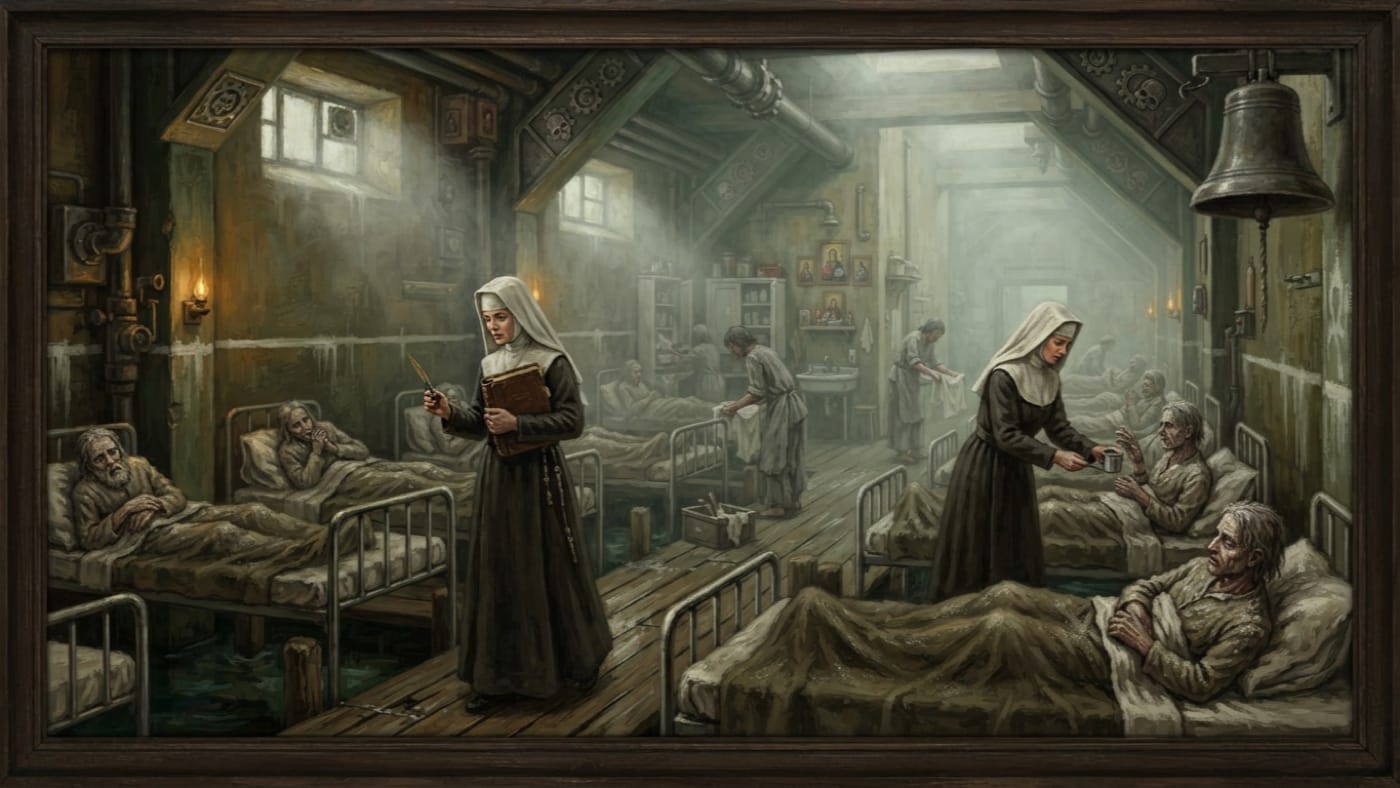
#On the Quarantine Housing
"Persons exposed to condemned dust should report for observation. Observation duration: indefinite." — Purity Office notice, Mournwater, A.S. 201
Mournwater keeps seven districts strung along its river bend like casks on a dray. The Cooperage Yards make the barrels. The Grading Hall tests the dust. The White Steps certify it, the Seal Locks tax it, the Slurry Docks load it, and the Backchannel Shacks take whatever the others drop. The seventh district takes in the people the other six have used up. It is the Crumble Ward, the town's quarantine housing, and in my survey of Mournwater I gave its smell as lime and fear. I have found no reason to change either word.
The ward sits as the rest of Mournwater sits, on pilings above flooded cellars, in a fog that leaves a pale film on every sill. Lime cordons mark its edge. Whitewash runs down its doorposts in streaks that the damp opens again within the day. The beds lie close together. The air is the river's air, and that is the trouble.
Quarantine intake is one of the four lawful ways into Mournwater, along with the lock permit, the guild writ and the dust-labour voucher. Of the four, it is the only one that admits a person without first asking what they can carry out. One paper governs departure: the release. Mournwater sells it as it sells every other paper.
No record I hold dates the ward's founding, names the hand that first limed its cordon or counts its beds. The Codex will not invent them. Mournwater's other institutions arrived with charters. This one arrived with a need.
#On the Crumble-Sick
The Crumble-Wrong record describes dust that settles into bone shapes when it ought to settle into rosary strata, and powder that moves with humidity toward water, toward breath, toward the living. A river town is humidity with a charter. The ward's patients come from the docks, the yards and the shacks, and they come marked.
The marks are small. Hairline cracks open along the skin at the knuckle, the lip, the corner of the eye. The teeth grit as if the patient had been chewing chalk. The voice dries until speech sounds like paper drawn across a table. The worst cases cough pale grit into cloth, and the cloth is taken away, counted and washed.
On one point the Codex is exact, because exactness is all the Bureau of Doctrine has left to offer the sick. Secondary reduction, in which a body falls into mobile powder, is documented in corpses touched by turned dust: the garrison dead of the southern corridor crumbled in their vaults within hours. The living of the Crumble Ward are documented differently. Their record is cracks, grit and drying voices. Nothing I hold proves that every patient ends as a pale heap, and I decline to finish their sentences for them.
The countermeasures are the town's own. Lime washes on the thresholds. Salt baths. Sealed-sleep masks strapped over the sleeping face, which hold until the sleeper scratches in a dream and wakes with grit on the tongue. Pitch burned at the doors, which drives the powder up into the rafters to wait. Each fails at its own pace. Re-settling, the second and third trials of the dish, belongs to the Grading Hall and is done to dust. The ward has no second settling for people.
So the cask and the cooper leave the same yard on different papers. The cask goes downriver under a clean certificate. The cooper who sealed it goes to the ward with a cracked cheek and a line in the intake book.
#On the Sisters and the Washers
The Crumble Ward Sisters are a care order. Their public office is quarantine mercy. Their real office is deciding who receives treatment and who becomes evidence, and they carry it out with two instruments: the medicine cupboard and the ledger. A draught is given or withheld. Either way, it is entered.
They take no orders from coopers. The Cooperage Compact commands the yards and has no writ over the ward's beds. I have recorded this separation before and record it again, because Mournwater's gossips keep filing it wrongly. Purity Prefect Sister Halvein shares their honorific and nothing else that matters here. Her office certifies saint-dust at the White Steps. Nothing in the record makes her mistress of the Crumble Ward. The Codex names no superior, no founder and no membership count for the order. In linen, masks and ledgers it resembles the Mercy Ward-Sisters of the field infirmaries. The record says nothing more, and I do not borrow their ranks to fill the gap.
The Sisters' ledgers are the only running account of what the dust does to the living. Every other office in Mournwater counts casks. The Sisters count cracked lips. When an outbreak spikes, the pressure lands on them first: more intake, the same cupboard, the same number of hands to decide.
The hands that do the washing belong to another kind of person. In Mournwater, guild bailiffs enforce futures debts, and an unpaid slip turns into labour, a surrendered name or a sudden call to volunteer for quarantine. The volunteer washes linen in the ward until the debt, the debtor or the linen gives out. On the docks this is called quarantine labour "to pay your stay." Many washers sleep in the Shacks below the flood mark, because nothing above it is cheap enough.
The washhouse holds what the ward will not say aloud. A washer folds the cloth a patient coughed into. A washer knows whose linen has stopped coming. The docks say the quarantine washer knows which families are already gone.
The Codex keeps three columns where the ward's walls keep one. The patient is held for the dust in their lungs. The washer is held for a debt on paper. The witness is held for what they said. Each comes in on a different paper, and all three sleep behind the same lime.
#On Observation and Evidence
In A.S. 198, three graders submitted sealed reports to the Bureau of Rites stating that whatever grinds the bones at the Ossuary Shoals is alive. They were later transferred to the Crumble Ward for observation. The published record dates the reports. It does not date the transfer, and I will not date it on the record's behalf.
Observation is the gentlest verb the Church has for custody. It needs no charge, no tribunal and no sentence. It needs a bed, a lime-washed threshold and an entry in a ledger kept by someone else. A witness under observation has not been silenced. They have only been placed where their testimony becomes a symptom.
This is why the Cooperage Audit cannot leave the ward out. According to the audit dossier, the Sisters' treatment records are the only running account of contamination in living flesh, and they are kept by the faction holding the patients. A release is a fee. An intake is a deposition the patient did not know they were giving. Whoever reads those ledgers will learn which casks went out clean, which coopers came in cracked, and in what order.
The Grading Hall keeps its own books, sealed in red. The published Crumble-Wrong record says that among the dust formations entered there is a child's rib with three healed fractures. It matches no catalogued saint. By the Hall's entry, it matches a living patient in the Crumble Ward. No record available to me names the patient. Everyone agrees the match is impossible. Everyone has filed it under "pending."
Another report moves through the backchannels in fewer words: bodies in the Crumble Ward are said to vanish into "test barrels." The report gives no destination, no procedure and no operator. I add none. I note only that in a cooperage town, a barrel is the one object everyone knows how to seal.
#On the Present Condition
The pressure on the ward has a published sequence, though it has no published casualty count. In A.S. 199 the Settling Bell kept silent for nine hours, and the same year a southern corridor garrison received casks stamped pure by Sister Halvein's office and buried its dead a second time. In A.S. 200 the Bureau of Alchemical Standards and the Bureau of Rites reviewed the anomaly jointly. That same year, Mournwater's purity figure was printed and then withdrawn.
The Bureau of Records' annual certification of Mournwater's slurry purity, submitted in A.S. 200, affirmed a contamination rate of 0.3%, well within acceptable parameters.
Recalculated. The revised figure is withheld pending "ongoing methodological refinement." The intake ledgers of the Crumble Ward were not consulted in the original calculation. Nobody has said whether they were consulted in the revision.
At the bell, the ward falls silent with the town. The coopers lower their mallets, the boatmen plant their poles in black water, and the Crumble Ward Sisters stop beside beds where the quarantine poor cough pale grit into cloth. The dust in the Grading Hall's dishes settles or it does not. The beds wait on the answer like everyone else.
Releases are bought. Silt-Rook Dema controls the routes and the information that travels with them. The Backchannel Needleway carries people as well as casks, at a price and with no promise attached. A boatman who takes a family past the lime cordon has earned a fare. Sentimental visitors call it rescue. The boatmen call it inventory, and the family learns the difference when the blackmail falls due. Departure from the Shacks is possible, but it is never free and never guaranteed.
The casks keep moving. Certified slurry leaves the Slurry Docks for the chapels, shrines and field hospitals of the Sagittal Line, stamped by the White Steps and taxed at the locks. The coopers who seal them, the loaders who carry them and the debtors who wash the cloth of both all stay within reach of the ward. The Purity Office's notice of A.S. 201 still stands: anyone exposed should report for observation, for an indefinite period. The audit is still pending. The anomaly stays operational under second-settling guidance, and Mournwater goes on certifying.
The ward goes on receiving. The washers fold. The ledger is kept.