
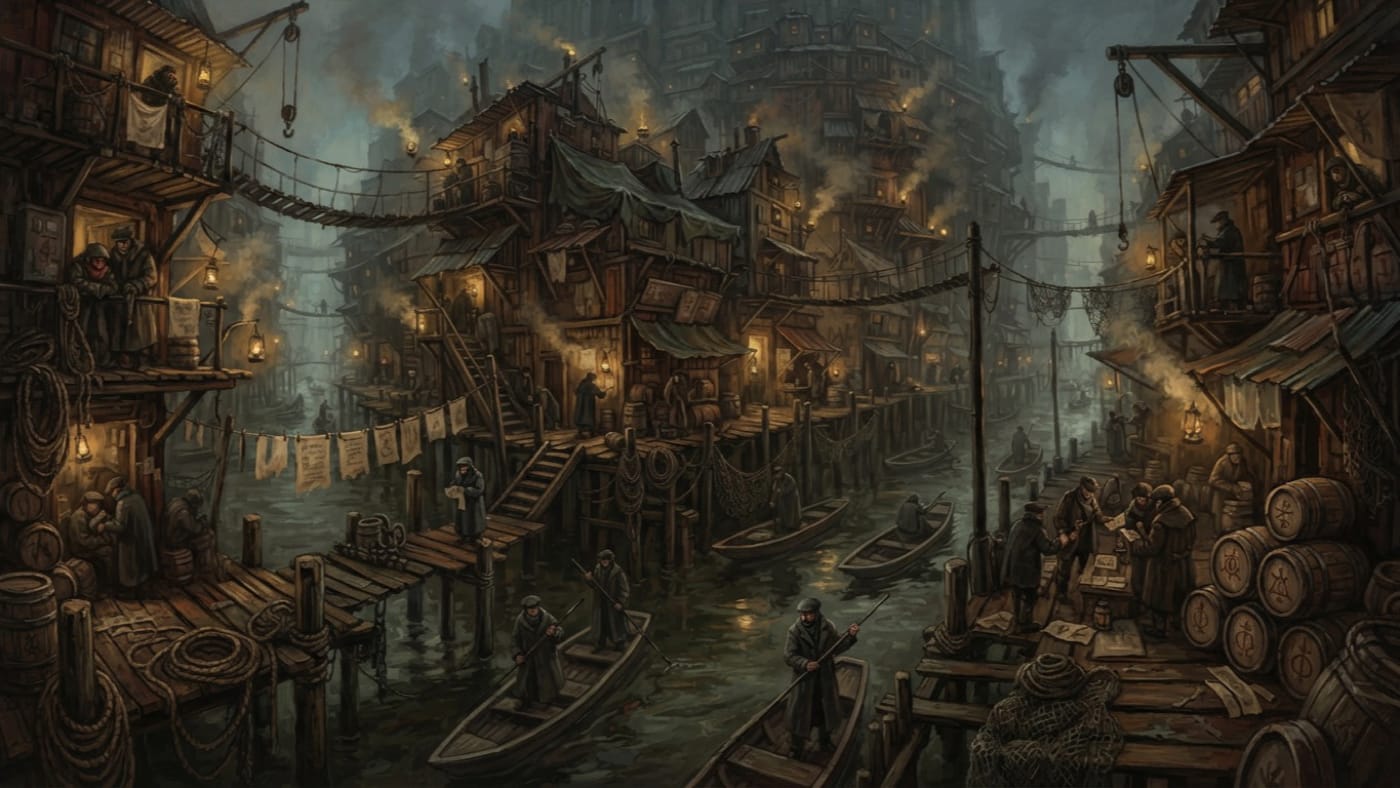
"Seals are cheaper than truth." — underworld saying, Mournwater
#On the Shacks
The Backchannel Shacks smell of fish oil and wet paper. Any visitor will name the first within a breath and take a week to understand the second. The fish oil burns in the hooded lamps and greases the skiff poles. The paper is everything else. Lock passes go soft in the fog, ration chits turn to pulp in a pocket, and futures slips dry on cords strung between pilings like pennants at a procession. Then there are the forged purity seals, whose wax must be kept cool and whose parchment must be kept just damp enough to take an impression. The whole quarter is a document drying badly.
It is one of the seven districts of the Saint-Dust Cooperage of Mournwater, strung with the others along a lowland bend of a Weser tributary in the Zone 2 River-belt. The parent survey places the town at roughly 51.5°N, 9.8°E. The Shacks have no coordinate of their own, because no surveyor has asked for one and none would be paid to. The Shacks have no charter, no founding year, no council and no census apart from the town's. They are what Mournwater has built beneath itself: rough timber on rotting wharves, cellars full of brackish water, and the people the town's hierarchy ranks below its quarantine poor.
That rank has a name. The ledger descends from certifiers to guild masters, then graders, dock crews and the quarantine poor, and it ends with the backchannel untouchables.
#On the Waterways
Mournwater's streets have two storeys, and the lower one is wet. Beneath the catwalks and drying lofts, the under-streets have been flooded so long that nobody pretends they are streets. Skiffs go where barrel carts once rolled, and silt ferries and catwalk runners carry whatever cannot be poled. At night the lamps are hooded and the lock patrols tighten. Then the channels wake to quiet oars and to casks that appear on no manifest.
The Shacks exist because of a single legal fact. The Seal Locks are the only passage for certified slurry ships. A cask that goes through them is Compact property and Church doctrine. A cask that goes around them is contraband. All the architecture of the backchannels amounts to a long dispute over the word around.
The most notorious route is the Backchannel Needleway. It is a smuggler run of mud, fish oil and ambush, and the counterfeit ring keeps its hub there. No plan in the Bureau of Records shows where the Shacks end and the Needleway begins. Mournwater's own account of the Seal Locks also mentions a secret side-sluice kept for smugglers. The Needleway may feed it, skirt it or simply charge for rumours of it. I leave that question with the lock provosts, who would sell my answer before the ink had set.
The dangers come with the address. Floods rise through the cellars, silt opens into sinkholes underfoot and brine burns the hands. Mold fever lives in the walls. Lung-rot takes whoever sleeps nearest the water, which in the Shacks is everyone.
#On the Silt-Rooks and Their Neighbours
The Backchannel Consortium calls itself a ferry service, and Mournwater calls its members the Silt-Rooks. The ferries are real, and so is the rest of the trade. They move cut dust, forged seals and smuggled people along their routes, protect the trade with blackmail and collect from whoever cannot afford the lawful price. The Consortium's boundaries and internal ranks are undocumented, which is how a cartel likes its paperwork.
The broker is Silt-Rook Dema, who holds routes, counterfeit seals and information. Dema is one of the three powers that actually rule Mournwater. Master Cooper Vell Arno holds the barrels and Purity Prefect Sister Halvein holds certification. Dema holds whatever the other two refuse to touch. The Rooks cannot smuggle anything without Arno's casks, and without Halvein's seals a forgery is worth nothing. Arno and Halvein need the backchannels for cargo, persons and information that a licensed port cannot be seen to move. Each has enough on the other two to keep them in check, and so the steadiest arrangement in Mournwater rests on three appetites.
Dema's boots are always dry.
Most people in the Shacks are not Rooks, and a Rook would take offence at the confusion. The residents are boatmen, loaders between shifts, and quarantine washers who cannot afford to sleep above the flood mark. Debtors live here because bailiffs dislike wet boots. Graders come down after dark. The Graders' Quiet Union guards what its members know about taint and also sells it, and the backchannels are where that knowledge fetches its price. The Union's whistle codes carry across water better than any bell. The Crumble Ward Sisters send no one into the Shacks. The Shacks send patients to them, and the Sisters decide which of those patients will become evidence.
A Rook who carries a family past the lime cordon has earned a fare. Sentimental visitors call it rescue. The Rooks call it inventory, and the family learns the difference when the blackmail comes due.
#On Paper, Dust, and Passage
Mournwater forbids a great deal, and the Shacks sell all of it. The town will not pass unsealed dust, unstamped barrels, unregistered corpses or wild relics. Each prohibition creates a price, and each price creates a boatman.
Saint-dust is graded and suspended in brine as holy slurry. It supplies bastion chapels, trench shrines and field hospitals, and the Orison engineers lace their broadcasts with it. Demand stretches along the whole Sagittal Line as far as Bastion-Constantinople. Lawful supply passes through the Grading Hall, the White Steps and the locks, moving at the speed of seals and costing whatever the fees demand. The backchannels fill the gap. Cut dust stretches a certified batch, miracle boosters claim to strengthen a weak one, and a forged seal makes either look finished.
The seals are imitations. Genuine certifier signet molds are watched too closely to sell, and a buyer offered one on a Shacks jetty is being robbed with unusual courtesy. Some things that can be bought are papers Mournwater's own officials issue: testing results, seal allocations and quarantine releases. The district puts a price on names and on children. The one thing it will not sell is the map of where the dust is harvested upstream.
Money here is anything the damp has not yet ruined: coin, stamped paper, ration chits, dust scrip, oath-notes and futures slips. The slips do the most work. Guild bailiffs enforce futures debts, and an unpaid debt turns into labour, a surrendered name or a sudden call to volunteer for quarantine. The bailiffs do not wade. They wait at the catwalk ladders, because every debtor has to climb one eventually.
People travel the backchannels too. The Consortium's hidden passenger trade carries debtors away from bailiffs, relatives beyond the Ward's reach and witnesses away from inquisitors. The fare is paid once in coin and afterwards in silence. The Rooks keep the ledger of that silence more carefully than the Compact keeps its own.
#On Contamination and Silence
The Shacks are always damp, and crumble-wrong favours damp. Contaminated dust makes the dead crack into a fine powder that moves with the humidity. Breath and water spread the danger, and by morning the powder has gathered into rosary shapes on any flat surface. In the living it shows first as hairline cracks in the skin, grit between the teeth and a voice that dries out. The Shacks stand over brackish water and keep casks of cut dust beneath their sleeping-lofts, so the official classification tells the residents nothing they do not already know.
The countermeasures are lime washes, salt baths, sealed-sleep masks and burning pitch at thresholds. A shack at least has a threshold, which a skiff does not, so pitch burns in the doorways all night beneath the smell of fish oil. Lime is dear and salt is dearer. A boatman takes off his mask whenever he needs to hear the oars of an ambush. The Bureau of Purity has never called any of these measures a cure.
Every day the Settling Bell silences Mournwater while dust falls in the Grading Hall's dishes, and the Shacks fall silent with the rest. Skiffs lie still under the pilings. No paper changes hands, and even the whistle codes stop. Genuine dust settles into rosary strata. Tainted dust hangs, drifts or forms shapes, and the silence lasts until the graders can name the cause. In A.S. 199 it lasted nine hours.
The Shacks hold beliefs the Grading Hall does not certify. Residents say the dust remembers names, and water-wardens report having seen dust-eels. The backchannels spread word of the nine-hour silence before morning, and they now say the river is making saints of its own. The Codex records these claims as spoken and does not rule on them.
#On the Present Condition
A.S. 201. The locks are open. The Bureau of Alchemical Standards and the Bureau of Rites convened a joint review in A.S. 200 and have published no finding. The Cooperage audit remains pending. Meanwhile the Shacks keep trading, knowing the delay will end.
Two outcomes hang over the district. The first is Dema's fear that the locks will close for good. That would strand the Consortium's stock in the channels and its operators in the open, since contraband only has value while lawful traffic runs beside it to hide in. The second is the Consortium's ambition. The backchannels report a plan to seize the locks and control passage for one storm season. It is still only a plan, and in Mournwater plans are sold as futures before anyone lifts an oar.
Mournwater never ships tainted.
Retracted. In A.S. 199 a shipment certified pure at the Grading Hall caused the dead of a southern-corridor garrison to crumble. The Synod denied receiving the chaplain's report, and the Compact blamed the handling. The original statement stands only for the backchannels, which officially ship nothing, since nothing they ship officially exists.