
#On the Clerk's Station
"Predicts death with numbers and calls it weather." — Mournwater description of the trade, current in A.S. 201
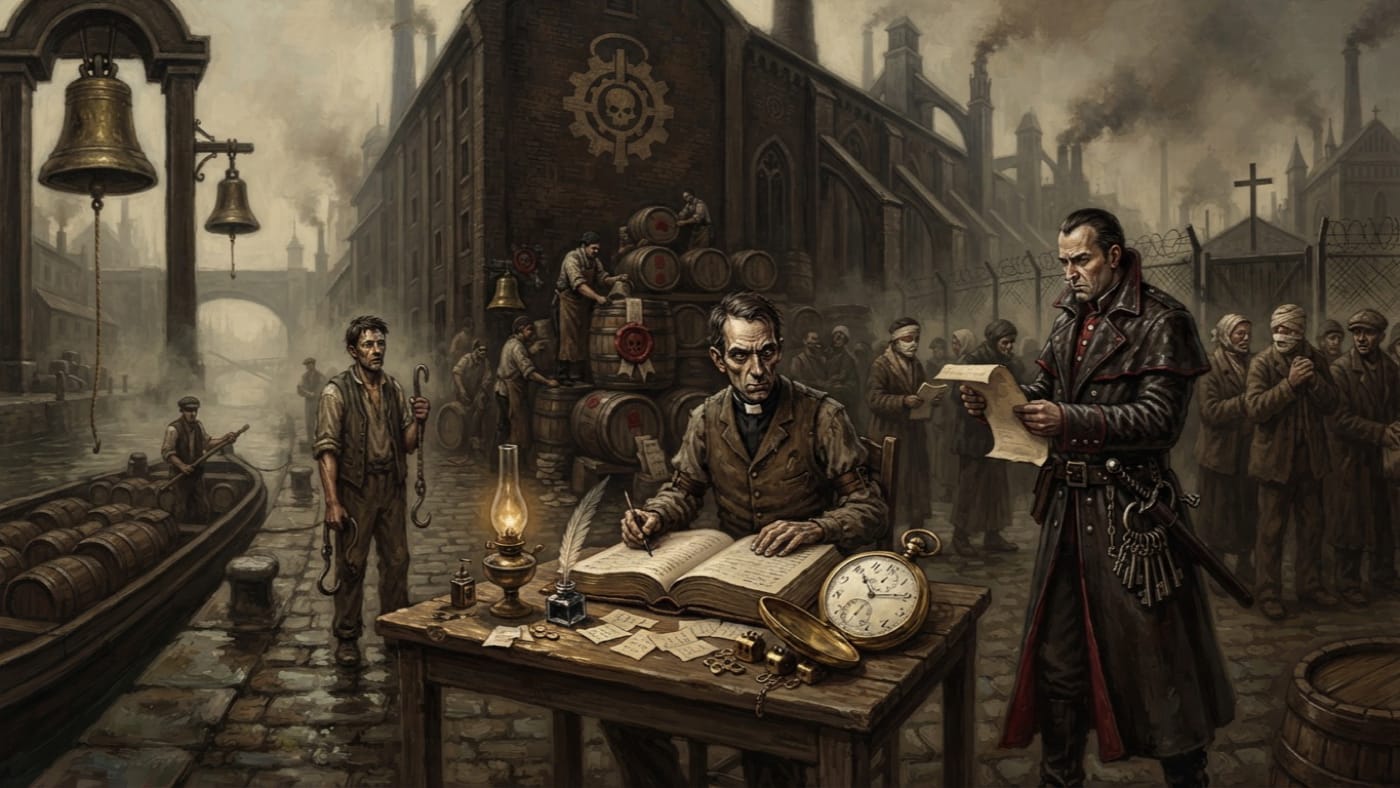
The futures clerk of the Saint-Dust Cooperage of Mournwater makes nothing. The coopers of the Cooperage Compact make casks. The graders make dust legible in shallow glass. The certifiers make it holy by stamping it. The lock provosts of the Seal Locks make it expensive. The clerk sits at a damp table between the tavern and the landing with a ledger, a bottle of ink that never dries properly in river air, and a stack of slips, and decides what all of that labour will be worth tomorrow.
Their raw material is Saint-Dust, and what saint-dust will be needed for. Field hospitals want it for salves. Trench shrines along the Sagittal Line want it by the cask. Broadcast houses want it to weight their Orison signals against the unhymns of the Pale Chanters. Every one of those demands rises with the dead. So the clerk counts the dead before they are dead, writes the count as a price, and calls the result a forecast of fair or foul conditions, as though mortality were a front coming in off the marsh.
Nobody at Mournwater can say when the first clerk opened the first ledger. The trade has no founder and wants none. A founder can be blamed.
#On What Is Bought
The oldest form of the business has nothing to do with Mournwater. Across the territories of the Church, a household short of bread may pledge the rights to its own future cremains for rations now. The grandmother's ash, the father's, sometimes the infant's, all promised before anyone has died. This is the ash mortgage. The Bureau of Tithes holds dust futures to be lawful tender and calls the pledge proof of faith. The Bureau of Mercy objects that a corpse is not currency. Doctrine regards the ashes as relics. Purity regards them as evidence. All four positions are filed, and the bread is eaten while they argue.
Mournwater's clerks deal in that paper when it comes downriver, but their own trade is local and wetter. They write slips against casks: whether a batch will grade true, whether it will clear the Bureau of Purity, whether it will pass the locks, whether it will turn in transit, whether the quarantine ward will fill or empty by the turn of the month. Above all of it sits the question the Line asks every season: how many men will need sanctifying, and how soon.
The ash mortgage and the cask slip are cousins. They are not the same instrument, and a clerk who confuses them in front of a grader is laughed out of the tavern.
The slips circulate openly. They pass across tavern tables, change hands at gates and serve as bribes beside resin, clean cloth and certifier ink. They sit in the same purse as coin, stamped paper, ration chits, dust scrip and oath-notes, and every Mournwater child can sort the six by touch. Dust scrip buys dust. Ration chits buy soup. Oath-notes buy someone's promise. A futures slip buys a share in a death that has not yet happened.
#On the Second Bell
Once a day the Settling Bell tolls and the town shuts its mouth.
The coopers lower their mallets. Poles stand upright in black water. In the Grading Hall the samples rest in their dishes under prayer, and the graders watch dust either fall into proper strata or fail to. If it settles true, the bell tolls a second time, and Mournwater resumes the noise of commerce. If it hangs, the bell stays silent, and with it every price in town.
Silence is the clerk's working hour. Speech is forbidden, so the ledger does the talking. The clerk at the tavern window keeps a watch open on the table and a column ruled for minutes. As the silence lengthens, they mark it. According to the Codex entry on Crumble-Wrong, the market's thresholds are well understood. At three minutes cask rates shift. At ten, quarantine scrip moves. At an hour, someone becomes rich enough to buy a certifier's conscience, if one remains unsold. Those are thresholds, not a formula, and no two clerks agree on what lies between them. They agree only that they must be first to know.
Picture the landing during one of these silences. A dockworker stands with a hook in one hand and nothing to lift, and he cannot ask whether he will be paid for the hour. The clerk two yards away already knows what the hour cost him, and has sold a slip on it.
The documented example is A.S. 199, when, by the published record, the bell held its second toll for nine hours. The town prayed because prayer was the only permitted noise. Accounts of Dish Twelve and what rose in it belong to another entry. For this one it is enough that the river traffic stopped for most of a working day, and that the slips written before the silence did not all fall due in the same direction.
The first bell confirms holiness. The second confirms price. Rites prefers to say the second toll releases the faithful to their labour. The clerks prefer to say it opens the market. Both are correct, and only one is paid.
#On the Slip That Falls Due
A slip is a promise, and promises at Mournwater have bailiffs.
The clerk writes. The guild bailiff collects. The division is jealously kept, and I record it precisely because the clerks are so proud of it. No clerk arrests anyone. No clerk signs a quarantine order. They write the number, and when the number goes against the holder, the debt passes to the bailiffs of the guild, who carry it to the debtor's door in their boots.
Coin is rare among the people who lose. Payment takes the forms Mournwater has always preferred. Labour, first: grading rotations, cask scraping, slurry hauling and the shifts nobody volunteers for, measured in days against the face value of the slip. Names, second: whose, and for which ledger, the bailiffs do not explain, and the debtor does not ask. Quarantine, last: "volunteering" for a bed in the ward, where one's stay is worked off and one's lungs are watched for grit.
Mark who stands on each side of the table. The buyer of forecasts is a syndicate agent, a chapel purchaser, a provincial quartermaster, a broker with a lock pass. The holder of the failed wager is a cooper who took a slip in lieu of wages, a bargeman who accepted one as a fare, a widow who bought one because a clerk in the tavern said the weather looked fine. The first kind of person loses money. The second kind pays with a body, theirs or someone else's.
#On Correct Predictions
I have seen Mournwater futures slips that predicted garrison mortality more accurately than the War Office's own casualty forecasts. I draw no conclusion about the War Office in print.
The clerks' accuracy owes nothing to prophecy. It is purchased. In Mournwater, testing results can be bought. So can seal allocations and quarantine releases. The Graders' Quiet Union knows which batches carry taint, marks some of them, and sells what it knows when the price justifies the risk. Master Cooper Vell Arno decides how many casks exist. Sister Halvein decides which of them are pure. Silt-Rook Dema decides which routes run and whose seals are counterfeit. A clerk need serve none of them to profit from all of them; they need only hear first. The upstream source map, which shows where Mournwater's holiness actually comes from, is kept beyond any clerk's reach, and the clerks manage splendidly without it. Information carried on the dock by grader, boatman or bailiff is enough.
Then there is condemned dust. A batch that fails the dishes ought to be worthless. It is worth more than certified stock, because it can ruin a certifier, frighten a chaplain, panic a garrison and move every slip in town. A clerk who knows a batch will fail and writes against it has made the most rational wager in the River-belt. A clerk with such a wager outstanding also has every reason to prefer that nobody catch the failure early.
Mournwater never ships tainted.
Struck from this survey. The phrase remains printed on every clean certificate, where it serves its purpose. It cannot also stand in an entry that describes merchants paid to know which casks are tainted before they leave.
One line the town does not cross: betting against a declared miracle shipment is prohibited. Writing against an ordinary cask is commerce. Writing against a shipment that the Church has announced as a miracle is blasphemy with a ledger attached. The two rules coexist without strain, because the declaration determines which category a wager falls into.
Every tavern also tells the story of a clerk who forecast an outbreak to the day, and the outbreak came. The story attaches itself to no name. Observation, purchased knowledge and deliberate contamination would all produce the same slip, and the same tribunal would ask the same question: who profited? I decline to settle the matter here. Doing so would require the Bureau to decide which answer it can afford.
#On Present Business
As of A.S. 201 the trade continues. The bell rings and holds and rings again. Fog moves over the landing on white-weather days, and rumour moves the market on what the tavern calls futures-fog days. The Cooperage Audit remains pending. The slips meanwhile pass from hand to hand at a pace no auditor can match.
Further downriver, the Ash Exchange of Saint Pelagia at Rheinscarp trades dust futures and saint-shares at a volume that makes Mournwater's tavern clerks look like parish almoners. The Exchange has its own appetites and does not instruct Mournwater. Each simply prices the other's dead. Readers who confuse the futures clerk with the Commerce Clerk (Unregistered) are reminded that the weigher measures what is on the scale. The futures clerk has priced it before the cask was coopered.