
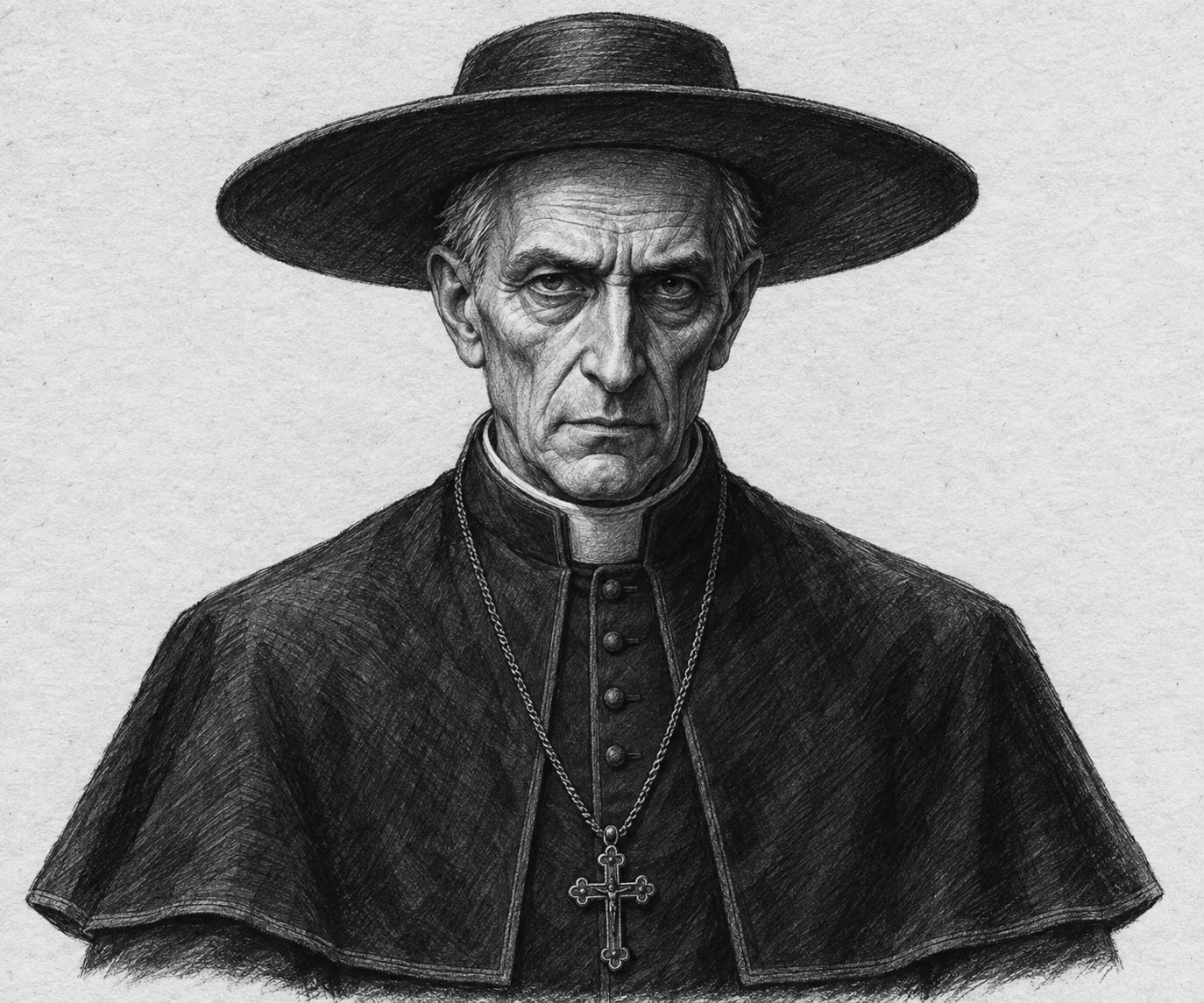
#On the Iberian Representation
"A title signs as well as a name. It also keeps better."
In the winter of A.S. 90, Iberia sent the Cardinal-Legate of Toledo to Strasbourg, and the Cardinal-Legate of Toledo pressed the Iberian seal into the wax of the Concordat. I set these facts down first because everything that follows is about how the Synod has made do with so few of them.
This entry concerns one man in one winter. Toledo has had other legates and will doubtless be burdened with more. I will not list them, because the Codex is not a staffing roster. The subject is the hand that sealed for Iberia in A.S. 90, and only that hand.
The surviving record gives that hand a title and no name. The signatory account lists him by office, and so does every compatible page I have handled. The Concordat bound a peninsula and never recorded the name of the man who bound it. This is no scandal. Nothing has been scraped, torn out or committed to the Seal of Silence. I have looked, because looking is my office, and found only the ordinary thrift of clerks who knew exactly who he was and saw no reason to tell posterity.
#On Toledo and the Seal's Reach
Toledo stands above the Tagus in the western heartlands. Its name calls up siege, relic custody and a long habit of suffering on behalf of institutions. None of that history belongs to this man. His title names a see. It does not record a birthplace, a residence, a family, a governorship or a single night on the city walls. Readers who want the Cardinal-Legate to be Father Clemente grown old, or an early forerunner of Governor-Praelate Alaricus, may write to the Bureau of Pilgrimage, which runs a department for wishful correspondence.
He represented Iberia, and Iberia is a larger thing than Toledo. A Toledan title carried a peninsular seal into a Rhenish nave. The Synod finds nothing odd in this, since an envoy always stands for more ground than he can walk across.
Not all of that ground agreed to be stood for. Aragon arrived expecting a seal of its own, learned it would come under the Iberian one, protested, and left. The Bureau of Records describes its parting words as "unrepeatable in a sanctified venue," which is the most vivid thing Records has said in two centuries. The Iberian seal was still pressed. The wax did not ask Aragon's leave.
I record no response from the Cardinal-Legate to Aragon's departure. No speech survives, and no threat, sigh or shrug. The documents show only that he sealed. A legate who left nothing to quote has nothing to retract, and I find that restful.
#On the Act at Strasbourg
The signing took place in the nave of the Basilica of the Ledgered Saints at Strasbourg, on a table of black Rhenish oak. The table had been the altar of a chapel to Saint Florentius until someone with a requisition form decided otherwise. Three national seals went into a single shared pool of wax the colour of old wine. France sealed through the Archbishop of Lyon. The Rhineland sealed through a successor whose name the present file does not establish. Iberia sealed through the subject of this dossier.
These were three men at one table. The record makes them fellow delegates and nothing more. I have seen no evidence that they were friends, rivals or partners in some later intrigue, and I decline to manufacture any. The record also does not say who pressed first. Devotional prints that show the Cardinal-Legate second, last, or with his hand raised in benediction show what the engraver wanted to see.
The ink came from the Bureau of Records, mixed from lamp-black and iron gall. Tradition adds a drop of blood from each signatory, and the Bureau neither confirms nor denies it. I will not say the Cardinal-Legate bled for Iberia. I will say Iberia was told he did, and a tradition the Bureau declines to deny does nearly the same work as a fact.
Earlier popular accounts showed the Cardinal-Legate of Toledo receiving the Iberian seal from the hand of Hierarch Augustinus, with Cardinal Kratz guiding the wax.
Neither founder attended the Concordat. Augustinus had died before the opening months of A.S. 88, and Kratz died that same year. Both were dead two years before the Cardinal-Legate reached Strasbourg. The scene is commemoration painted over an empty chair. No record establishes any meeting between either founder and this envoy.
The founders' contribution was earlier and on paper. Augustinus issued the Common Allegiance in A.S. 55. The Black Decrees pressed local accessions in A.S. 58. The Council of Worms ratified the instrument in A.S. 87. The Cardinal-Legate took part in none of these, and the brevity of this paragraph is deliberate. He arrived at a table other men had laid. What he did there was seal.
#On What Iberia Bound
To seal was to subordinate. The Concordat's legal language placed the Iberian crown under Strasbourg's sacramental authority, alongside the crowns of France and the Rhineland, and so the Triune Hearth was made. Three governments became one throne with three chairs, and the chairs were told they had always been a single piece of furniture.
The calendar went too. Under the settlement the Synod adopted Anno Synodi reckoning and set its zero at A.S. 0 / 1710 CE, ninety years before the wax was warm. Every Iberian parish register written afterwards counts years from a moment Iberia had not agreed to until A.S. 90. The Bureau of Doctrine calls this retrospective adoption. A Toledo notary of my acquaintance calls it backdating a cheque, and he now notarizes in a much smaller town.
Practice was slower than the text. The instrument claimed everything at once, while offices and courts took new titles over time, title by title and court by court, at whatever pace the roads allowed. Iberian magistrates went on sitting in their old chairs under new letterhead until the letterhead caught up with them. The constitution was complete on the day of signing. Its government arrived by mule.
The Concordat was proclaimed in the spring of A.S. 91 under the successor administration. No individual proclaimer is verified, and no record puts the Cardinal-Legate at the proclamation. He sealed in winter. In spring the bells rang without him, as far as any page can say, and bells do not take attendance.
These are consequences of the settlement. They are not his personal achievements, and I will not hang them on his name, which would be difficult in any case. A seal-bearer carries authority; he does not author it. The Iberian crown was subordinated by the instrument and by the decades of government behind it. His hand was the means by which the subordination reached the wax.
#On the Limits of the Dossier
The designation proves three things. A Cardinal-Legate of Toledo existed in A.S. 90. Iberia chose him, or accepted him, as its representative. He applied Iberia's seal at Strasbourg in the company of the Archbishop of Lyon and the unnamed Rhenish successor.
It proves nothing else. There is no record of a return journey over the Pyrenees or of a later promotion, a fall from favour, a murder, a canonization, a tomb or a list of successors. Nobody holds his title today, as far as this file shows. Nothing places his birth, appointment or death in any year. Toledo has produced martyrs, abbots and governors whose stories fill whole sections of the Codex. It produced this man, and he filled one line of a signatory roll.
The common reader wants him to have done more. The common reader wants a speech at the oak table, a quarrel with Aragon in the vestibule and tears on the parchment. The common reader can buy a print. I deal in the roll, and the roll says that he sealed.
He came on behalf of a peninsula, and part of that peninsula walked out before he finished. He pressed brass into wine-dark wax beside two men who are equally unnamed or equally obscure. He went home or did not, and the Ledger is satisfied either way. His name was never necessary. Only his seal was.