
#On the Mark
"Unsealed is unbound." — Stamper's Catechism, Bureau of Records, A.S. 91
The word does three jobs, and the Bureau of Records pays it for one. A bone-stamp is the iron stamp-head, coded by district, that a clerk carries in a felt-lined case and wipes with an ash cloth at the end of every shift. A bone-stamp is also the red impression that head leaves in warm wax on a cranium, a femur, or any fragment broad enough to hold a wafer. And in the mouth of an ossuary superintendent, a bone-stamp is the whole procedure, of which the iron and the wax are two parts in six. The street adds a fourth meaning and pins it on the clerk. That unfortunate has an entry of their own under Ritual Bone-Stamper.
The mark certifies very little, and in very exact terms. These remains were received, processed, catalogued and prayed over, and they were assigned a position in the ledger. The skull is the usual example because visitors look at skulls, and my account in The Dead uses it for that reason. The mandate covers every bone the trade can seal.
A legible impression proves that the procedure was recorded. Whether it worked is a separate question. The corridor answers it at night, and the ledger has no column for the answer.
#On Its Authority
Jurisdiction over the dead belongs to the Bureau of Records, which exercises it through the Office of the Last Watch. The Office has lost its founding charter so many times that the charter is now declared self-evident. The Bureau of Rites supplies the prayers and the placement prescriptions. The Bureau of Bells supplies the acoustic standard against which a tapped bone is judged. Engineering arrives uninvited whenever the prescriptions fail, and it corrects them without saying so.
Stamping is older than the vocation. In the decades after the Sundering of A.S. 45, ossuary clerks sealed remains when intake allowed it and gave up when intake did not. Local offices kept local customs long before there was a formal Synod to standardize them. Nobody recorded who first pressed warm wax to a dead brow, or in what year. I have looked. The folio is missing, and the clerk who should have kept it is presumably shelved somewhere, unsealed.
The Corridor Twitching came next, in a sealed passage beneath what is now Bastion-Brest on the Bug. Its year is unrecorded as well. After it came the Directive.
The Directive licensed the hand and started the clock. The seal was already old.
#On Application
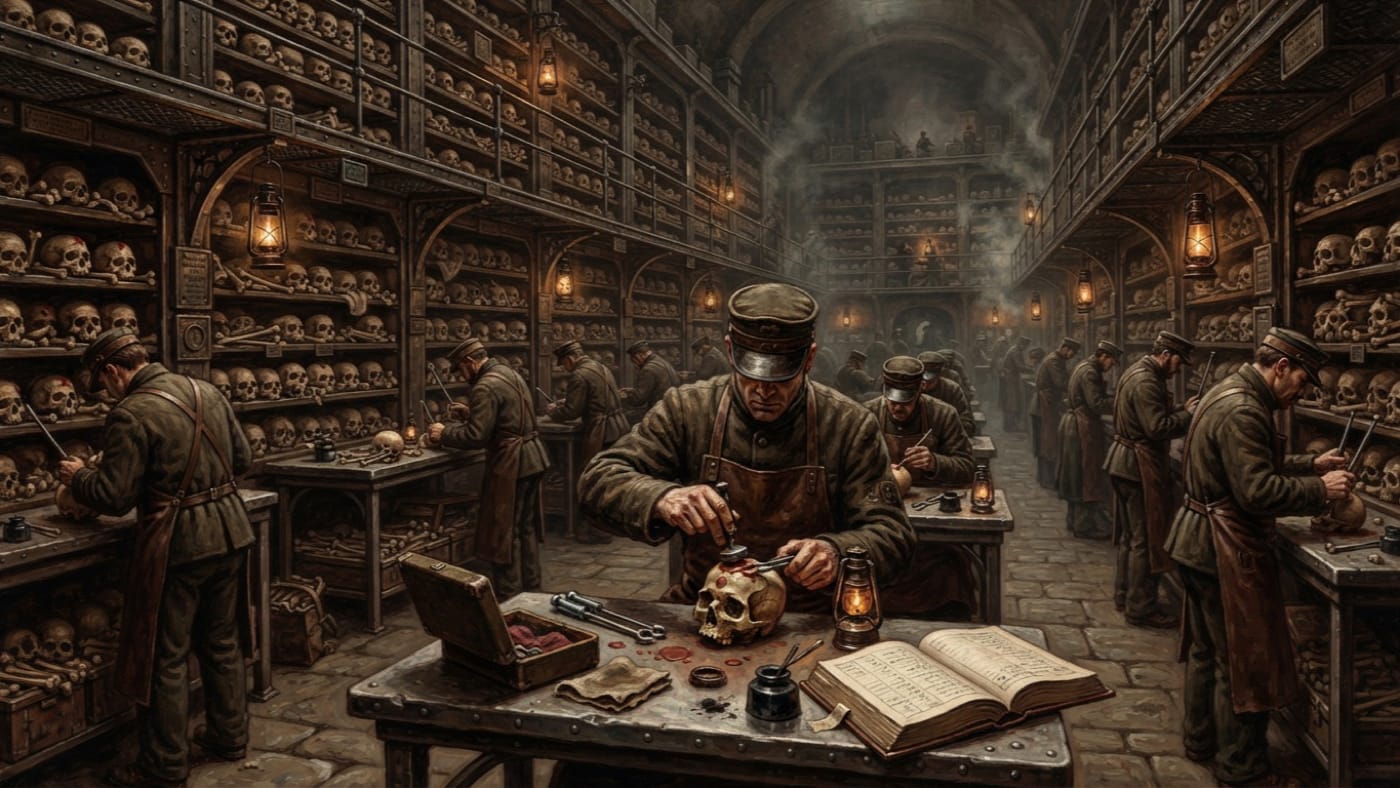
Consider one skull on a damp stone bench under a hooded lantern.
First comes the tap. The clerk strikes the bone with a tap-rod or tuning fork, and the Bureau of Bells calls the resulting tone diagnostic. An inert bone answers flat, and the sound stops where it should. A bone in what the trade calls "live drift" rings longer than it should, or its pitch climbs. The clerk notes it and then either slows down, sends for the Corridor Notary, or leaves. Senior stampers rank these three choices in ascending order of wisdom.
Second, the clerk wipes the skull and orients it, handling it with bone tongs and turning it to the axis the Rites prescribe. Stampers say a skull set crooked is "open." The Bureau of Rites calls this superstition, then prints the orientation chart in four colours.
Third comes the seal. A wafer is warmed over the lantern's covered flame and laid on the bone, and the iron head is pressed home while the clerk recites the Force-Count aloud.
The Catechism sets force and duration by cadence. I have read the section and I will not reduce a prayer to a weight in pounds, because the Catechism declines to do so and I have no wish to be more precise than scripture. If the hand is too light, the wax sits on the surface without biting, which the ledger calls "soft wax." If the hand is too heavy, the bone cracks, or the wafer does, and a cracked bone is filed as worse than a bare one.
The information on a skull is spread across three places. The wafer carries the Synod's mark, the district code and the date. The Office's own description adds the deceased's name, where known, and the diocese. How a name reaches a particular wafer is left to district practice, and district practice varies by district. If the name is unknown, the wafer bears the inherited inscription FILIUS DEI, which the Office glosses as "child of God." A child of the Creator whose paperwork has gone astray still needs filing.
Fourth, the clerk adds the secondary mark, an ink line and notch code giving district, date and chamber. Fifth comes the ledger: count, location and anomalies, written in the trade's dry vocabulary of "fracture," "soft wax" and "warm stone." Sixth, the clerk places the skull back in the stack according to the prescribed pattern.
The pattern has two editions. The official one belongs to the Bureau of Rites. The practical one is the revision Engineering made quietly after A.S. 178, when, by the profession's own account, a resonance cascade in the Przemyśl Third Gallery killed two stampers and a visiting auditor. Senior stampers use the second edition. The Bureau knows they do, and it has never issued a third.
#On Conviction and Verification
The Bureau's explanation is sacramental. The seal authenticates the dead under sacred authority, and authenticated dead are granted rest. That is doctrine, and I have printed it in larger type than this.
Field reports describe the same results in plainer terms. Corridors where the tap was honest, the bite firm, the placement stable, and the chant and bell-schedule kept steady show fewer entries for tapping, warmth and sweating wax. The trade adds one more variable: the clerk's belief. Stampers who seal with conviction work quieter corridors than stampers who seal from habit. Why that should be so, the Bureau has not asked. I decline to answer on its behalf.
An audit is a precise instrument aimed at the wrong place. The inspector checks the stamp-head for wear, compares wax batch codes against supply ledgers, counts the notches, and walks the corridor cold, listening. Iron, wax, ink and sums are what the audit can check. Whether the Force-Count was meant when it was said leaves no trace on a wafer.
A memorandum from this office stated that "the bone-stamp's efficacy derives from the sacred authority invested in it by the Bureau of Rites and confirmed by seventeen consecutive annual audits."
The Bureau of Doctrine amends: the seventeen audits confirmed seventeen years of legible impressions, correct notch codes and reconciled wax inventories. Not one of them measured a quiet corridor. Sacred authority is retained as the governing framework. The confirmation has been reclassified as bookkeeping.
#On the Failed Seal
A seal fails the way a ledger fails, one small omission at a time.
The stamp-head wears down until the district code is a rumour in iron. Dry wax fractures ("Never trust dry wax," the wax-runners are taught before they are taught to pray). Then there is the weak bite, the skipped tap, the skull filed against a shelf it does not occupy. A bell-array out of calibration can sour a gallery. A shift cut short by the curfew bell leaves half a stack sealed and half waiting. After a battle the intake exceeds the hands, the quota exceeds the intake, and every one of these faults becomes routine.
The quota is the cruellest of them, because it produces valid work. A clerk who lightens the pressure and skips the tap to meet the Superintendent's number generates impressions that pass audit, notches that count correctly and ledger entries free of anomalies. The corridor stays quiet for a season, and then it begins to sweat. Re-sealing and inspection never end. The Office has never set a service life for a seal, because no figure has held long enough to print.
The mark also has a market, because the living need it. Remains without authentication cannot be given a place in sanctioned ossuary space, as the Ossuary Housing Allocator will explain in triplicate. Without a place there is no consecrated ground and no grave to stand at. The Bureau of Mercy's Rite of Passing, the name in black ink in the Great Ledger of Souls, and the Ashbinders' pyre are different instruments with different jobs. None of them substitutes for the seal, and the seal certifies no sanctity, which remains the province of the Relic Authenticator. A widow whose husband died in the wrong district under an unregistered name will therefore find a stamper after hours. She pays in wafers or fuel chits, and the ledger records the work as "routine, no anomalies." She gets a grave. The Office gets a correct count.
#On Present Application
This survey is filed in A.S. 201, the year of the survey, not of any founding. The Bureau's monitoring has recorded rising disturbance since A.S. 198. The rise is steepest at the front-line bastions and measurable even in Strasbourg, where the most qualified clerks in the Synod's employ work the best-supplied galleries in the Church.
The Bureau has answered with the remedy it understands, which is to double the allocation. Twice the wafers will yield twice the impressions, and that will mean twice the legible certificates, every one of them correct. The number of hands has not changed, and neither has the number of hours before dawn. Nobody has requisitioned conviction, because nobody has found it in the supply schedule.
The Office of the Last Watch reports full compliance with the Directive of A.S. 92. The Office is correct. In the lower galleries the tapping continues, also in full compliance.