
#On the Blue Flame
"If your candle burns blue, don't say your name that night." — Candle-Sump custom, attributed to no one, observed by nearly everyone
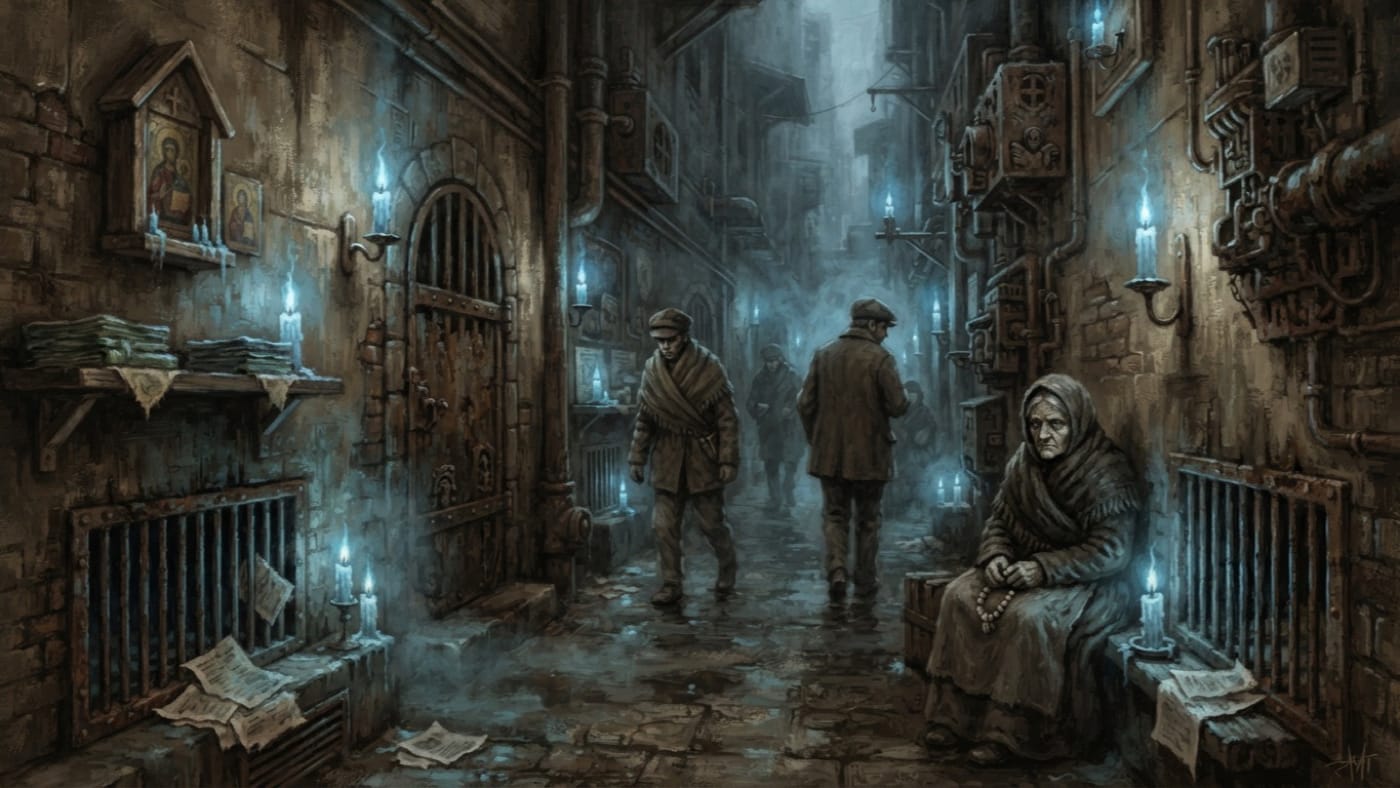
A tallow candle in Candle-Sump is an unlovely object. It smokes and spits, it smells of the rendering vats, and its light is the yellow of old teeth. It has also been licensed, taxed, marked with an ash-cross at the morning Wick Blessing and entered in the district's register of open flames. The Sump knows its candles the way a confessor knows his regulars.
Near the crypt mouths, by the residents' account, some of those candles burn blue. The district calls this blue-burn. The flame is reported as a cold blue, and I enter that as a description of its colour. No survey I have seen measured its heat. I decline to measure it on the Sump's behalf.
What follows a blue-burn is more regular than the flame. The household goes quiet. Children are no longer called in from the landing by name. A man stopped at the floodwall stair holds out his tag receipt in both hands and keeps his mouth shut. Nobody speaks a name until morning, least of all their own.
This tract is a companion to my Pastoral Assessment of the district, which the Bureau of Doctrine sealed in A.S. 201. It takes up one question that the assessment left on the counter: how a candle changes colour and a resident is taken from their bed.
#On the Drafts Beneath It
Beneath the district run the burial lanes and crypt routes of a riverside shrine district older than the Sundering. Their air rises through vent alleys and maintenance shafts and through the grates the poor call "warm corners," where they sit in winter because the draft is warmer than the street. The warmth belongs to the draft and the blue belongs to the candle. I record them separately because Wickmarket gossip has joined the two into a "cold wind," a union no instrument has yet blessed.
The drafts carry rot-spores, which the coughing corners map with grim reliability. They also carry what the residents call name-whispers. Paper near the vents fuzzes at the edges, ink bleeds, and candles gutter in shapes that resemble letters. After curfew the crypt mouths breathe louder and the streets around them go silent. A blue-burn may arrive with any of these signs, with some of them, or with none. The Sump does not wait for the whole liturgy before it shuts its mouth.
The Ash-Sluice Line supplies one further report. Bureau survey notes I was allowed to read there record that blue-burn reports cluster in the hours after release bells, when low water lets the underworks breathe. The Line believes the water governs the air. I believe a survey note is a survey note. Its recommendation was a further survey, which is how that Bureau says amen.
None of this establishes a cause. The crypt routes reach well beyond the Sump, and the River-belt keeps its dead in more places than one. This tract concerns the candles in this district and the uses made of them.
"The Synod sealed the crypt mouths. The seals hold." — Pastoral Assessment, Candle-Sump District, On the Crypt-Route Drafts.
The seals hold where nobody opens them. The same assessment records Crypt-Mouth Wardens who maintain the vents and keep passages sealed or open as they are instructed, tunnels the Prefecture's maps call "collapsed," and a registry at work in those tunnels. The underworks are maintained. The earlier sentence described the doors and left out the traffic through them.
#On Names and Silence
In Candle-Sump a name is the most valuable thing a person owns, and the easiest to take. The Bone-Tag Registry stamps the dead into the Great Ledger: name, date, cause, and a confession attachment sealed in wax. Funeral candles are burned in three stages, called name, debt and silence. A marriage requires a shared ration registry. An untagged corpse is waste for the sluice. A living man whose tag says otherwise is, in Chief Clerk Dalen Voss's cabinets, whatever the tag says.
In such a district the custom of silence needs no demon to recommend it. I state this as a matter of administration. No record available to me shows whether a name spoken on a blue night is heard, taken or answered, or merely remembered by a neighbour with a grievance. The custom forbids speaking the name. It does not say what happens if someone does, and the people who keep the custom will not say either.
Then there is the shadow registry. Names are harvested from the crypt drafts below, copied onto Registry paper and passed up through the Washhouse as clean identity slips. Air, names and forged paper meet in that trade, and the blue flame burns in the same air. The papers in front of me do not show whether the flame marks a harvest, warns of one or only shares its address. The Bureau of Records has not offered its own papers on the matter. I have not asked twice.
#On Reports and Their Uses
A blue-burn becomes evidence once someone describes it to a Quarantine Provost. The Provosts answer jointly to Prefect Sera Mott's Sluice Prefecture and to the Bureau of Purity, and they treat blue-burn reports as actionable intelligence. By the district's own description, the procedure needs little more than a name. The Provosts come after curfew in cough masks with ribbon shears at their belts, and they take the named resident for doctrinal health assessment. They examine the household's tag receipts. They examine its damp paper, because damp paper is always present in the Sump and always suspicious. A smear of wax on the sill becomes an exhibit.
The Provosts never have the burning candle. They have a report of it, and the residents learned long ago what that difference is worth. Blue-burn is reported chiefly when someone wants a neighbour removed. A debt, a Wickmarket stall or a room with one dry wall can each be settled by reporting a colour.
The Wickmarket complicates the evidence further by selling counterfeit blue-burn candles, and the district's contraband lists place blue-burn candles beside blank tag stock and master-seal wax. I have seen no recipe, no maker's mark and no test that distinguishes a purchased blue flame from one that appeared unbidden. The Provosts have shown me none. A counterfeit candle proves that somebody wanted a blue flame on demand. It does not prove that every blue flame was bought.
Some households have tallow, soap or clean paper to spare. With these they can sometimes buy a ribbon of a better colour from a Provost squad. That is commerce, not clearance, and I do not confuse the two. The Provosts, being paid, have no reason to.
#On Classification and Precautions
The draft complex as a whole is classified as a Category Two Localized Atmospheric-Scribal Disturbance. The classification was entered in A.S. 194 and, seven years later, is still pending review. My assessment attributed it to Purity. The Bureau of Alchemical Standards uses the same label in its field notation, so both offices use it, and neither has told me which wrote it first. On the classification ladder a category records what a thing does and how unwise it is to stand near it. It explains nothing. I have found no separate designation for blue-burn. AMBER is the district's status, not the flame's.
The work is divided as follows. Alchemical Standards surveys and recommends another survey. Purity acts on reports through its half of the Provosts. The Sluice Prefecture controls the gate timings and the access, and it keeps a page of the Alchemical Standards notation that it removed. Prefect Mott would discuss that page with her gloves on, which means she would not discuss it.
An ash-cross shows that a candle is registered. It does not guarantee the colour it will burn. The Sump's other precautions are vinegar baths for paper, wax-sealed folders, salt lines around the vents and bone beads. The first two preserve documents and are sound clerical practice in any damp quarter. The last two are custom. None of the four has been shown to stop a candle burning blue or to protect the person sitting beside it. The residents wear the beads anyway. I have not asked whether the beads help, and no one in the Sump would answer me if I did.
#On the Present Reports
Blue-burn reports are elevated in A.S. 201. A sanitation abstract cited in the entry for Zone 1 recorded an increase in sightings near the crypt mouths in A.S. 199. That figure is an increase. The phenomenon's first appearance lies somewhere before it, and no record I have seen dates it. The Provosts still cannot say whether the present numbers reflect stronger drafts, more counterfeit candles in circulation or more neighbours with scores to settle. They have never been able to tell these apart, and the reports keep coming either way.
Several pressures keep the reports coming. The wick blight has made candles scarce, and a scarce candle draws more attention to its colour. Rot-lung is rising again in the Paper Loft Quarter, and in the Sump a cough is enough for a neighbour to mention to a Provost. The Registry and the Prefecture are fighting over seized clean slips, and each would be glad of a blue-burn report against the other's clerks. Below all of them, someone not yet identified keeps the underworks in working order.
A transfer order for Inquisitor Halvyr, called White-Lung, is moving through Purity's approval chain. Halvyr carries a portable audit press and the authority to burn. Halvyr has not arrived. When that changes, the Sump's paper will be audited by an officer who brings a press and a flame, and I would not care to guess the colour of the flame.
The district has no explanation for blue-burn, and neither do I. What I can record is how it is used. A candle burns blue, a household falls silent, and a neighbour names someone to a Provost.