
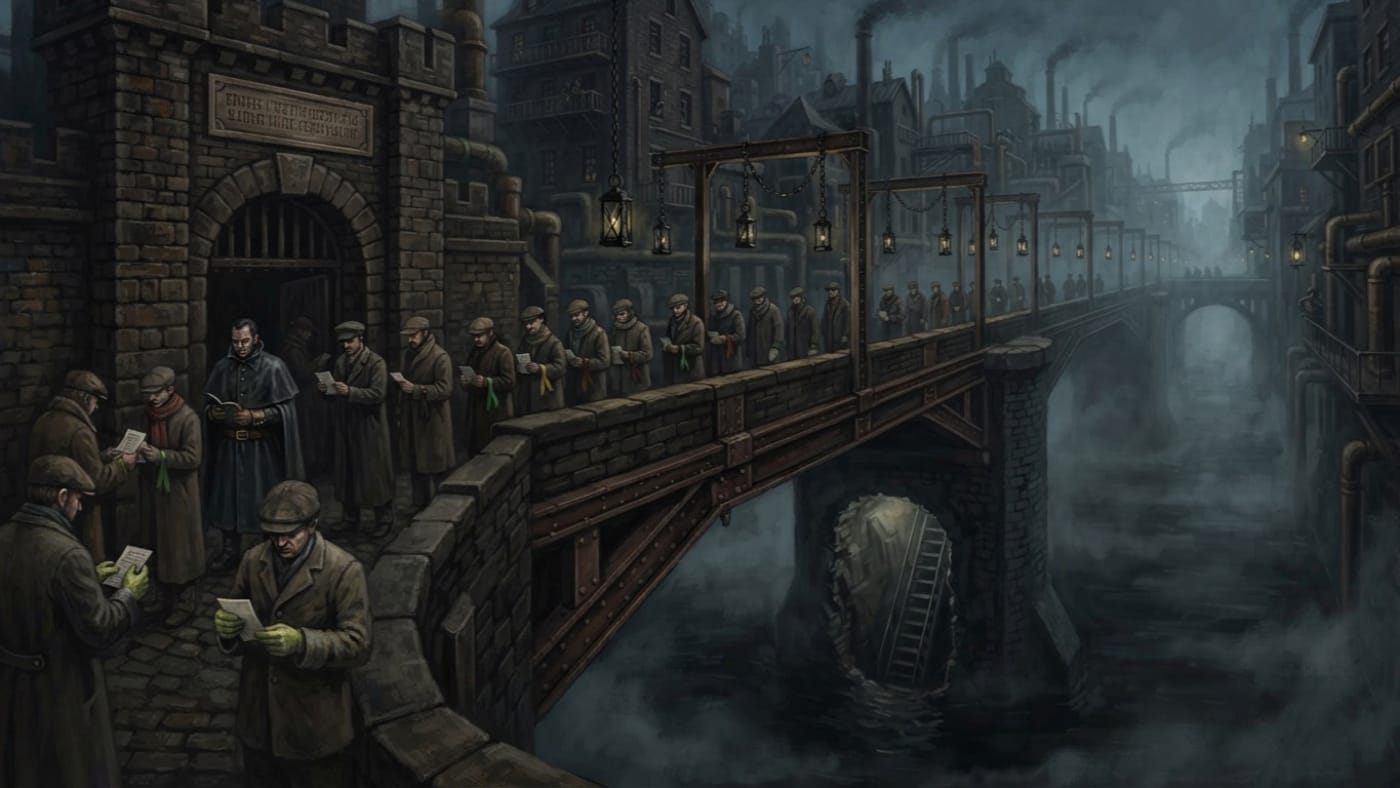
#On the Crossing
"Light costs bone." — inscription above the Candle Bridge tollgate, attributed to no one
Candle Bridge is the main crossing of Candle-Sump, and the Bureau of Doctrine files it under doctrine because no better drawer exists. A bridge is masonry. This one also preaches. Candle-Sump holds three teachings: purity through labour, cleanliness as obedience, and the counting of the dead as sacred accounting. The bridge sets all three in soot brick over the black canal water of Lower Vire, and it charges for the lesson at the gate.
Its known features are few. The brick is soot brick, the district's common material, slick under the hand and darker than the fog around it. Lantern chains hang along the crossing and carry what little light the Sump allows itself after dark. There is a tollgate. Above it someone carved the four words that the district now repeats as its motto. That is the whole of the physical record.
The Bureau holds no survey of the bridge. It has no recorded span, arch count, height, or measured depth of water beneath. Nobody has recorded when the bridge was raised, who paid for it, or whose chisel cut the inscription. The Bureau of Records can give you the cause of death of a tallow-renderer's grandmother, with confession attached. It cannot tell you who laid the first brick of the busiest crossing in the quarter.
Candle-Sump lies in the lowest, wettest ground of the River-belt, on the Vire's inner bend, among reclaimed marsh, locks and floodwalls, deep inside Zone 1. It has two throats. Sluice Gate IX, on the Ash-Sluice Line, controls the water, the skiffs and the runoff. Candle Bridge controls the feet. Whoever closes either one can choke the district, and the district knows it.
#On the Price of Light
The inscription is literal before it is anything else. The Sump renders tallow, and tallow is fat, and much of the fat in this district comes off bone. The candles that light Upper Vire Heights come out of these vats. The Heights buys them in bulk, credits its own chandlers, and does not ask where the fat came from. The district also produces marrow broth, bone-lime, repaired paper and canal haulage. The Heights eats some of that as well. It does not ask about that either.
The second reading is administrative. In Candle-Sump a corpse without a tag is not a person. It is waste, and waste goes into the sluice. The Bone-Tag Registry stamps name, date and cause onto a tag, seals a confession to it in wax, and enters the dead into the Great Ledger of Souls. Counting is sacrament here. Every certified remain is a line of devotion paid in bone, and every candle that leaves the district has passed through that accounting at least once on its way to becoming light.
The flame itself is regulated. Open flames must be registered, and an unregistered flame is charged as arson or heresy, whichever the inspector prefers. Each day at the Wick Blessing, inspectors mark approved candles with an ash-cross. If the ordinance means what it says, every lantern on the bridge's chains is a registered flame, and somebody keeps the register.
Funeral candles in the Sump burn in three stages: name, debt, silence. Anyone who has stood at a Sump funeral can read the inscription that way too. The dead are named, the dead are charged, and then the dead are quiet.
The actual toll is not on file. The Bureau does not know its amount, its currency or its collector. Bribes across the district are paid in tallow, soap, clean paper and medical tincture, so the bridge has plenty to choose from.
#On Passage and Recognition
All passage in Candle-Sump is a matter of being recognised. Sluice Wardens, in rust keys and waterproof capes, check permits. Registry clerks, in ink cuffs and lime gloves, check receipts. Quarantine Provosts carry ribbon shears and read the colour tied at a traveller's wrist: green for passage, yellow for restriction, red for confinement, black for a conclusion. Polite people present clean hands and offer tag receipts with both hands. Cleanliness is obedience, and in this district obedience is something you show at checkpoints.
Which of these officers stand at the bridge, and in what order, is unrecorded. These are district controls. Each office could plausibly claim the bridge, and none has a written title to it. Ask the Sluice Prefecture who holds the toll franchise and they will refer you to the Registry. The Registry will refer you back to the Prefecture. The Marrow Kitchens will offer you soup and a question about your recent conduct.
Some cargo is forbidden anywhere in the district, and that includes the bridge: untagged bones, blank identity stock, unsealed ink, relic-grade marrow, living patients without a quarantine ribbon, and bells and bell-hammers. Nearly everything else can be bought. Ribbons can be bought from the Ribbon Yard and from runners. Bought ribbons are not genuine quarantine clears, and nobody in the Sump has ever sold a true Inquisitorial waiver, though people have sold a great many things that looked like one. Any Provost who mistakes the first kind of document for the second will eventually answer to the Bureau of Purity.
The bridge's characteristic danger is the toll ambush. Consider what a tollgate produces: a queue that cannot move, purses already open, and faces lit by rationed lanterns that go dark when the rations do. Knives find such places on their own. The Bureau has no single massacre to cite. It has a pattern, and Sump people cross early and in company, which tells you more than any report.
#On the Hollow Pier
One of the bridge's piers is hollow. Inside it a ladder runs down into the underworks.
Before the Sundering of A.S. 45, this bend of the Vire held a riverside shrine district, with burial lanes and crypt routes under the streets. The routes remain. The district's map of them is a list of sealed doors, the crypt mouths, and the Church's public position is that those doors stay sealed. Opening a sealed crypt mouth after curfew is one of the Sump's three red lines, along with moving untagged bodies and falsifying ribbons. Nobody wrote the ordinance with a bridge pier in mind. Whether a hollow pier counts as a crypt mouth is a question the ordinance never anticipated, and so it has been answered in practice.
The Codex entry on Candle-Sump District, sealed A.S. 201, stated: "The Synod sealed the crypt mouths. The seals hold."
The crypt mouths carry seals. Whether those seals hold is a separate question, and the same entry goes on to call the underworks "not sealed" and "maintained." A pier that drops to a ladder is an entrance, whatever the paperwork says. The doors are the Church's public account. The ladder is masonry.
Someone keeps the underworks in working order. Below the doors, in tunnels the Prefecture's maps mark "collapsed," a shadow registry operates. Names drawn from the crypt drafts are written onto fresh paper, passed up through the Washhouse and fed into the legitimate tag channels. Those clean slips carry accurate seals and regulation ink. That is why the pier matters. A ladder into that economy, set under the busiest crossing in the district, is worth more than the toll.
What the Bureau does not know is longer than what it knows. It does not know who uses the pier, how its entrance opens, or how deep the ladder runs. It does not know whether slips pass through this pier, or through Gate IX's own documented shaft, or through routes no one has filed. Below all three governing powers is an unknown hand whose aims go beyond fraud, and nobody has identified it. Nobody has questioned it either.
The district's anomaly is well documented and goes no further than the record. Near the crypt mouths, drafts carry rot-spores and what residents call name-whispers. Paper fuzzes at the edge. Candles gutter in shapes that look like letters. Blue flames have been reported near the crypt mouths, and the local custom says that if your candle burns blue, you should not speak your name that night. The Bureau of Alchemical Standards has classified the whole affair as a Category Two Localized Atmospheric-Scribal Disturbance, pending review since A.S. 194. No report on file places a blue flame on the bridge's lantern chains. The absence is noted here and not interpreted. See Blue-Burn Phenomenon.
#On the Present Application
This entry accompanies the district assessment that the Bureau of Doctrine sealed in A.S. 201, which in turn rests on the inspection of autumn A.S. 197. Its AMBER status belongs to the district. The bridge has never received a status of its own.
Several current pressures fall on the bridge.
The Registry and the Sluice Prefecture are disputing who owns the seized stocks of clean slips. If either side wins outright, the winner will want the crossing's receipts read its way. The Care crews have threatened to strike if rations are cut again. Broth wagons cross under guard, and a strike would leave the queue at the gate hungry as well as stalled. The Candlewright Compact has declared a wick blight and tripled its prices. That bears directly on the lantern chains, because a registered flame still needs a wick and rationed lanterns are rationed further when wicks cost three times as much. A darker bridge suits the ambushers.
The Washhouse is reported to be planning a large identity swap. Matron Ilka is reported to be pressing for the Kitchens' autonomy. Both are plans and neither has happened. Neither has happened at the bridge, either.
If the order is executed, the tollgate will get its first serious reading in living memory, and the hollow pier will be found by whichever Bureau arrives first. If that happens before the Church has decided whether a hollow pier counts as a crypt mouth, then the first Bureau to arrive will decide it.
Cross with clean hands. Show receipts two-handed. Do not linger at the gate after the lanterns go out. Do not ask about the pier.