
#On the City and the River
"Light costs bone." — inscription above the Candle Bridge tollgate, attributed to no one
Lower Vire is a Synod-administered city of the western River-belt, deep in Zone 1, so far behind the Sagittal Line that its checkpoint officers file complaints of idleness. No Sin-General has ever looked upon it. None needs to. The city has its own afflictions: lye, quarantine ribbons and the Bureau of Purity. Its residents rank them in roughly that order of preference.
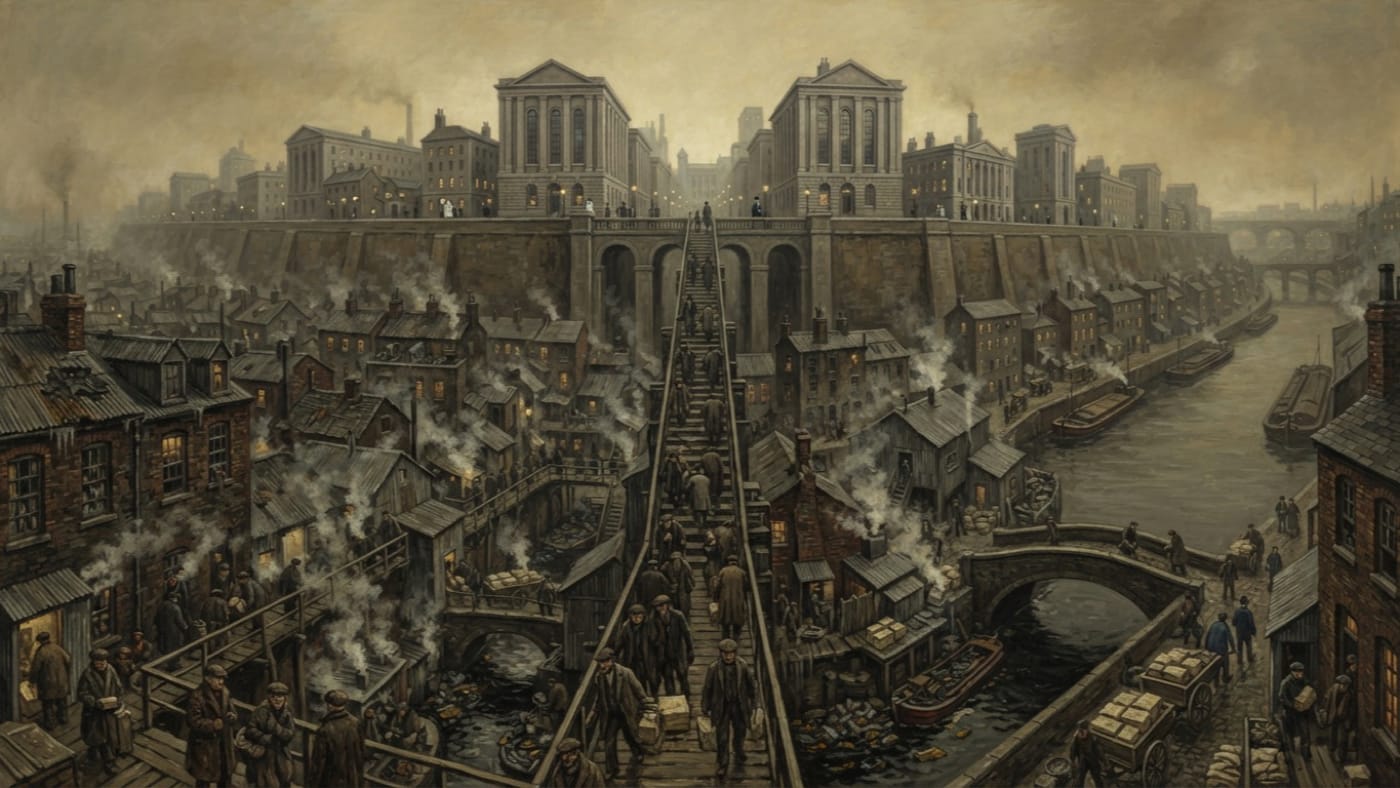
The Vire bends here. The water slows and drops its silt, and on the inner bank, on the lowest and wettest ground the river could find, lies Candle-Sump. Above it rises an administrative ridge called Upper Vire Heights, where the offices keep their stamps dry and their gloves white. Candles go up. Refuse comes down. The Heights burn the Sump's tallow, eat the Sump's broth and file the Sump's dead, and they describe all three as municipal services.
No authority has supplied this Hieromnemon with a population for the whole city, a founding charter, a founding year, or the name of any single person who rules it. I decline to invent them. Candle-Sump registers roughly forty-two thousand people, and that figure belongs to the district alone. The rest of Lower Vire has not been counted to my satisfaction, and I suspect it has not been counted to anyone's.
#On the Canal Expansion
There was a city at the bend before its canals amounted to anything. The burial lanes beneath the low quarter are older than the Sundering of 1 November A.S. 45, and the stone remembers a riverside congregation the Bureau now files as unrecoverable. Those lanes date the dead. They tell us nothing about when the living began calling the place Lower Vire.
The expansion is better documented. Once the Line had become defensible, though it was still incomplete, around A.S. 65–68, the River-belt became the larder of the heartlands, and larders need drains. Lower Vire's canal grid was extended and deepened. Lock gangs cut new chambers, masons raised floodwalls, and the men who worked both slept in lock-side sheds that were never meant to become houses. The houses drew chandlers, and the chandlers drew bone-dealers. By A.S. 78 the published district account records walls and habitation around drainage works whose writ authorised a ditch.
The Lye Flood of A.S. 84 turned the canals caustic with ash runoff. The water stripped skin and dissolved paper, and the brick still carries its scars. The River-Belt Chapterhouse responded by installing the Sluice Prefecture, and over the following years it developed a registry for the dead. By the Concordat of Strasbourg in A.S. 90 the low quarter was functioning. By the First Continental Levy of A.S. 110 the city could not do without it.
The Synod's response was characteristically efficient: the Sluice Prefecture was installed within the month.
There was no Synod in A.S. 84 to be efficient. The installation was an act of the early Church administration through the River-Belt Chapterhouse. The formal Synod was constituted at Strasbourg six years later, and it has been accepting credit for the Chapterhouse's work ever since.
#On the Heights and the Low Quarter
A city is the time it takes to get from one part of it to another, and Lower Vire is measured in stairs.
On foot, Upper Vire Heights is two to three hours from the Sump. That is the stairway route, with provost searches at the landings and "cleanliness inspections" at the top. When a rumour of rationing reaches the queues, the stairs become a stampede. A licensed cart takes forty-five minutes. The licence costs more than the time it saves, and that is how the Heights prefer it.
Dockchain Quay, the river port, is an hour away by skiff or two hours on foot along the floodwall. Tallow, grain and soap pass through it, and so do bodies, quietly. The quay and the Sump share their smugglers, and they share a grudge over a plague ship that each blames on the other. Saint Vire Ossuary-Spires receives the tagged dead. It is ninety minutes on foot. A cart takes thirty minutes if the body cargo is certified, and certification is the entire point. The Lockworks Bastionette is forty-five minutes away. Its soldiers enforce gate law, grant convoy permissions and allot fuel, and their chief friction with the Sump can be stated in three words: papers, papers, papers.
Inside the low quarter, function determines address. The Wickmarket sells the light the Heights will later burn. The Bone-Tag Arcade stamps the dead into existence. The Coughwalks carry foot traffic on planks above the flood line. The Washhouse launders cloth by daylight and, according to the published assessment, other things by arrangement. Two chokepoints govern every movement out of the district: Candle Bridge, the main crossing, and Sluice Gate IX, which controls flooding, trade skiffs and disease runoff. Gate IX must not be confused with Gate Nine on the Queue Road. The two have nothing in common except numerals and an indifference to the people waiting at them.
#On Gates, Names and Rations
Three powers rule Candle-Sump. I must be precise here, because careless survey writers have let their jurisdiction drift up the stairs. These three rule the Sump. Nothing in the record shows that they command the Heights, the quay or the Spires.
Prefect Sera Mott holds the water. She sets the gate timings and the flood releases, and so she decides which street will be wet and which convoy will wait. Chief Clerk Dalen Voss holds the Registry's seals, cabinets and entries. In practice he decides who exists. Matron Ilka holds the kitchens, which means she holds the calories. The Marrow Row regulars call her the Broth-Saint, and the kitchens carry a saint's name, but no canonisation is on file. The Bureau notes that nobody has been foolish enough to raise the matter while queuing for soup.
Their instruments are plain. A bone tag issued by the Bone-Tag Clerks records a name, a date, a cause and a confession sealed in wax. Ration chits buy broth. Passage receipts buy the crossing at Candle Bridge. Quarantine ribbons come in green, yellow, red and black, and the Provosts will sell any colour except the last. A labourer in debt can pledge his dependents' papers against the loan, and if he dies the lien passes on with the tag. Anyone caught holding blank tag stock or master-seal wax receives an oath-collar and a sanitation draft, and the draft lasts as long as the lungs do.
#On the River Trade and the Papers
Lower Vire lies downriver of the Archivolt Causeyworks, one to two days away by barge or three to four by road. Archivolt sends food and ink downriver. Labour and identity services travel back up. The two cities trade out of necessity and suspect each other on principle, and their toll quarrels and registry disputes run deeper than the canal between them. Between Lower Vire and the inland canal roads stands the Vire River-Belt Interchange, which bargemen call the Hook or the Mud-Saint. Its cranes, rail platforms and Lock Courts belong to the Interchange and have never belonged to Lower Vire. The Hook is not Dockchain Quay. Its open toll war with Lorn, which began in A.S. 187, belongs to the Hook as well. Lower Vire merely pays the surcharges.
The city's paper is exposed to three distinct hazards. The first is damp. Mould and vinegar rot ledgers in the Paper Loft Quarter, and the quarter's livelihood is mending them. The second is fraud. The published district assessment describes a shadow registry that feeds identities through the Washhouse into legitimate channels and so into the Great Ledger of Souls. Who works the underworks, and how the drafts carry names, remain unestablished. The third is Fading Winter. In A.S. 199 text vanished from documents whose paper, signatures and seals survived intact. Damp destroys the page. Fading Winter left the page and took the writing. Lower Vire's clerks still find blank, sealed certificates in their cabinets, and the mechanism remains unresolved.
The Synod sealed the crypt mouths. The seals hold.
The crypt mouths are officially closed. The passages beneath them are maintained, and maintenance requires access. Since A.S. 194 the drafts have carried the Category Two Localized Atmospheric-Scribal Disturbance designation, and the review is still pending. A designation names a disturbance. It does not find a cause.
#On the Present Condition
The Candlewright Compact has declared a wick blight and tripled its prices. No independent inspector has confirmed the blight, dated its onset or explained it. The darkened windows on the lower stairs are easier to count than the blighted fibre, and their number grows. The Care crews have threatened to strike if rations are cut again. They have not yet struck. The Registry and the Sluice Prefecture are disputing who owns seized clean slips, and that dispute decides who keeps the leverage. Rot-lung reports are rising in the Paper Loft Quarter. Blue-burn reports are rising near the crypt mouths. Their frequency proves neither a fresh anomaly nor a fresh vendetta, and the Quarantine Provosts have never had the means to tell one from the other.
According to the published assessment, the Washhouse brokers are planning an identity swap on a scale of several hundred names, and it has not yet happened. Matron Ilka wants the kitchens freed from the Prefecture's calorie allocation, and she has not yet won that.
In the Bureau of Purity's approval chain sits a transfer order for Inquisitor Halvyr, called White-Lung for reasons the Bureau does not set down. The order has not been executed. Halvyr has not arrived. No audit has been opened and no purge carried out. Down on the Coughwalks they speak of the arrival as already settled. On the Heights they speak of it as a matter for the Sump. Both are mistaken, and both will be surprised by the same knock.
The candles keep going up the stairs, a third as many as before at three times the price. The refuse comes down in the same quantity as always.