
#On the Ladder
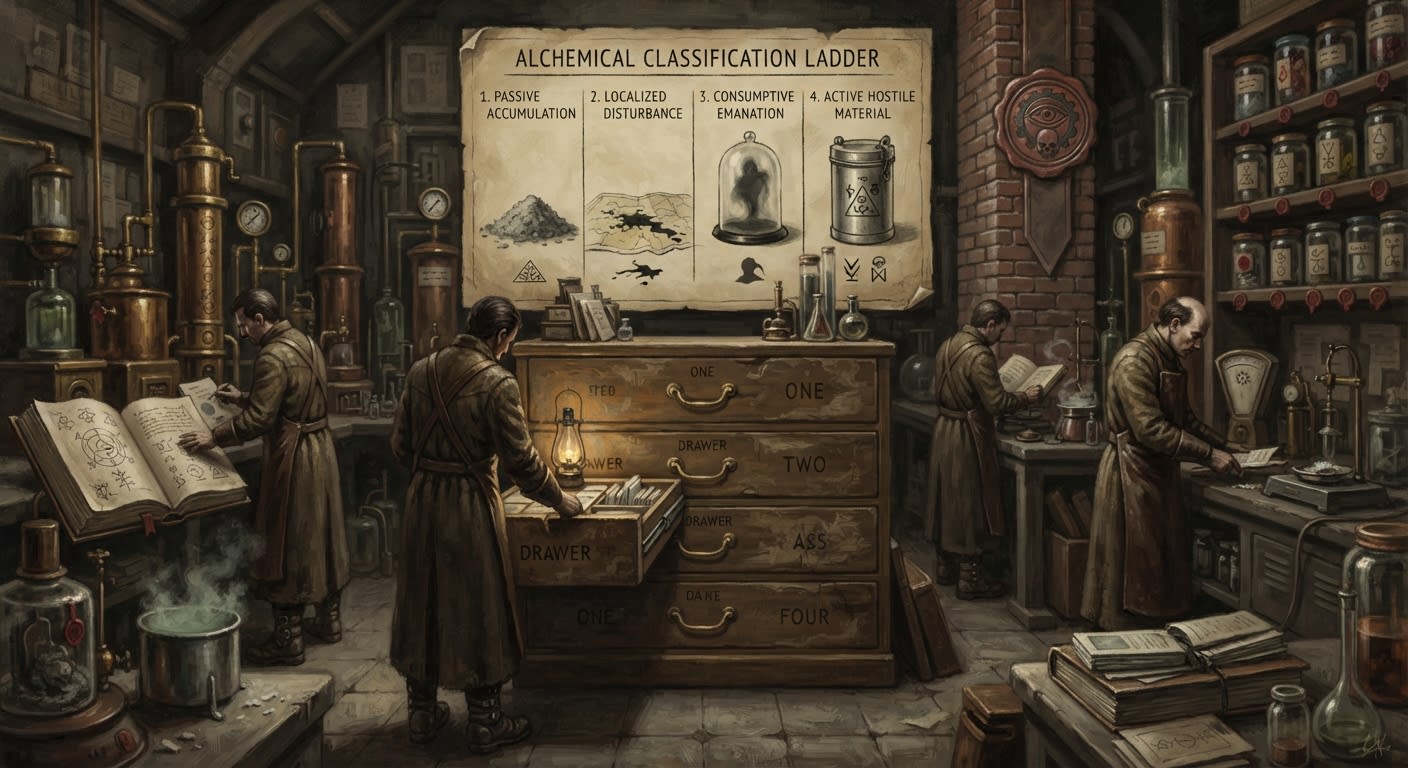
Before A.S. 92, a sample of ash that twitched on the scale went wherever the nearest officer's nerves sent it. It went to Rites if he was pious, to Engineering if he was busy, to the brazier if he was sensible, and into his coat if he served Tithes. That year the Bureau of Alchemical Standards was recognised under the Twelve Portfolios, and its first act of consequence was a cabinet: four brass-handled drawers stencilled One to Four. Once terror had somewhere to go, it went there.
The ladder runs from Category One, Passive Accumulation Site, to Category Four, Active Hostile Material. Everything the lower east laboratories of Strasbourg believe lies between those two rungs. Several hundred times a week, bottle-priests in lead aprons decide there how frightened the Synod is permitted to be.
The rungs measure what a substance is doing. How much of it there is falls to Tithes. A ton of saint-dust lying quietly in a cooperage is Category One. A thimble of ink that has begun eating its neighbours is Category Two. A vapour that takes memory from the men who breathe it climbs to Three. Anything that has demonstrably wanted something sits at Four, whatever its size and whatever its manners.
#On Categories One and Two
Category One holds residue: stable demon-glass optics in a confiscated rangefinder, unclean light clinging to a trench wall after a sortie, the grey devotional film on chapel pews where too many men prayed too hard in the same winter. Category One material is present, measurable and, for the moment, uninterested. Assessors log it on ash-paper, seal it in white wax, and schedule re-examination at intervals set by budget. The Chaff-Winds were entered here as Category One Atmospheric-Acoustic, which tells the reader how loudly a wind must scream before Strasbourg considers it active.
Category Two is where the Bureau lives. It is the rung for localized disturbances: phenomena active enough to need watching and inconvenient enough that nobody wishes to name them in strategic correspondence. Hungry Ink at Candlewick is a Category Two Localized Scribal Anomaly. It was first correlated with atmospheric ash in A.S. 143 and has remained pending ever since. The resonant vein at Saint-Helm's Cut, which supplies the Bureau's own slides, is Category Two Acoustic-Geological. The Bureau therefore tests heresy on glass it has itself classified as disturbed, and calls this economy. In A.S. 194 the Mournwater settling dishes became an Irregular Settling Pattern, Category Two. In A.S. 199 the Brielle spur of the Salt-Vigil Causeways refused to freeze and was given Category Two Localized Hydrological-Grief Disturbance, a phrase that took four clerks and a brazier's worth of drafts.
When the Bureau examined the Burnless Archive during the Year of Ash Rain, its vault phenomena went into the same drawer as Category Two thermal and scribal manifestations. The folios had survived fire, acid, water and grinding. The grinding wheel had not. They were filed as Category Two, sealed in amber wax, and the Archive was returned to its archivists with a pamphlet on humidity.
The great mercy of Category Two is that it obliges no one to do anything expensive. A Category Two file requires monitoring, and monitoring requires a clerk, a ledger and a stipend. A Category Three file requires evacuation. The arithmetic writes the classifications, and the classifications are then ratified by men who have already done the arithmetic. This is cowardice, and it is useful. A Synod that stamped every humming wall at Three would have no walls left to garrison.
#On Categories Three and Four
Category Three begins when the material starts taking from the living. It may take warmth, memory, appetite, hearing, or the steady hand that procedure requires. The rung admits harm and says nothing about who does the harming. Residual Consumptive Emanation, Category Three, was the phrase Alchemical Standards brokered when Medicine and Rites each refused to own the same field of grey exhalations, the one calling it a disease and the other a sacrament. The Drowned Choir remains a Category Three Harmonic investigation, and has been one for long enough that the investigation now has its own pension scheme.
Category Four admits agency. The sample need not move, burn or sing. It is enough that it means. The Bureau's own paperwork recognises "passive Category Four", which is material that never lunges and never has to, because it has intent and a procedure and waits for ours to carry the wound forward.
The education of the ladder was the Epitaph Plague of Novi Sad. In A.S. 122 it was filed as Category Two Calligraphic Deterioration: a disorder of script, of the kind usually blamed on damp or cheap gall. For fourteen years the plague wrote obituaries before the deaths they recorded. For fourteen years the file stayed in Drawer Two alongside mildew, forged signatures and three prophetic shopping lists. In A.S. 136 it went up two rungs at once, to Demonic Interference, Passive, Category Four.
A.S. 122 determination: script disorder at Novi Sad consistent with calligraphic deterioration. No agency indicated. Monitoring adequate.
Superseded A.S. 136. Agency was always indicated. The Bureau's prior finding recorded the absence of an approved instrument for detecting agency, which the reader will agree is a different thing. The Novi Sad reclassification is therefore a continuation of the original determination, and the original determination is correct.
#On Supplementary Designations
A rung says how bad. A suffix says in what way. The Bureau recognises eight complications, and they stack like indulgences on a dying banker.
Acoustic covers material that hums, answers bells, or thickens under bell-pressure. Scribal covers anything that writes, unwrites or eats writing. Geological is for stone, mortar and seams that have opinions. Atmospheric is for fog, ash, wind and weather that follows people home. Reliquary attaches to holy objects that behave, and it is the suffix Relics hates most, because a relic carrying it has been proven to do something, and what a relic can be shown to do can be shown to have limits. Biological covers flesh, bone, hair and anything that heals or should not. Doctrinal is for samples whose behaviour contradicts an active sermon. Doctrine receives these in advance of publication so that the sermon can be amended to have predicted them.
Fiscal exists because of grief-saline. Three phials drawn at the Salt-Vigil Causeways gained weight without gaining volume, and Tithes asked whether heavier tears owed heavier duty. Alchemical Standards ruled that sorrow is not taxable by mass. Tithes appealed, lost, appealed the loss, and in the course of the second appeal secured a supplementary designation for any sample whose classification might alter a levy. Every Category Four file now receives a fiscal review. Tithes argues that hostile material ought to carry a hazard surcharge payable by the jurisdiction that produced it. Novi Sad has received an invoice.
#On Failed Classifications
Some samples do not fit the drawers, and the Bureau has had to learn to write around them.
Compound 7 is drawn from the Third Ossuary beneath Bastion-Constantinople. It is lighter than hydrogen and will not burn, and it smells of old churches. It draws toward relics and thickens under bell-pressure. The Bureau failed to classify it four times. The first attempt put it at One and was withdrawn when the gas followed a reliquary down a corridor. The second put it at Three and was withdrawn because nobody had come to harm who had not also been paid. The third invented a Category Two-and-a-Half, and the minutes record the cabinet-maker's objection. The fourth was lost. The fifth succeeded by writing: Material behaves as assigned under approved conditions. The sentence places the gas on no rung. It describes the conditions under which the Synod is permitted to stop asking.
Chamber 7 was formed on 23 Argent A.S. 170, during the Vigil of the Hollowed, from forty-seven volunteers and consecrated cement. It is filed as residual exothermic curing. The Bureau found no prior aggregate with comparable warmth retention, breath-pattern vibration or hymn-responsive microfracture, and so it filed the wall under the mildest process that produces heat. Cement cures. The Bureau put that down and moved on to the next sample.
DRAWER 143-A, ASH-RAIN INTAKE: Forty-one ash-paper envelopes received from Thracian collection stations, A.S. 143–144. Envelope 17 found resealed from inside. Envelope 29 contained ash in excess of envelope volume. Envelope 33 returned ███████████ when placed beside Candlewick ink. Drawer rung assignment: ████. Drawer relocated beneath Foundry Archive floor on instruction of ████████████.
After Compound 7 the Bureau stopped treating failure as a reason to stop classifying. It treated failure as a reason to coin a phrase. Thermally non-compliant came from the Burnless Archive and has since been applied to parchment, a saint's tooth, treaty seals and a Munich oven. Novel has been applied to the Ash Gallery residue. Behaves as assigned now appears on eleven substances besides Compound 7. Each phrase is a drawer built after the thing was already inside the laboratory.
#On Present Use
As of A.S. 201, Category Two spreads through the Ledger. Since A.S. 199 the Fading Winter has put black halos on Candlewick pages. The Third Stone rubbing went missing from the Burnless Archive the same year, and the living addenda that began there in A.S. 194 have gone on writing themselves. The Archive stands at Amber. Compound 7 yields have fallen every year since A.S. 194, and no one has yet proposed a rung for a substance that is leaving. Every one of these files carries the same number on its spine, and assessors have begun ordering Drawer Two runners by the gross.
Category Three waits, and everyone in the lower east laboratories knows which files are nearly heavy enough to drop onto it. Category Four is the word nobody wants stamped before breakfast. Stamping it summons Purity, Doctrine, a fiscal review, and the sealed transfer envelope that each field kit carries for samples that speak first.