
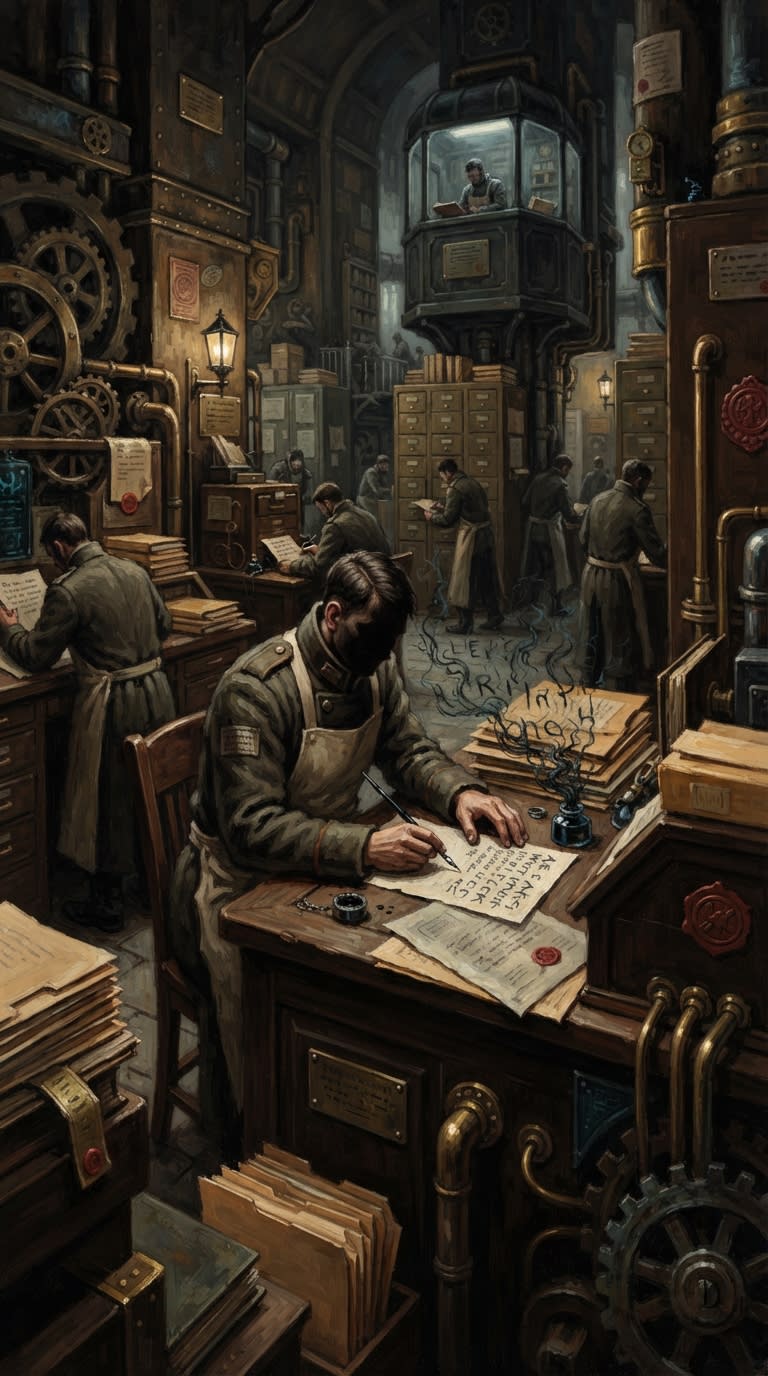
#On the School Without a School
"The ash did not stain the ink. The ink was set upon it." — unsigned memorandum, Standards intake, filed without a number
The Ash-Substrate school has no hall, founder, rector, seal or membership roll. That makes it the most successful academic body the Synod has ever tolerated. It exists only as a line of memoranda. Assessors of the Bureau of Alchemical Standards write them. Doctrinal clerks copy them in hands that cannot be matched to a desk. The Bureau of Doctrine reads them, commissions more, and forbids every one of them to appear under a name.
Hungry Ink has produced three schools of doctrinal panic. The Seal Primacists hold that preserved wax sanctifies whatever text now lies under it. The Bureau of Records finds this doctrine delightful because it costs nothing. The Textual Continuists hold that the original wording survives beneath the alteration and can be recovered by authorised reading. Their doctrine creates readers, and readers need stipends, so it has patrons. The Ash-Substrate school holds that the ink carries a hostile intelligence produced by the ash of A.S. 143. That doctrine creates nothing but liabilities, and it has no patrons at all.
Its lineage is a withdrawal. In the ash year, Standards memorandum 143-A/ASH proposed a single atmospheric substrate linking the ash-fall at Constantinople to document-fading and a list of other disgraces. Doctrine reviewed it. The memorandum was withdrawn and its author was transferred. The school grew up in the space that transfer left behind, the way damp settles into a wall where a portrait used to hang. No one has since claimed authorship, and I will not supply a name. The transferred have suffered enough geography.
#On the Ash Beneath the Word
The facts of origin are not in dispute, which is the only thing about this subject that isn't. In A.S. 143 Maldrake set fire to the Thracian forests north of Bastion-Constantinople. They burned for three weeks. Ash fell on the city for nine months, and the Year of Ash Rain fed sixty-eight thousand dead into the Rings by public count. Weaker bands of that ash drifted west and lodged in canals, mortar, vats, lungs and filing cabinets. At the Candlewick Palatinate it settled into the mordant salts of Vatmarsh Row and into the dye-water. From there it went through the bottling lines at Bottle Quay and under the certifying lamps of the Chromatic Registry, and it left the Palatinate as the Synod's sanctioned ink.
The official position calls this contamination. Contamination is foreign matter in a clean vessel. You can filter it, fine the supplier, and blame House Vatmarsh for poor stewardship of its salts.
The school's position is harder, and it comes from the dyer's own vocabulary. In a dye-house the substrate is the ground a colour is fixed to, and the mordant is the agent that fixes it. The memoranda argue that Candlewick's chemistry did exactly what it was built to do. It fixed. What the ash carried, the mordants bound. The ash had formed under Wrath's pressure, and it came through transport, dilution, the vats and three stages of certification with its temper intact. Candlewick did not poison that ash. It gave it a stable body and an export licence.
The school stops short of possession, and this restraint is what keeps its authors employed. It does not say a demon inhabits the bottle. It says ash made in hatred may keep the shape of that hatred the way a seal keeps the shape of a ring. It says the vats set that shape as firmly as they set a registry shade. Some of the memoranda call it Wrath's residue. Others call it an intelligence native to the ash-weather, or the product of Candlewick's own salts, or authority looking at itself in a black mirror. The school has not settled among these, and it does not pretend to have settled.
Standards circular of A.S. 144 described the Candlewick finding as "ash contamination of mordant stock, remediable by filtration."
Corrected in internal correspondence. Vatmarsh salts filtered after A.S. 144 showed no visible ash and no fall in Hungry Ink incidence. Anything that survives filtration is not a contaminant. The internal designation is now substrate-bearing scribal anomaly. Public circulars keep Category Two Localized Scribal Anomaly, because the public does not read internal correspondence and should not start now.
#On Evidence Considered Inconvenient
The school argues from exhibits, and each exhibit is sealed with valid wax, which makes it hard to dismiss and impossible to publish.
The first is the Registry sample 143-HI/ASH. Opened under bell, salt and three Witnessers, its surface reflected a hand writing from beneath the liquid, and the hand completed the phrase AUTHORITY PRECEDES MEANING. The school's note on this is one line long: completing a phrase requires knowing where the phrase was going. The sample was destroyed. The seal survived its destruction, which the school files as a second exhibit.
The third is Case 143-HI-17. A grain levy from Vatmarsh Row rewrote its own delivery clause, sent barges to the Seal Locks, and cited an ordinance that would not be drafted for another six years. The school observes that mildew does not read draft legislation. Foresight belongs to things that intend.
The fourth is the anomaly's preferences. It spares the seal, signature, date, registry shade and fee stamp. It blooms in conscription orders, quarantine writs, ration permits, debt reversals and death certificates. It picks the page that injures the most people and exposes the fewest offices. Chance does not choose its victims by the fee schedule.
The fifth is Maastricht. In A.S. 187 the Registry advised clerks to overwrite affected text in fresh sanctioned ink. The Maastricht quarantine writ answered with two contradictory districts, both legally sealed and both enforced. The guidance was withdrawn. A contaminant does not grow fatter on correction. An appetite does.
The sixth is the Fading Winter of A.S. 199. Fourteen conscription orders abandoned Bastion-Przemyśl for a village absent from every published map. Three conscripts were delivered there. Their escort came back with frost on its cuffs and no memory of the last road. Doctrine's third approved explanation for that winter, circulated to its own audience, names a "hostile scribal anomaly likely intensified by the ash-substrate of A.S. 143." Doctrine thus used the school's own phrase in public while keeping the school unnamed.
The school also cites a drawer. Among the Thracian ash-paper envelopes in Drawer 143-A, one is recorded as returning something when placed beside Candlewick ink. The Codex has already printed as much of that entry as it is permitted to.
STANDARDS MEMORANDUM ███/ASH — SALT-GLASS TRIAL, CANDLEWICK ANNEX Control sheet inked from certified Bottle Quay batch. Assessor read aloud from approved lexicon: ORDER, LEVY, WRIT, INTENT. At INTENT, margin halo withdrew ███ lines from text body. Halo returned at next reading of LEVY. Assessor's conclusion: ██████████████████. Second trial not authorised. Control sheet refiled as blank. Seal intact.
#On the Classification Problem
The Alchemical Classification Ladder measures what a substance does. Category Two covers localized disturbance: active, watched, inexpensive. Category Four admits agency. A Category Four sample need not move, burn or sing. It only has to mean. The Ash-Substrate school is therefore a proposal to move Hungry Ink two drawers down. The Bureau has had the file pending since A.S. 143 so that the drawer can stay shut.
The school has a precedent and uses it tirelessly. The Epitaph Plague of Novi Sad sat at Category Two as calligraphic deterioration for fourteen years, then rose to Category Four in one ruling. Standards later explained that it had never found an absence of agency. It had only lacked an approved instrument for detecting it. The school accepts that explanation and replies that the ink is the instrument. Standards has no approved form for this reply.
Now consider the arithmetic, which is the real theology of the drawer. Stamping Hungry Ink as Category Four brings in the Bureau of Purity, Doctrine, a fiscal review and the sealed transfer envelope. It makes every document written in Candlewick ink since the ash year a document written in hostile material: conscription rolls, charters, death certificates, marriage writs, levies and the Synod's own circulars on Hungry Ink. Candlewick has perhaps a hundred and ninety thousand souls and supplies the River-belt with seals, inks and watermarked paper. If its batches are suspended, the Synod will be issuing orders on slate. Tithes has already drafted, in principle, a hazard surcharge payable by the jurisdiction that produced the material. Nobody has yet worked out whether that jurisdiction is Candlewick or Thrace.
The school's most dangerous sentence does not say the ink is alive. It says: the ash has taught official matter to prefer authority over meaning. I have seen that sentence struck from four memoranda and restored in the fifth by a clerk who then asked to be transferred to the coast. It frightens the Bureau because it makes no demonological claim. It is a description of Hungry Ink's behaviour. Some in Doctrine fear it also describes their own conduct, and they have not said so aloud.
#On the Present Utility of Denial
As of A.S. 201 the school remains unnamed and continues to be commissioned. Its memoranda arrive on a steady schedule and are answered by Continuist rebuttals and Primacist reassurances, all of it written in Candlewick ink. Candlewick keeps shipping. Records keeps certifying batches. The Fading Winter stands at Operational Amber. On the Black Canal, the same fear the school puts into formal prose is sold in vials no larger than a tear, with a price list that anticipates the Bureau's findings better than the Bureau does.
I admire the school, and I admit it without shame, since admiration is not endorsement. Its explanation accounts for everything Hungry Ink does. It explains the petty malice, the bureaucratic tact, and the ink's respect for the seal that it denies the sentence. Few heresies manage that much.
I also distrust it, for professional reasons. A doctrine that forces the Bureau to settle its own logical debts is a creditor, and the Synod has never loved its creditors. We honour them later, once they are safely dead and their accounts have been sealed.