
#On Victor's Station
The great bell of Saint-Victor shares its name with a dead soldier and a building, and with nothing more. The cathedral is dedicated to a soldier-martyr whose bones, Marseille's canons say, were carried through the old port in a plague year while the harbour rats drowned themselves. That Victor has a crypt, a reliquary dispute and the steady attention of the Bureau of Relics. This Victor has a rope. Nothing in the register lets the bell borrow the saint's biography. I will thank the pilgrim trade not to sell candles to the bronze.
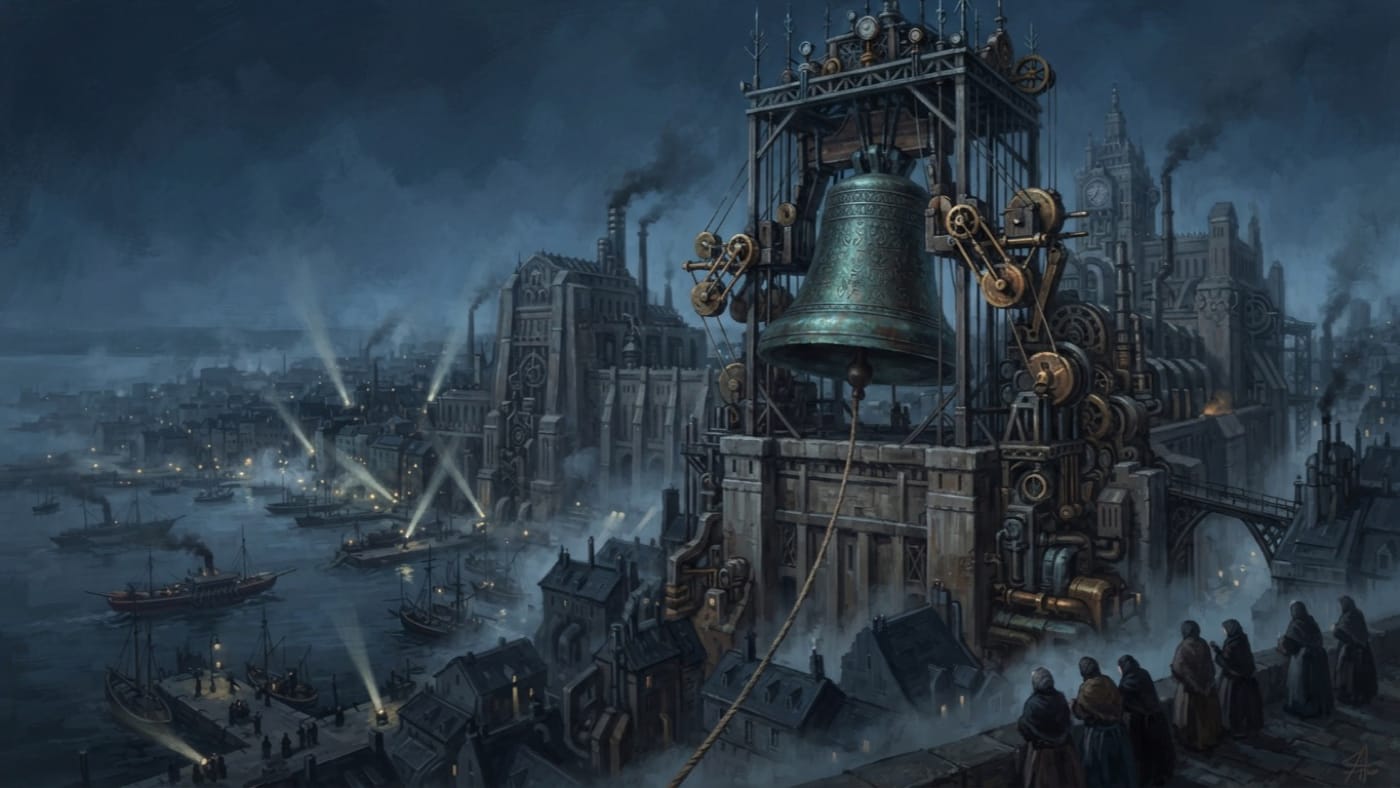
The Bureau of Bells lists Victor as the largest of the nine principal bells of the Cathedral of Saint-Victor. It hangs in the reinforced bell cage of the western mass, the Bureau's southernmost major relay, above the old harbour of Marseille. The register describes a deep bronze mass, cast after the Concordat and inscribed with a prayer against shipwreck. That is the whole of its birth certificate. The register gives no founder, foundry, donor, weight, pitch or casting year, and I will not forge them for readers who like their bronze with a pedigree.
Doctrine takes an interest in Victor because it is sacred sound held in custody. A prayer cut into metal prays again every time the metal is struck, whether the man on the rope is pious, drunk or paid by the hour. The Church must therefore decide who strikes it, when they strike it, and what the harbour may believe it heard.
#On the Prayer Against Shipwreck
The register records that the prayer exists. It does not record the words, and the Bureau has issued no transcription. A ship's chandler on the lower quay once struck tin medals showing a bell, a wave and a pious sentiment of his own composition. He sold several hundred. Relics has not been asked to rule on them, and that is the only mercy in the matter.
The audience, at least, is certain. Marseille lives by hulls and hawsers. Pilgrim galleys go out toward Thessaloniki, and fishing boats leave before dawn and come back one man lighter more often than the parish registers care to admit. Salt rides the air into every lane and settles on every bronze surface without filing a request. A bell with a prayer against shipwreck hangs over a congregation that knows shipwreck better than it knows doctrine.
The Church claims authority over danger, and the sea is included. It addresses the Creator on behalf of men who have nothing between them and the deep but tarred planks and a captain's sobriety. Victor performs that office in bronze, and it is a proper office. Whether the prayer has ever turned a hull from a reef is another question. The canons say the harbour has been spared more often than it deserved. The pilots say the harbour has been spared whenever the pilots were sober. No Bureau record credits Victor with a single rescue, and the Codex will not supply one.
The prayer does work on the living. On a clear morning the relay reaches a sailor beyond the harbour mouth, and he knows the Church has spoken for his trade, if not for him by name. He keeps working and keeps his footing. Call it a miracle or call it morale. The Ledger has a column for each.
#On the Relay and Its Custody
Victor does not ring alone, and its size gives it no seniority over the others' duties. Lazare tolls for relic arrivals and disputed deaths. Oraison marks Bureau business at the quay. Marthe, thin and sharp, calls pilgrim muster. Salt-John sounds harbour danger. Little Beryn, cracked in A.S. 167, makes its nasal complaint at terce. Three lesser bells carry parish business, funerals, debt remissions and the small humiliations the municipality orders. Victor carries its prayer and its mass. The register gives it no narrower duty.
A previous Bells register listed Saint-Victor as possessing ten principal bells.
Corrected. The tenth, Saint Armand of the Foam, was removed in A.S. 158 after repeated mis-tolls and was melted into harbour brackets. Victor did not inherit its duties, its rope or its reputation. Victor has since acquired a reputation of its own without assistance.
The relay's repertoire belongs to the whole company. One sequence opens pilgrim embarkation. Another holds ship traffic while relics cross from Quai Saint-Lazare. A descending five-peal announces fire in the dock quarter. A broken triplet summons the Bureau of Purity, and a low sustained toll seals the harbour during suspected demonic contamination. The published record does not say which bells sound which sequence. Junior scribes assume that the largest bell must own the most frightening noise. Those scribes now copy tide tables.
The doctrine here is custody. The Office of Bells was constituted in A.S. 52. The current Bell Codex was ratified in A.S. 115, after the Synod took its formal shape at Strasbourg in A.S. 90. Neither date belongs to Victor. Those years mark the point at which the right to strike bronze became something a man could hold under licence, lose at audit and answer for under oath. Bellwardens keep schedules, calibration logs and toll-keys chained to their own bodies. The register names none of Victor's ringers, and I add none.
Every Bureau on the harbour wants a hand on that rope. Pilgrimage would ring Victor for departures, because a great bell flatters a ticket. Tithes would ring it for assessments, because men pay faster when the sky is shouting. War would ring it for drills and call the result discipline. Bells refuses all three and keeps the refusals on file.
#On the Midnight Return-Peal
In A.S. 191 the Bureau of Bells filed an internal note on the Saint-Victor relay. I reproduce it as it stands.
BUREAU OF BELLS INTERNAL NOTE — SAINT-VICTOR RELAY, A.S. 191 The midnight return-peal of Victor during calm weather has no authorised ringer. Rope inspection: dry. Bell motion: confirmed. Sound direction: inward. Witnesses: ███████████████████ Recommendation: do not silence the bell until we know what is answering.
Read it slowly, as a clerk reads. No authorised ringer does not mean that no one rang it. Marseille has a great many unauthorised hands, and some are attached to men who can climb. A dry rope on a calm night proves that the rope was dry. Bell motion confirmed means someone saw the bell swing. Sound direction inward means someone stood where they could judge where the sound went and wrote it down in a word the Bureau has not used of any other bell. The witnesses are blacked out. The last line uses the verb answering and gives it no subject.
The note names nothing. It does not say whether Victor began the exchange or ended it.
The Bureau of Bells denies any anomaly in the relay. The canons of Saint-Victor deny hearing anything after midnight. Both denials are filed, sealed and current. Neither body has withdrawn the note, which is also filed, sealed and current. So the Bureau keeps a record whose contents it denies, while the chapter sleeps beneath the tower and has heard nothing. I have sat through enough chapter meetings to know that a canon who hears nothing has usually decided to.
The fishwives of the lower quarter disagree, and they show it by what they do. When Victor groans in fog they cross themselves and refuse to sell eels before dawn. The note speaks of calm weather. The fishwives speak of fog. These are separate observations, and I will not marry them to please a pamphleteer. They agree in one place only: the people who listen to Victor most carefully are the people with no licence to ring it.
Below the tower, the chapter keeps the Arm of Victor under Relics seal. The canons report that its crystal hums and the grille tags move when the bell tolls, and they call this reverence. The engineers call it sympathetic vibration in an old crypt. Neither report concerns midnight, and neither ties the saint's arm to the bell's conduct. The martyr stays in his chamber, and the bell stays in its cage.
#On the Present Application
As of A.S. 201 the western relay is active. Victor hangs in its cage as the largest of the nine: deep bronze, cast after the Concordat, with its prayer against shipwreck and salt on its shoulder. The canonical hours pass through the company across the harbour, out to the pilgrim fleet, east along the coastal chain and inland toward the Rhône road.
The A.S. 191 recommendation has been kept in the only sense that counts, because no one has silenced the bell. Nor has anyone explained it. The Bureau denies, the canons sleep, and the fishwives hold back their eels until daylight. Each time the bronze is struck, the prayer goes out again over the water by order of the Church.